
What Trump’s Temporary Immigration Ban Means For EB-5 and E2: Experts Comment
IIUSA’s Bob Kraft: “This is in line with other actions taken by the US Government to protect its citizens in a period of unprecedented challenge.”

IIUSA’s Bob Kraft: “This is in line with other actions taken by the US Government to protect its citizens in a period of unprecedented challenge.”

The Dominica CIU, accustomed to processing during hurricanes, finds that maintaining operations amid a pandemic is, relatively speaking, a breeze.

The proposal, allegedly, would see the annual quota on EB-5 visas amplified to 75,000, as well as a halving of the investment requirement to US$450,000.

A former President of the American Immigration Lawyers’ Association thinks we have only seen the contours of the fallout from changes to the EB-5 program.

Between Jan and Sep 2019, the USCIS terminated 75 regional centers and approved only six. 80% of terminations since ’08 have taken place in the last two years.

Investment migration firms are taking client fees on the presumption that their applications will be processed in the future. What if that doesn’t happen?
New regulations that raise the minimum investment requirements are now in effect. But legislative developments may change the rules again within a month.

New rules raising min. investments to $900,000 are scheduled to take effect this week. President Kraft of IIUSA thinks there’s a chance that won’t happen.

Angie Rupert compares the EB-5 and E-2 visas on which gives clients more flexibility in terms of work, running a business, and traveling.

Republican Senator Rand Paul is asking his colleagues in the Senate to sign a Joint Resolution that would stop the EB-5 program’s planned price increase in November.

Angie Rupert delves into the differences between the EB-5 and E-2 visas: Time frames, immigration status, cost, child dependents, and investment flexibility.

Applicants to golden visa programs around the world are made to wait years for approval. That puts an unnecessary damper on demand, writes Stephane Tajick.

But the new rules may never take effect if the EB-5 Regional Center Program gets a congressional extension before Sep 30th.
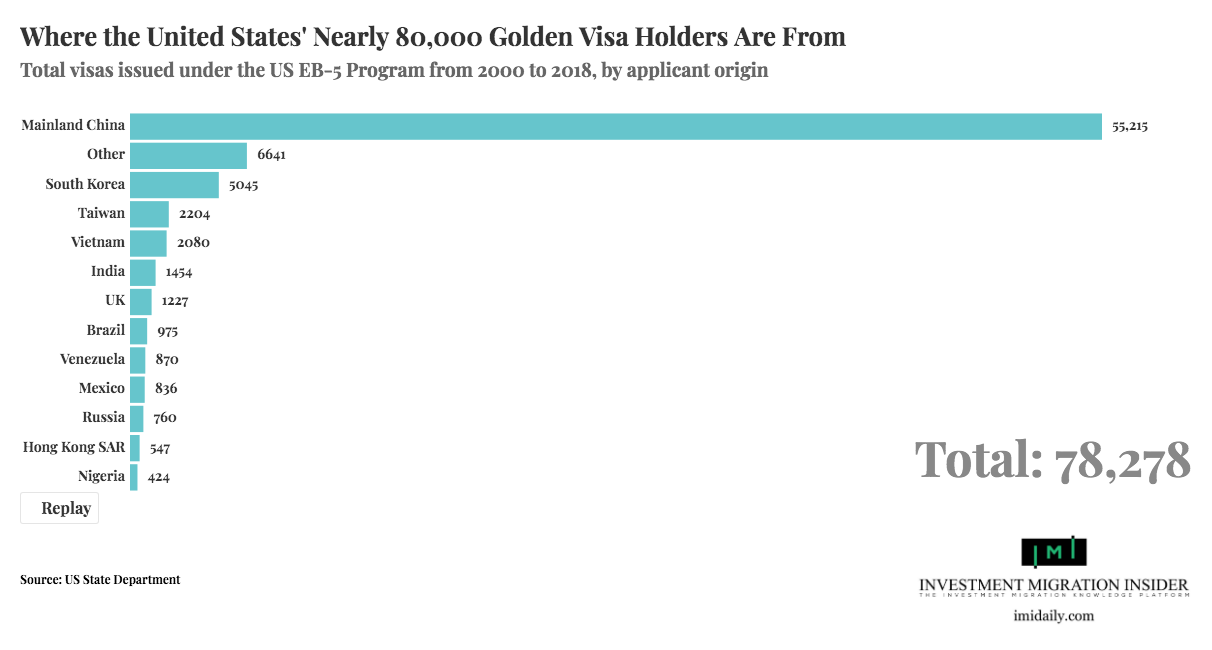
Our dynamic bar chart shows how the volume and demographic make-up of EB-5 visa grants have changed drastically over the last two decades.

Eyes are now on the Senate’s deliberation on S386. Should it pass as well, the Fairness for High-Skilled Immigrants Act goes to the president for signing.
Stakeholders warn that removing per-country caps without also increasing the number of available visas will not solve the program’s capacity problem.

EB-5 practitioners are holding their breath ahead of the publication of new program rules that could see minimum investment requirements nearly triple.

During the two-year fiscal period of 2014-15, the US EB-5 program accounted for some $11 billion in capital investments in

The effects of 15-year wait times and a growing interest in European alternatives are starting to manifest in Chinese application

Chinese applicants are no longer the only group suffering under the EB-5 program’s intractable retrogression nightmare; Indian and Vietnamese investors