
EB-5 Golden Age? Application Volume, Processing Efficiency, and Project Quality All Rising
1,879 investors started their EB-5 journey in Q2, 2024. Varvara Latyntseva sees signs a new EB-5 golden age is now in the making.

1,879 investors started their EB-5 journey in Q2, 2024. Varvara Latyntseva sees signs a new EB-5 golden age is now in the making.

“Demand for the EB-5 program still sharply exceeds the limits established by the US Government,” writes Varvara Latyntseva.

Mona Shah and Rebecca Singh detail 11 issues facing the United States EB-5 program this year, along with their predictions for each.

EB-5 application volume more than tripled in 2023 compared to the two preceding years. But 4 in 10 applicants are getting rejected.

“We are confident that we will prevail in court, given the strength of our legal and factual arguments,” Shah said in a statement to IMI.

The Q3, 2023 statistical report from USCIS shows demand for EB-5 gaining ground despite stubborn backlogs, writes Varvara Latyntseva.

Not since 2019 have so many investors applied for initial EB-5 visas. But at present, USCIS is rejecting more than half of all applications.
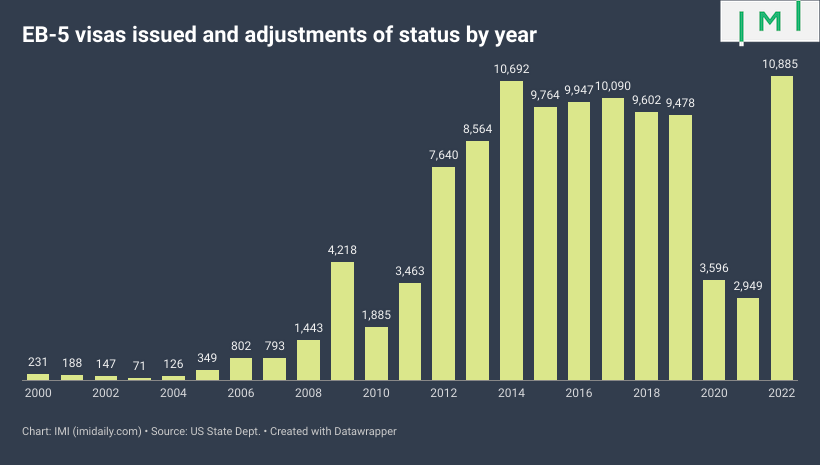
In this special feature, Varvara Latyntseva details how the EB-5 program changed last year and the effects on applications and stakeholders.

USCIS last week shocked the EB5 market by saying all regional centers will need redesignation. That’s not the case, say congressional leaders.

All Regional Center designations are now defunct and all entities seeking to recruit RC-based investors must file for designation again.

While the regional center program has been reauthorized, individual RCs need authorizations of their own through I-924s, Brian Ostar prompts.

“It’ll take a long time for this new program to be stable,” says Matt Galati. “I don’t know if that gets done before 2027, frankly.”
The EB-5 Reform will bring minimum investment levels to $800,000 and $1,050,000 and grandfather in existing regional center investors.

The more than 40,000 EB-5 investors left in the lurch by the closure of the Regional Center Program are not going down without a fight.

The Department of Homeland Security will not appeal the Behring ruling after all, confirming $500,000 minimum investments for direct EB5.

Now that the regional center program has lapsed, maintaining EB-5 capital at-risk through redeployment poses challenges, writes Aaron Grau.

What do “budget reconciliations,” “continuing resolutions,” “omnibuses,” and “minibuses” mean for the future of EB-5? Aaron Grau answers.

“By filing numerous lawsuits because the agency wasn’t doing anything in 2019, we finally got the agency moving again,” says Matt Galati.

EB-5 min. investment amounts could change for a third time in two years if the Behring appeal goes ahead. That’s a big “if”, says Matt Galati.

Tens of thousands of lawsuits could stem from the Regional Center Program’s lapse, warns IIUSA’s Executive Director Aaron L. Grau.