

As of April 7, 2026, the population threshold to qualify for Italy’s flat tax regime for foreign pensioners has risen from 20,000 to 30,000 residents, unlocking 74 new municipalities across Southern Italy.
One sentence. That is all it took. Article 26, paragraph 1, of Law No. 34 of March 11, 2026, replaces the words “20,000 inhabitants” with “30,000 inhabitants” in Article 24-ter of Italy’s Consolidated Income Tax Code (TUIR). The change takes effect today, and its consequences are more significant than the brevity of the provision might suggest.
Italy’s 7% flat tax for foreign pensioners, one of the most competitive tax regimes available to retirees anywhere in Europe, now covers a substantially broader swath of the country’s south.
Overview of the Regime
The mechanics are straightforward. Foreign pensioners who transfer their tax residence to an eligible Italian municipality can elect to pay a flat 7% substitute tax on all their foreign-source income, not only their pension, but any income of any category earned outside Italy. The election lasts for ten years from the first year in which it is made.

To qualify, a person must:
- Receive pension income from a foreign entity;
- Have resided outside Italy for at least five consecutive years (this applies to both foreign nationals and Italian citizens registered with AIRE);
- Transfer their official residence (residenza anagrafica) to a qualifying municipality.
Once elected, the 7% rate applies for that year and the following nine.
A notable feature of the rule: receiving even a single foreign pension is sufficient to bring all foreign-source income under the 7% umbrella.
This includes investment returns, rental income abroad, capital gains, trust distributions, private annuities, and business income of foreign origin. Italian-source income remains subject to ordinary progressive taxation.
Key Advantages of the Regime
A flat, final tax, with no wealth tax obligations
The 7% is a substitute tax: it replaces all Italian income tax on foreign-source income. There are no progressive brackets, no surcharges, and no additional taxation on the covered income.
Equally important, beneficiaries are exempt from IVIE (the Italian wealth tax on foreign real estate) and IVAFE (the Italian wealth tax on foreign financial assets), which can represent a significant saving for retirees with property or investment portfolios outside Italy.
No foreign asset reporting
One of the most underappreciated benefits of the regime is the exemption from the RW section of the Italian tax return, the form used to report foreign-held assets and accounts.
For retirees with complex international portfolios, bank accounts in multiple countries, or real estate abroad, this eliminates a substantial compliance burden and the associated risk of penalties for omissions or errors.
Particularly attractive for Americans
The regime holds special appeal for US citizens and green card holders, who are subject to US taxation on their worldwide income regardless of where they live. This means American retirees moving to Italy cannot escape the IRS simply by relocating, but the 7% flat tax creates a highly efficient structure under the US–Italy Tax Treaty.
Under the treaty, Italian taxes paid on income that is also taxable in the United States can generally be credited against the US tax liability via the Foreign Tax Credit (FTC).
Because the 7% flat tax is a bona fide income tax paid to a foreign government, it is typically creditable, meaning an American pensioner may be able to offset a significant portion (or potentially all) of their residual US tax bill with the Italian tax already paid. The result: a combined effective rate that, for many Americans, ends up being very low or close to zero on their foreign-source income.
This makes the Italian 7% regime one of the few relocation incentives in Europe that actively works in favor of Americans rather than simply ignoring the US tax dimension.
Interpello: certainty before you commit
For individuals with complex situations, unusual pension structures, multi-country income, trust arrangements, or uncertainty about the classification of their income under the treaty, Italian tax law allows the filing of an interpello (advance tax ruling) with the Agenzia delle Entrate.
This is a formal written request for confirmation of how the law applies to a specific set of facts. The ruling is binding on the tax authority, providing legal certainty before the taxpayer commits to relocating and electing the regime.
For high-value cases or structurally complex situations, an interpello is strongly advisable and is standard practice in professional planning for this regime.
Simplified compliance
Beneficiaries file a simplified tax return. There is no need to report foreign assets, no IVIE, no IVAFE, and no obligation to calculate and declare income on an asset-by-asset basis.
The annual tax payment (due by June 30 of the following year, with no instalment option) is a single lump sum equal to 7% of all foreign-source income for the year.
Duration and what ends the regime
The regime runs for 10 consecutive years and cannot be extended. It is lost if the taxpayer moves to a non-qualifying municipality, fails to pay on time, or omits the election in the tax return. It can also be voluntarily revoked. Once lost or revoked, it cannot be reinstated.
The Geographic Expansion
Until yesterday, eligible municipalities were those with fewer than 20,000 residents located in Southern Italy or in the areas of Central Italy affected by the 2009 and 2016 earthquakes. The new law raises that ceiling to 30,000 residents.
For Southern Italy, this unlocks 74 municipalities that were previously just out of reach. These are not remote villages, they are functioning mid-sized towns with hospitals, schools, transport links, and a quality of urban life that smaller comuni often cannot offer. The profile of the potential beneficiary changes accordingly.
Note: For the Central Italy earthquake zones, Abruzzo, Lazio, Marche, and Umbria, the official list of eligible municipalities is maintained by the Government’s Special Commissioner for Reconstruction at sisma2016.gov.it. The application of the new 30,000-inhabitant threshold to that specific area is pending further clarification, and practitioners should seek guidance before advising clients on those locations.
The 74 New Municipalities
All population figures are from ISTAT as of January 1, 2025.
Campania, 23 municipalities
| Municipality | Province | Population |
| Marigliano | NA | 29,351 |
| Frattamaggiore | NA | 28,558 |
| Mondragone | CE | 28,294 |
| Gragnano | NA | 27,694 |
| Orta di Atella | CE | 27,452 |
| Pontecagnano Faiano | SA | 26,512 |
| Sant’Anastasia | NA | 26,192 |
| Volla | NA | 25,936 |
| Boscoreale | NA | 25,833 |
| Bacoli | NA | 24,988 |
| Qualiano | NA | 24,780 |
| Pompei | NA | 23,647 |
| Nocera Superiore | SA | 23,511 |
| Ottaviano | NA | 23,271 |
| Poggiomarino | NA | 22,618 |
| Capaccio Paestum | SA | 22,410 |
| San Nicola la Strada | CE | 21,873 |
| Casal di Principe | CE | 21,744 |
| Cardito | NA | 21,484 |
| Ariano Irpino | AV | 20,741 |
| Trentola Ducenta | CE | 20,741 |
| Vico Equense | NA | 20,198 |
| Sessa Aurunca | CE | 20,093 |
Sicily, 18 municipalities
| Municipality | Province | Population |
| Milazzo | ME | 29,830 |
| Castelvetrano | TP | 29,297 |
| Misilmeri | PA | 29,095 |
| Belpasso | CT | 28,242 |
| Aci Catena | CT | 27,507 |
| Scicli | RG | 26,844 |
| Giarre | CT | 26,557 |
| Erice | TP | 25,770 |
| Gravina di Catania | CT | 25,318 |
| Enna | EN | 25,102 |
| Termini Imerese | PA | 24,797 |
| Niscemi | CL | 24,770 |
| Noto | SR | 24,612 |
| San Giovanni la Punta | CT | 24,231 |
| Biancavilla | CT | 22,942 |
| Pachino | SR | 22,117 |
| Palma di Montechiaro | AG | 21,341 |
| Lentini | SR | 21,235 |
Puglia, 18 municipalities
| Municipality | Province | Population |
| Ostuni | BR | 29,943 |
| Manduria | TA | 29,665 |
| Canosa di Puglia | BT | 27,507 |
| Gioia del Colle | BA | 26,465 |
| San Giovanni Rotondo | FG | 26,249 |
| Terlizzi | BA | 25,982 |
| Conversano | BA | 25,938 |
| Mesagne | BR | 25,921 |
| Noicattaro | BA | 25,902 |
| Triggiano | BA | 25,764 |
| Putignano | BA | 25,718 |
| Santeramo in Colle | BA | 25,648 |
| Galatina | LE | 25,319 |
| Ruvo di Puglia | BA | 24,254 |
| Mola di Bari | BA | 24,245 |
| Copertino | LE | 22,827 |
| Ginosa | TA | 21,717 |
| Palo del Colle | BA | 20,366 |
Sardinia, 7 municipalities
| Municipality | Province | Population |
| Selargius | CA | 28,377 |
| Assemini | CA | 25,630 |
| Carbonia | CI | 25,623 |
| Iglesias | CI | 24,653 |
| Capoterra | CA | 23,092 |
| Porto Torres | SS | 20,846 |
| Sestu | CA | 20,751 |
Abruzzo, 5 municipalities
| Municipality | Province | Population |
| Roseto degli Abruzzi | TE | 25,882 |
| Francavilla al Mare | CH | 25,568 |
| Giulianova | TE | 23,584 |
| Ortona | CH | 21,984 |
| Sulmona | AQ | 21,759 |
Calabria, 2 municipalities
| Municipality | Province | Population |
| Castrovillari | CS | 20,605 |
| Montalto Uffugo | CS | 20,034 |
Molise, 1 municipality
| Municipality | Province | Population |
| Isernia | IS | 20,529 |
Basilicata, Zero municipalities
No municipality in Basilicata falls within the 20,001–30,000 range. After the two regional capitals, Potenza and Matera, both above 50,000, the largest town is Policoro at roughly 17,700 inhabitants, already below the old threshold.
Before and After: The Full Picture
The table below compares eligible municipalities by region under the old and new regimes, based on ISTAT data as of January 1, 2025.
| Region | Old regime (<20,000) | Newly eligible (20,001–30,000) | New total (<30,000) | Change |
| Campania | 483 | 23 | 506 | +5% |
| Sicily | 337 | 18 | 355 | +5% |
| Puglia | 213 | 18 | 231 | +8% |
| Sardinia | 363 | 7 | 370 | +2% |
| Abruzzo | 292 | 5 | 297 | +2% |
| Calabria | 395 | 2 | 397 | +1% |
| Molise | 133 | 1 | 134 | +1% |
| Basilicata | 129 | 0 | 129 | — |
| Total | 2,345 | 74 | 2,419 | +3% |
In raw numbers, the increase is 74 municipalities, a 3% expansion of the eligible universe. In practical terms, the shift is more consequential. The newly eligible towns are, on average, considerably larger and better-served than the small villages that anchored the original regime.
Puglia, which sees the largest proportional gain (+8%), adds towns like Ostuni, Manduria, and San Giovanni Rotondo, destinations with established international communities, good infrastructure, and strong appeal to both European retirees and members of the Italian diaspora returning from the Americas or Australia.
Familiar Names on the List
Among the 74 newly eligible municipalities are several of Italy’s most iconic destinations. Pompei, the UNESCO-listed Roman city frozen in time by the eruption of Vesuvius in 79 AD, now qualifies.
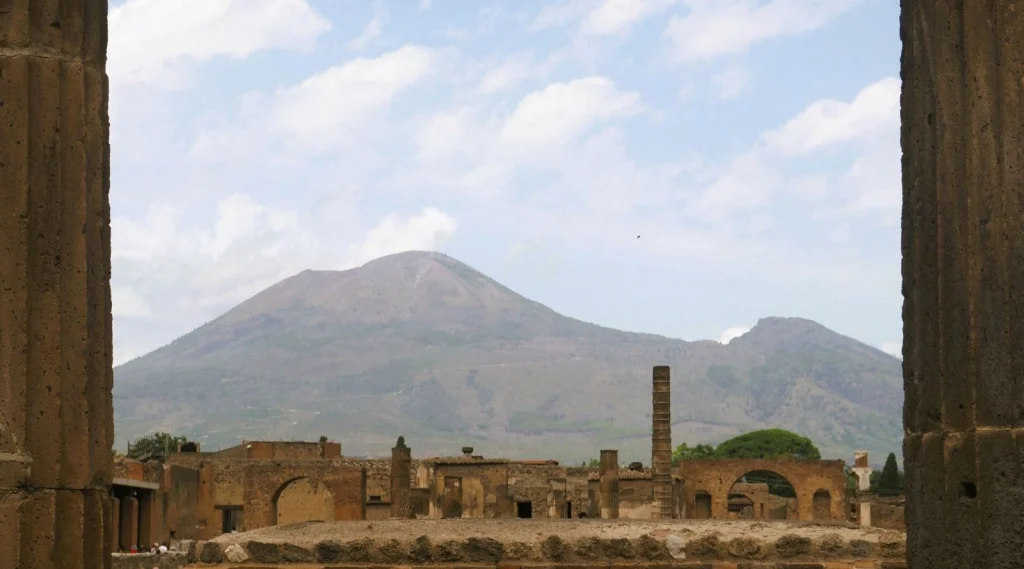
So does Noto, the jewel of Sicilian Baroque, rebuilt in honey-colored stone after a devastating earthquake. Ostuni, the “White City,” is a hilltop labyrinth of whitewashed buildings overlooking endless olive groves.

In Puglia, Alberobello brings its UNESCO-listed trulli, the cone-roofed stone houses found nowhere else on earth. Polignano a Mare offers dramatic Adriatic cliffs and the postcard-famous Lama Monachile beach carved between them.

Taormina, Sicily’s glamorous hilltop resort, is also on the list with a Greek theatre framing views of Etna and a starring role in The White Lotus.

“Hamlets and Mountain Villages“
Italy has been quietly building one of the more credible menus of tax incentives for inbound residents in Europe. The 7% flat tax sits alongside the €300,000 lump-sum regime for high-net-worth individuals (Article 24-bis TUIR) and the impatriates relief for workers and self-employed professionals.
Taken together, these regimes position Italy as a serious competitor to Portugal’s now-discontinued NHR, Malta’s various tax residence programs, and Greece’s 7% pensioner regime, against which the Italian version has often been compared but less publicised.
The expansion to 30,000 inhabitants is a pragmatic acknowledgment that depopulation in southern Italy is not only a problem of hamlets and mountain villages.



