

The 183-day rule is the global default for tax residency. Most countries use it, the OECD model treaty incorporates it, and tax planners build their advice around it. Spend more than half a calendar year in a country and you become a tax resident under domestic law.
A small group of jurisdictions has codified pathways well below that threshold. The conditions vary, but the common feature is that physical presence on its own does not run the show. Ties, investment, lump-sum payments, or aggregate-year accounting can all stand in for time on the ground.
This guide covers five jurisdictions that combine codified low-day pathways with practical accessibility from the major North American, European, and Middle Eastern aviation hubs: Cyprus, the United Arab Emirates (UAE), the Bahamas, Mauritius, and Andorra. None of them is a calendar trick.
Each requires substantive economic anchoring, and each comes with conditions that limit who can use it. The accessibility filter matters because a 60-to-90-day annual commitment is only as easy as the flights getting you there: a 45-minute direct hop makes a substantively different proposition than two connecting legs plus a ferry.
A note before the entries. Tax residency in a destination country is only half the equation.

Your home country may continue to claim you as a tax resident under its own rules, and treaty tie-breaker provisions, exit taxes, and forced-residency presumptions can override the destination’s lower threshold. As Marco Mesina has argued for IMI Daily, the 183-day rule is widely misunderstood, and trying to live tax-free by avoiding residency anywhere often backfires.
1. Cyprus (60 Days)
Cyprus operates the lowest day-count tax residency rule in the European Union. Under the 60-day rule, codified in 2017 and refined by the December 2025 tax reform, an individual qualifies as a Cyprus tax resident in any tax year by satisfying four conditions:
- Spending at least 60 days in Cyprus during the calendar year
- Not spending more than 183 days in any single other country
- Carrying on a business in Cyprus, holding employment in Cyprus, or holding a directorship in a Cyprus tax-resident company that does not terminate during the year
- Maintaining a permanent residence in Cyprus, owned or rented, available for personal use
The 2026 reform removed the previous fifth condition, which required that applicants prove they were not tax resident anywhere else. From 1 January 2026, dual tax residency conflicts are resolved through double tax treaty tie-breaker rules instead of disqualifying the Cyprus claim outright.
Once tax resident, an individual can apply for non-domiciled (non-dom) status. Non-doms are exempt from the Special Defence Contribution (SDC) on worldwide dividend and passive interest income for up to 17 years from the date they become a Cyprus tax resident.
The exemption ends once the individual has been a Cyprus tax resident for 17 of the preceding 20 years, at which point they become deemed domiciled.
Beyond the SDC exemption, Cyprus levies no inheritance tax, no wealth tax, and no gift tax. Capital gains tax applies only to gains from Cypriot real estate and to shares in companies whose value derives from Cypriot real estate, not to general securities or foreign property.
Earned income remains subject to standard progressive income tax, with the tax-free threshold raised to €22,000 under the 2026 reform.
The combination of a 60-day physical presence requirement, a 17-year non-dom exemption, and EU membership has positioned Cyprus as one of the Western European destinations expected to absorb HNWIs displaced by the closure of the UK non-dom regime.
Larnaca International Airport runs direct flights from London, Frankfurt, Vienna, Athens, Dubai, and Tel Aviv, which keeps the 60-day annual commitment reachable as a single flight from most of Europe and the Middle East.

2. United Arab Emirates (90 Days)
Cabinet Decision No. 85 of 2022, in force since 1 March 2023, gave the UAE its first codified tax residency framework for individuals. The decision creates three independent tests, and meeting any one of them establishes UAE tax residency.
A center-of-vital-interests test sits at the top of the list. An individual qualifies if their principal place of residence and center of financial and personal interests lies in the UAE.
A standard 183-day test runs in parallel. Physical presence in the UAE for 183 days or more across a consecutive 12-month period establishes residency on its own.
The 90-day fast-track is the test that makes the UAE relevant for this article. An individual qualifies under it by being physically present in the UAE for 90 days or more across a consecutive 12-month period, plus meeting two further conditions.
The individual must hold UAE nationality, Gulf Cooperation Council (GCC) nationality, or a valid UAE residence permit. And the individual must either maintain a permanent place of residence in the UAE or carry on employment or business activity there.
Days are counted on a 12-month rolling basis rather than by calendar year. Parts of a day count as full days. Exceptional circumstances, defined as events beyond the individual’s control that prevent departure, can be disregarded.
The tax payoff is the reason the program matters. The UAE imposes no personal income tax on individuals, no capital gains tax on personal investments, and no wealth or inheritance tax.
The 9% federal corporate tax that took effect in 2023 applies only to business income above AED 375,000 per year, and personal investment activity sits outside its scope.
For a holder of the UAE Golden Visa or any standard UAE residence permit who can spend 90 days a year in the country and maintain a residence, the 90-day test produces a Tax Residency Certificate (TRC) usable for treaty claims against high-tax home jurisdictions.
Dubai International is itself one of the top three global aviation hubs by international passenger traffic, with direct service from virtually every major city worldwide, which makes the UAE the most logistically straightforward tax residency on this list to maintain.
The catch sits in the conditions. Without a permit, GCC nationality, or UAE citizenship, the 183-day test is the only domestic route. The 90-day route is open by design only to individuals already integrated into UAE residency.
3. Anguilla (45 Days)
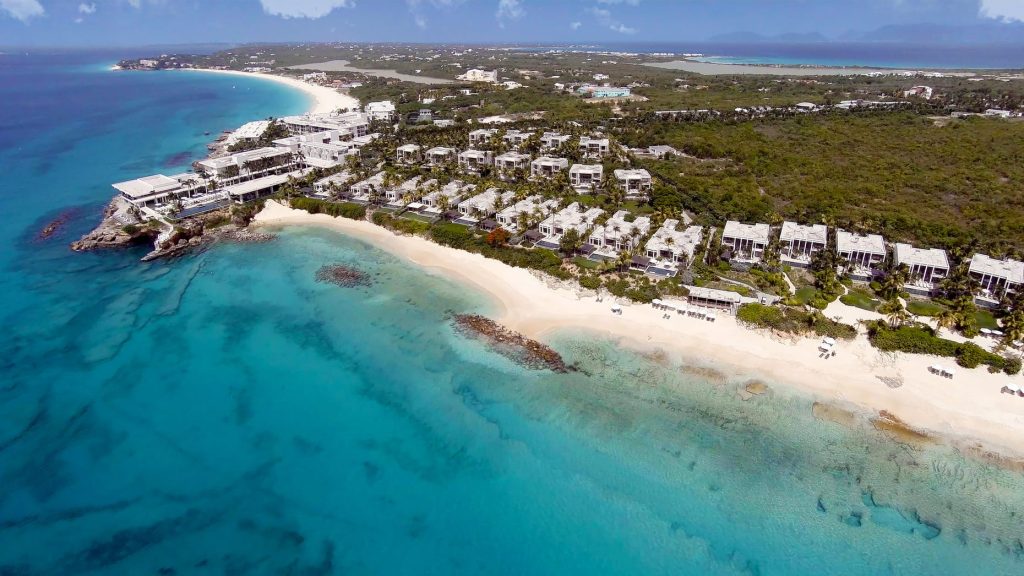
Anguilla’s High-Value Resident (HVR) program, launched by the Government of Anguilla in 2019, runs the lowest physical-presence requirement in the investment migration market. The program targets ultra-high-net-worth individuals who spend their year split across multiple jurisdictions and need a defensible tax residency for Common Reporting Standard (CRS) self-certification.
The HVR conditions are concrete. Applicants must own and maintain Anguillan real estate valued above $400,000, with at least $100,000 of that allocated to land.
They must pay an annual lump-sum worldwide income tax of $75,000 to the Anguilla Treasury, and demonstrate the financial capacity to prepay the first five years of that obligation.
They must spend at least 45 days per year in Anguilla, and they must declare annually, in writing, that they have not spent more than 183 days in any other single country.
Genuine ties are part of the package: A local bank account, club memberships, and an Anguillan driver’s license.
Due diligence fees run $7,500 per adult applicant. Processing fees are $3,000 for a family of up to four. Approval typically takes around three months.
Anguilla itself imposes no personal income, capital gains, inheritance, or corporate tax. The $75,000 lump sum effectively caps the tax liability of an HVR resident at a fixed amount regardless of worldwide income, which is the entire point of the program for clients structuring out of high-tax jurisdictions.
Continuous physical residence in Anguilla can build toward eligibility for British Overseas Territories Citizenship (BOTC), but typically requires substantive presence on the island of around 270 days per year over five years, well above the 45-day HVR commitment.
BOTCs other than those connected solely to the Sovereign Base Areas of Cyprus may register for full British citizenship under section 4A of the British Nationality Act 1981, generally without a separate UK residence requirement.
The HVR pathway and the citizenship pathway are therefore distinct workstreams: The 45-day rule serves tax residency, not naturalization.
The HVR program is structurally distinct from Anguilla’s separate Residence-by-Investment program, which grants permanent residency through a $150,000 Capital Development Fund donation or a $750,000 real estate investment but does not by itself establish tax residency.
As IMI’s coverage of digital nomad visas that don’t trigger tax residency notes, the HVR is aimed at “low-volume, high-value” applicants who move between jurisdictions throughout the year.
4. Mauritius (90 Days Averaged Over Three Years)
Mauritius does not run a special low-day program. Its standard tax residency law contains a clause that produces the same outcome.
Section 73 of the Mauritius Income Tax Act sets out three independent tests for tax residency. Physical presence of 183 days or more in a single income year qualifies an individual.
So does an aggregate of 270 days or more across the income year and the two preceding income years. Mauritius domicile is the third route, subject to an exception for those whose permanent place of abode is elsewhere.
The 270-day aggregate test is the relevant one for this article. Spread evenly, 270 days across three years averages 90 days per year.
An individual who spends roughly three months annually in Mauritius for three consecutive years qualifies as a Mauritius tax resident under domestic law from year three onward.
The Mauritian income year runs from 1 July to 30 June, not the calendar year, and the day-count tracks the income-year cycle.
Day counts are typically based on the entry and exit records held by the Mauritius Passport and Immigration Office, which the Mauritius Revenue Authority can consult when verifying residency.
Tax-resident individuals are taxable on Mauritian-source income directly, and on foreign-source income only when remitted to Mauritius.
Section 73B(2) of the Income Tax Act, introduced through the Premium Visa framework, provides expressly that spending in Mauritius through a foreign credit or debit card is deemed not to have been remitted to Mauritius. That leaves a sizable gap between holding tax residency and paying tax on foreign income.
For income that does enter the Mauritian tax net, post-July 2025 rates run 0% on the first MUR 500,000, 10% on the next MUR 500,000, and 20% above MUR 1 million.
The Finance Act 2025 added a 15% Fair Share Contribution for individuals with annual net income above MUR 12 million, which lifts the effective top rate to 35% through June 2028, although only on remitted income.
The Mauritius Premium Visa, available to remote workers and retirees, is the most common vehicle for using the 270-day test. The visa itself does not trigger tax residency; the day count does.
For investors who want immediate permanent residency rather than a renewable visa, the Mauritius Permanent Residency Permit provides that route through a $375,000 real estate investment.
SSR International Airport runs direct services from Paris, London, Dubai, Johannesburg, Hong Kong, Singapore, and Mumbai, which keeps the three-month annual presence reachable as a single long-haul flight rather than a connecting trip.

5. Andorra (90 Days, with Caveat)
Andorra’s passive residency permit, formally Residence Without Lucrative Activity, requires a minimum stay of 90 days per calendar year.
That figure has been the headline attraction of the program for years, and it remains in force after the January 2026 Omnibus 2 reform that raised the investment threshold to €1,000,000 plus a non-refundable €50,000 state fee for the main applicant and €12,000 per dependent.
The 90-day figure governs the immigration permit. Andorran tax law uses a different test for tax residency.
Article 3 of the Personal Income Tax Law treats an individual as a tax resident if they spend more than 183 days in Andorra during the calendar year, OR if Andorra is the center of their economic activities or interests.
The center-of-economic-interests test is what makes the 90-day pathway viable. Passive residents who structure their financial life around Andorra (holding their primary investment portfolio there, drawing income from Andorran assets, banking locally) can qualify as tax residents on the second limb of the test without meeting the 183-day threshold.
Andorran tax authority (DTF) verification practice has tightened materially since 2025. The DTF now routinely requests concrete evidence of effective day-to-day life in Andorra (bank statements, lease agreements, telecom records, local service receipts) before issuing a tax residency certificate, which means the structure now requires more substance than it did five years ago.
Once tax resident, an individual benefits from a personal income tax capped at 10% across all categories. There is no wealth tax, no inheritance tax, and no gift tax.
Capital gains on shares held more than ten years are exempt, as is foreign real estate held more than ten years. Gains on Andorran real estate follow a separate sliding scale under Article 27 bis of the IRPF, starting at 15% within the first two years and reducing to full exemption after ten years of ownership.
Andorra has signed double tax treaties with France, Spain, Portugal, Luxembourg, the UAE, and several other jurisdictions, which gives passive residents access to treaty tiebreakers in dual-residency disputes.
Andorra is the slowest of the five jurisdictions on the path to citizenship, requiring 20 years of residency and renunciation of any other nationality. As a tax base, it is built for European HNWIs who already hold EU passports and are looking for a 10% headline rate within driving distance of Barcelona.
Andorra has no airport on its territory. Passive residents fly into Barcelona-El Prat or Toulouse-Blagnac and complete the journey by road, a two-to-three-hour drive in either case.
Barcelona’s hub status keeps Andorra effectively one transfer from most major European cities and within direct-flight range of New York, Dubai, and Doha.
What These Programs Actually Buy
A low-day tax residency is not a license to disappear from your home country’s tax authorities. Treaty tie-breaker rules, exit taxes, and forced-residency presumptions all sit on the other side of the equation.
As IMI’s analysis of how the 183-day rule works differently in every country shows, jurisdictions like Italy, France, Spain, and Australia have aggressively challenged “residency-free” structures and apply tests well beyond simple day-counting.
If your home country has a long-arm fiscal test like the United States or the post-2025 United Kingdom, a low-day pathway in another jurisdiction will not, by itself, get you out from under it.
For investors prioritizing the rate over the day-count, IMI’s guide to the 29 countries that don’t tax foreign income in 2026 covers the territorial-tax options where the question of how many days you spend matters less than where your income is sourced.



