A government publication recently posted to a Saint Lucian official website contains the full names of more than a hundred individuals who obtained citizenship through the country’s CBI program via the government bond option.
The names appear alongside investment amounts and maturity dates, listed individually as domestic debt instruments in the publication’s fiscal appendix tables.
IMI has chosen not to identify or link to the document in question out of concern for the individuals it names. IMI has been aware of this disclosure for several months and has privately encouraged the government to remove the document.
We held off on publishing out of concern that drawing attention to it could harm the individuals exposed. We are publishing now because current and prospective applicants, and the agents who advise them, need to know that this breach occurred and that the legal framework offers no guarantee it will not happen again.

The CIU’s Chief Executive Officer, Mc Claude Emmanuel, told IMI: “The CIU was not aware that this was being published.” When IMI asked whether the disclosure was deliberate, he said: “No.”

The mechanism, however, is straightforward. Each CBI government bond is a sovereign debt instrument issued in the applicant’s name. When the relevant department compiled its standard listing of outstanding government obligations, it swept the CBI bonds in alongside other domestic debt: Treasury bills, private placements, regional securities. The debt tables functioned as designed, listing every outstanding obligation by creditor name.
The exposure affects only bond-option applicants. The three other investment routes (donation, real estate, enterprise) do not create government debt instruments, produce no paper bearing the applicant’s name, and carry no equivalent exposure risk.
The bond option is structurally unique in converting the applicant into a named creditor of the state, and that distinction is what created the exposure.
No law prevents this
The Citizenship by Investment Act No. 14 of 2015 contains no confidentiality provision, secrecy clause, or restriction on publishing applicant identities. Section 24(2)(b) actually requires the opposite: the CBI Board’s annual report must include the names, addresses, and nationalities of successful applicants.
In 2019, the Chastanet government decided, as a matter of policy, to stop including names in CIP annual reports. Chastanet had publicly expressed concern about the policy of publishing names as early as 2018. When IMI asked whether the current government is bound by that policy, Mr. Emmanuel said: “The Government has maintained that policy.”
But the decision was and remains administrative. No one has ever amended Section 24(2)(b). The legal requirement to disclose names remains on the books.
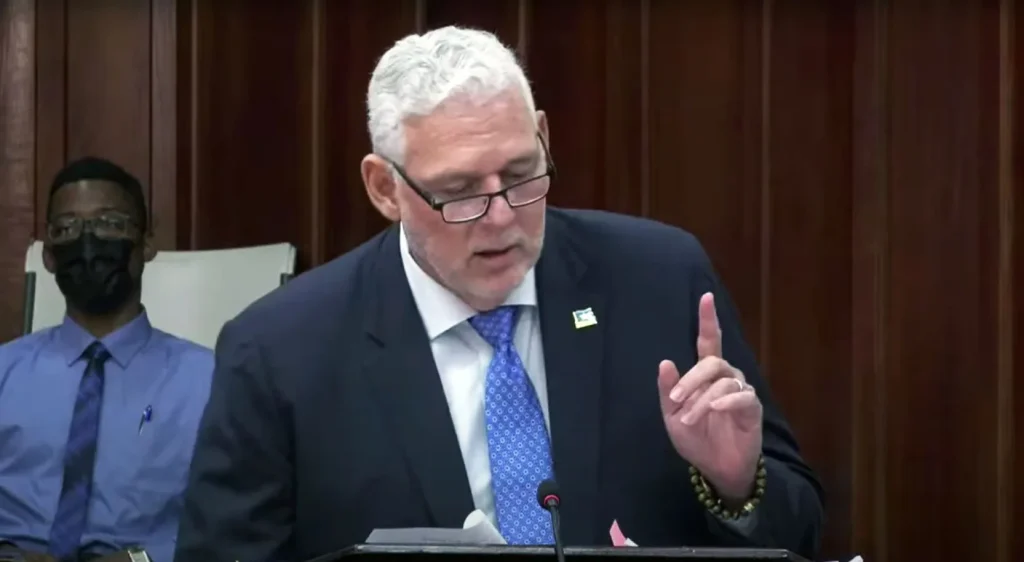
When IMI asked on what legal basis the program allows agents to market it as confidential, Mr. Emmanuel said: “The CIU is aware of the need for confidentiality and has not placed the names of granted or denied applicant in its Annual Reports.”
That is a description of practice, not a legal basis. The Act still contains no confidentiality provision, and the question of what happens when a different arm of government discloses names through a different channel remains open.
What happened here is that one arm of the government quietly stopped naming applicants in CBI reports, while another arm of the same government, under no obligation to coordinate with the CBI unit, named them in a fiscal publication.
The confidentiality that agents market, that clients rely on, and that competing programs cite as standard Caribbean practice rests on a policy choice that nobody ever codified in statute, and that a routine document has now overridden, one that nobody at the CBI unit appears to have reviewed before it went online.
Who is exposed
CBI bond-option investors tend to come from jurisdictions where a second passport is not a lifestyle upgrade but a contingency against political, economic, or personal risk.
Many of those jurisdictions do not permit dual citizenship. China automatically revokes nationality upon voluntary acquisition of foreign citizenship. India does not recognize dual citizenship. Russia has tightened notification requirements. Saudi Arabia, the UAE, Kuwait, Singapore, Japan, and Indonesia all restrict or prohibit it in various forms.
For anyone from these countries, appearing by full name in a publicly downloadable government document, linked to a CBI bond with a specific dollar amount, is not a bureaucratic oversight they can shrug off. It is a potential trigger for loss of original nationality, professional consequences, legal exposure, or worse.
From controlled sharing to open exposure
Caribbean CBI nations have spent the last three years building an architecture of controlled information sharing. The six CBI principles agreed with the US in February 2023 established common treatment of denials, mandatory interviews, FIU checks, and coordinated suspension of Russian and Belarusian applicants.
The March 2024 Memorandum of Agreement committed signatory states to sharing applicant information through a digital portal hosted by the JRCC in Barbados. The proposed EC CIRA agreement would centralize biometric data and application histories through CARICOM IMPACS.
All of this is deliberate, structured, and security-driven. Sharing applicant data with vetted counterparts through encrypted regional infrastructure is a reasonable response to the EU and US pressure that Caribbean CBI programs face daily.
Publishing applicant names in a fiscal report on the open internet is something else entirely. It is not controlled disclosure. It is not security cooperation. It is an accident that has the same practical effect as a data breach, except that no one broke any law, because no such law exists.
A policy, not just a convention
The CBI industry has operated for decades on what many assume is an unspoken rule: governments do not publish the names of their investors. In most jurisdictions, the practice of protecting applicant identities is just that, a practice, with no statutory underpinning.
In Saint Lucia, though, confidentiality was more than a passive convention. The Chastanet government made a conscious policy decision in 2019 to stop disclosing names, recognizing that applicants from countries hostile to dual citizenship would not invest in a program that might expose them.
That decision was not a courtesy. It was a calculated competitive response. It shaped how agents marketed the program, how clients evaluated it, and how Saint Lucia positioned itself against rival Caribbean CBI offerings.
A different arm of the same government has now undone that decision. Mr. Emmanuel confirmed to IMI that “the CIU was not aware that this was being published.” Nobody notified agents. Nobody informed the applicants, though Mr. Emmanuel said “some have now been contacted via the Authorized Agents.”

The question this raises is whether a government that accepts applications from nationals of countries where dual citizenship carries legal penalties can credibly promise confidentiality without a statutory guarantee.
The marketing says “confidential.” The law does not. Until someone reconciles the two, the gap between what applicants expect and what the legal framework delivers remains open.
The CIU responds
Mr. Emmanuel responded to IMI’s questions promptly and on the record. He confirmed the disclosure was not deliberate and that the CIU did not know about the publication.
When IMI asked whether the government had assessed the consequences for affected individuals, he said: “The Ministry of Finance is aware of the seriousness of the matter and have immediately addressed it.” He confirmed that applicants under other investment options should not expect their names to appear in future publications.
He denied that the government had ignored the issue: “I can assure you that the government has not ignored this matter and have ensured that this does not occur in the future.”
Two questions went unanswered. IMI asked whether previous editions of the same publication also contained CIP bondholder names.
Mr. Emmanuel did not respond to this. IMI also asked whether the government had assessed the legal and personal consequences now facing the affected individuals, many of whom appear to originate from countries that prohibit dual citizenship. Mr. Emmanuel’s response addressed the Ministry of Finance’s awareness but not whether anyone had carried out any such assessment.
Mr. Emmanuel said the government intends to remove the document and that the Ministry of Finance has “immediately addressed” the matter. At the time of publication, the document remains online.