

Equality among EU citizenships is a common assumption, but it stops at the rights the EU itself grants.
A Swede and a Bulgarian have the same right to live and work anywhere in the EU. The US lets the Swede visit without a visa, and Finland lets the Swede apply for citizenship after two years there. The Bulgarian can do neither.
EU law makes every national of a member state an EU citizen, and that status adds to national citizenship without replacing it. Everything else is national law. Each country decides who loses its citizenship, who inherits it, who must serve in the military, and who owes tax after leaving.
The national layer is also the part that survives a country’s exit from the EU. British citizens ceased to be EU citizens on February 1, 2020, when the UK’s withdrawal took effect, the EU’s top court ruled in 2022.
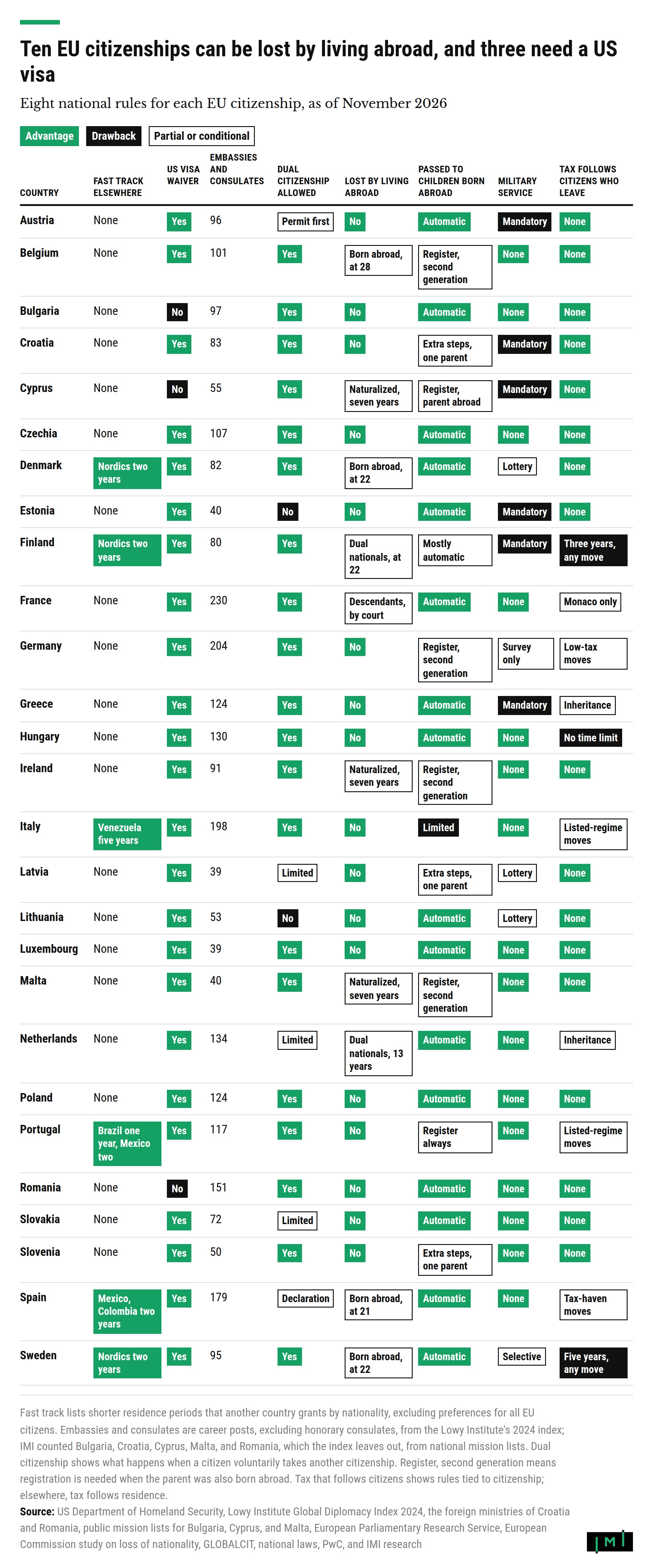
All 27 citizenships appear in one table covering eight national rules, as of November 2026.
10 EU citizenships can be lost by living abroad
Ten member states can end citizenship because a citizen lives abroad, the European Parliament’s research service found in February 2025. Four of the ten rules target people born abroad, and most can be stopped by a declaration, a passport renewal, or proof of ties.
Belgians born abroad who live abroad from 18 to 28 lose their citizenship at 28 unless they make a declaration before that birthday. Danes born abroad lose theirs at 22 if they never lived in Denmark or formed a close tie there.
Swedes born abroad who were never domiciled in Sweden also lose citizenship at 22. Finland applies the same age to dual nationals with no sufficient connection to the country.
Spain’s rule covers people born and living abroad whose Spanish parent was also born abroad. They lose Spanish citizenship three years after reaching adulthood unless they declare they want to retain it. Emigrants who use a foreign nationality exclusively face the same deadline.
Dutch dual nationals who live outside the EU for 13 consecutive years lose their citizenship. Renewing a Dutch passport or identity card within that period prevents it. The limit was ten years until April 2022.
Cyprus, Ireland, and Malta can withdraw citizenship from naturalized citizens who live abroad for seven continuous years, under a study for the European Commission. Notice of an intention to retain it, given annually in Cyprus and Ireland, prevents this. Since 2020, Malta’s citizenship law has also required that the person’s conduct harmed its vital interests or that the person threatens public security.
In France, a court can declare citizenship by descent lost when the person never lived in France. The family must also have neither lived there nor acted as French for half a century.
Estonia, Lithuania, and 5 others restrict dual citizenship
Seven member states end or limit citizenship when a citizen voluntarily takes another one. Germany left that group when it allowed dual citizenship from June 27, 2024.
Estonia and Lithuania restrict it most. Under Estonia’s constitution, no one who is Estonian by birth can be stripped of citizenship, which limits how far its rule reaches. A 2024 Lithuanian referendum to allow dual citizenship won 74.49% of votes cast but failed because fewer than 50% of registered voters backed it.
Latvia allows a second citizenship of another EU, European Free Trade Association (EFTA), or NATO state. It also allows Australian, Brazilian, and New Zealand citizenship, and some other cases.
Slovakia allows it for citizens who lived at least five years in the other country before acquiring its citizenship. The Netherlands allows it for some groups, such as people born in and living in the new country.
Austria requires approval before a citizen takes another citizenship, and without it the Austrian citizenship is lost.
Spaniards living abroad who take another citizenship lose their Spanish one after three years unless they declare that they want to retain it. No declaration is needed when Spaniards by origin acquire citizenship of an Ibero-American country, Andorra, the Philippines, Equatorial Guinea, or Portugal. The same applies to France under a 2022 treaty.
Ireland can also end the citizenship of naturalized citizens who acquire another one, while Irish citizens by birth face no such rule.
Children born abroad face conditions in 11 member states
In 16 member states, a child born abroad to a citizen parent becomes a citizen automatically. The other 11 attach conditions, based on the European Parliament briefing and a 2020 study by GLOBALCIT, a citizenship research network.
Belgium, Germany, Ireland, and Malta require registration when the parent was also born abroad. Registration is due within five years in Belgium, and Germany allows one year for children whose citizen parent was born abroad after December 31, 1999.
Croatia, Latvia, and Slovenia require extra steps for a child born abroad with one citizen parent. A child with two citizen parents becomes a citizen automatically. Cyprus requires registration when the citizen parent lives abroad permanently, and Portugal requires it for every child born abroad. In Finland, a child of an unmarried Finnish father becomes Finnish once he recognizes the child.
Italy narrowed descent in 2025. A child born abroad with another citizenship is now Italian at birth in two cases. A parent or grandparent must have had Italian citizenship alone, or a parent must have lived in Italy for two continuous years before the birth.
The Constitutional Court upheld those limits on March 11, 2026.
“For families planning a future EU citizenship, the ability to include the whole family tree is decisive,” says Vito Magagnino, managing partner of Mirabello Consultancy. Without “assurance that it can pass it on to children born abroad,” he says, “that citizenship becomes far less attractive.”
Magagnino adds that people with European roots now weigh narrower descent rules carefully when choosing which citizenship to pursue. It “remains important that new generations living abroad can still claim the nationality of their family heritage,” he says. He argues that “well-designed rules can protect that link while keeping it meaningful.”
10 countries require military service
Ten member states conscript in peacetime, based on a European Parliament briefing on conscription and later national laws. Exemptions for dual citizens and emigrants vary by country.
Austria, Cyprus, Estonia, Finland, and Greece have mandatory service, and basic service lasts six months in Austria and 14 in Cyprus. It lasts eight or 11 months in Estonia, 5.5 to 11.5 in Finland, and nine or twelve in Greece.
Croatia joined them when its parliament passed a law on October 24, 2025 bringing back two months of basic training. The initial intake of conscripts reported on March 9, 2026.
Denmark, Latvia, and Lithuania select conscripts by lottery, while Sweden selects conscripts and is the one member state that drafts both men and women.
Germany’s service is voluntary, but since January 1, 2026, 18-year-old men living in Germany must answer a questionnaire on their fitness and willingness to serve.
Tax can follow emigrants from 10 member states
Ten member states have rules that can tax some citizens after they move abroad.
Finland treats a citizen who moves abroad as tax resident for the year of the move and the next three years. Proof that substantial ties have ended lifts the rule, while Sweden presumes close ties for five years after departure.
Hungary counts every Hungarian citizen as tax resident, wherever they live. The exception is a citizen with another citizenship and no registered address in Hungary.
Spain and Portugal tax citizens who move to listed low-tax countries for the year of the move and the next four years. Italy presumes such citizens resident unless they prove otherwise.
Germany reaches citizens who move to a low-tax country while retaining essential economic interests in Germany, and France applies its rule to one destination, Monaco.
The Netherlands treats a Dutch national as living there for inheritance and gift tax for ten years after leaving. Greece taxes movable assets abroad of a Greek national who dies, unless they had been settled abroad for five consecutive years.
In the other 17 member states, tax follows residence. Latvia, Lithuania, and Romania make narrow exceptions for citizens working abroad for the state or, in Latvia, for a Latvian employer.
Bulgarians, Cypriots, and Romanians need a US visa
Citizens of 24 member states can visit the US for up to 90 days under the Visa Waiver Program. Bulgaria, Cyprus, and Romania are not members, so their citizens need a visa.
Romania came close. The US designated it on January 9, 2025, but rescinded the designation on May 2, 2025, before it took effect. Croatia joined the program in 2021.
US access can also narrow for one nationality. In early 2021, the US revoked travel authorizations of Hungarians born outside Hungary. In 2023, it limited all Hungarians to single-use authorizations valid for one year.
The Department of Homeland Security lifted those limits by a decision effective September 11, 2025, and the changes were implemented by September 30, 2025.
France has 158 embassies, Luxembourg 35
Outside the EU, citizens whose own country has no post can turn to any member state’s embassy or consulate. They receive help on the same terms as that state’s nationals.
France had 158 embassies and 72 consulates in the Lowy Institute’s Global Diplomacy Index 2024, with data to November 2023. Germany had 148 embassies and 56 consulates, and Italy 124 and 74.
Luxembourg had 35 embassies and four consulates, and Latvia and Estonia had 38 embassies each. The Lowy index leaves out five member states, so IMI counted their career posts from national mission lists in November 2026. Romania’s foreign ministry lists 95 embassies and 56 consulates, and Croatia’s lists 57 embassies and 26 consulates. Bulgaria has 74 embassies and 23 consulates. Cyprus has 50 embassies and high commissions and five consulates, and Malta has 31 and nine.
Portuguese, Spaniards, Italians, and Nordics naturalize faster abroad
Some citizenships shorten the path to another country’s citizenship.
Brazil naturalizes nationals of Portuguese-speaking countries after one year of uninterrupted residence. Mexico cuts its five-year requirement to two for people from the Iberian Peninsula and Latin America.
Mexico’s two-year rule also covers Spaniards, and Colombia naturalizes Spaniards after two years. Venezuela cuts its ten-year requirement to five for nationals of Spain, Portugal, and Italy.
Nordic citizens can apply for Finnish or Swedish citizenship after two years of residence. Sweden raised its general requirement to eight years on June 6, 2026, but left the Nordic route at two.
Denmark also asks Nordic citizens for two years of residence, plus three and a half years of full-time work in the previous four.
Several member states also favor citizens of other EU countries. Italy naturalizes them after four years and Czechia after three years of permanent residence. Austria lets citizens of the European Economic Area apply after six.
British citizens lost EU citizenship when the UK left
A member state can leave the EU under the withdrawal clause of the Treaty on European Union. The EU treaties then cease to apply to it once a withdrawal agreement enters into force, or two years after notice if none does. The European Council can extend that period.
The UK’s withdrawal agreement entered into force on February 1, 2020. A French court then asked the Court of Justice of the European Union (CJEU) about a British woman in France.
The court ruled on June 9, 2022 that UK nationals became nationals of a third country from February 1, 2020. They “lost the status of a citizen of the Union as from that date,” the court said.
The case, known as Préfet du Gers, concerned the right to vote in French municipal elections. The court ruled that this right ended with the EU citizenship that supported it.
“Leaving the EU as such may matter less than the relationship that follows,” Magagnino says. “A national citizenship that retains strong ties to the rest of Europe through cooperation and mobility agreements keeps much of its value,” he says. One “left with no connection to the EU would clearly lose appeal and influence for international clients,” he adds.
Some rights rest on older national treaties
The Common Travel Area (CTA) lets British and Irish citizens live, work, study, and vote in certain elections in each other’s countries. The UK government describes it as an arrangement that “pre-dates both British and Irish membership of the EU and is not dependent on it.”
Irish citizens thus have a right of residence in the UK that did not end with Brexit.
The Nordic countries built their own system before the EU, starting with passport-free travel in 1952. The common Nordic labor market came into force on July 2, 1954, and the Nordic Passport Union followed in 1958.
Portuguese citizens in Brazil can apply for equal civil rights with Brazilians under a 2000 friendship treaty. After three years of residence they can also apply for political rights, including the vote.
Spain’s dual-citizenship exemptions for Ibero-American countries, Andorra, the Philippines, Equatorial Guinea, and Portugal are written into its Civil Code. The exemption for France rests on a 2022 treaty, and none comes from EU law.
US visa-free travel is national too, because the US designates each country for the Visa Waiver Program separately.