Panama approved 5,821 investor and retiree residence permits from January to October 2026, according to the Servicio Nacional de Migración (SNM). No full year since the agency’s series began in 2010 produced as many.
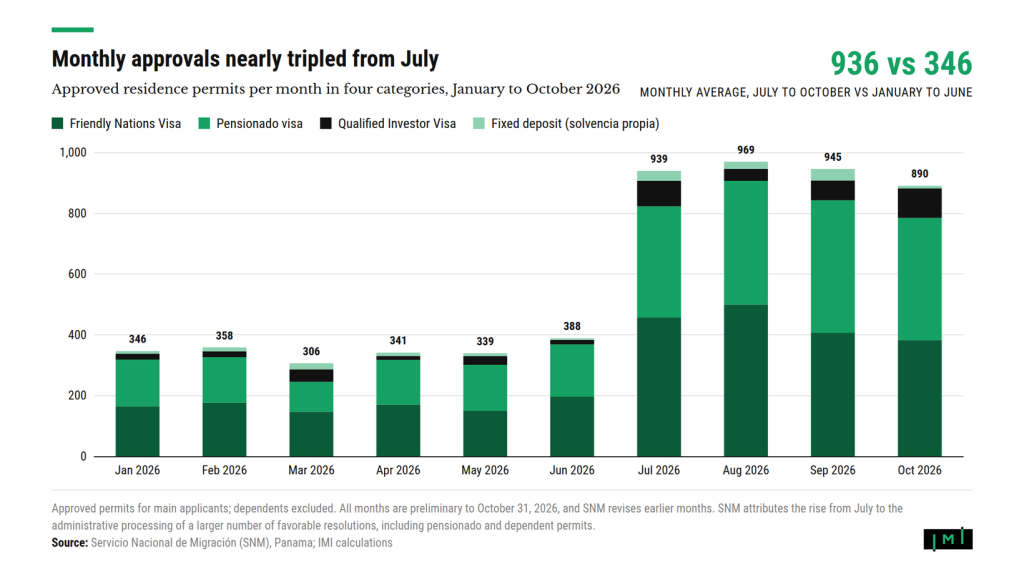
The ten-month count passes the previous high of 5,776, set in 2024, with two months left to report. Most of that volume arrived after June. Across the four categories, approvals averaged 346 a month in the first half and 936 a month from July to October.
The count covers the Friendly Nations Visa (FNV) and the Jubilados o Pensionados permit for retirees. The other two are investor routes, the Qualified Investor Visa (QIV) and the solvencia propia fixed deposit route. The 2024 total adds a property route that SNM no longer lists separately.
Monthly approvals nearly tripled from July
July brought 939 approvals in the four categories, against 388 in June. August reached 969, the highest month of the year, and approvals came to 945 in September and 890 in October.
SNM links the jump to its own processing. Changes from July correspond to “the administrative behavior of the approval process,” according to a note in its monthly residence tables. Pensionado permits appear on that list, alongside dependent permits and two humanitarian categories.
Advisers in Panama City notice the change. “We have observed significant improvements in immigration processing times,” says Ali Lenin Aguilera, a director and partner at Nexor Family Office. Faster decisions have “contributed to greater confidence among our clients,” he says.
The agency approved 39,664 residence permits of all types in the first ten months, above the 33,262 it approved in the whole of 2025. It denied 1,218 files over the same period, which puts the approval rate at about 97%.
Monthly denials climbed with the volume, from 83 in January to 226 in October. Infobae calculated that total resolutions in the third quarter rose 132.9% on the second.
Pensionado approvals reached 2,484, a record
Retirees took the largest increase. SNM approved 2,484 pensionado permits from January to October, 29% more than in the full year 2025, which set the previous record at 1,929.
Before 2022, annual pensionado approvals never topped the 936 of 2018, and they fell to 293 in 2020.
From July, the category averaged 403 approvals a month, against 146 in the first half. September produced 436, its highest month on record in the 2026 tables.
Friendly Nations Visa approvals passed the 2025 total
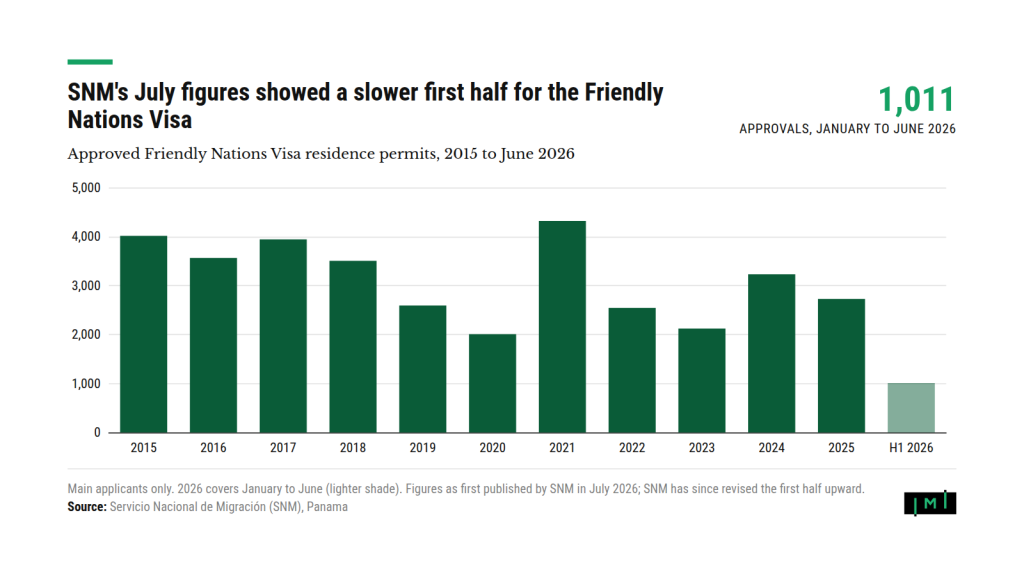
The FNV recorded 2,745 approvals by the end of October. That edges past the 2,725 of full-year 2025 with two months left to count.
Volume for the visa remains below its 2024 level of 3,228 and the 2021 peak of 4,318. That peak came in the last year of the old rules.
Until August 2021, citizens of the listed countries could qualify with a Panamanian company and about $5,000 in a local bank account. Decrees 197 and 226 of 2021 set a $200,000 minimum in property or a three-year fixed deposit. A job with a Panamanian employer became the alternative.
Approvals fell to 2,544 in 2022 and 2,118 in 2023, then recovered despite the higher price. Applicants now need 40 times the old deposit, and this year’s count already passes the 2025 total.
SNM does not split FNV approvals by route. Some of them may come through the employment option, which needs no investment.
Monthly FNV approvals rose from an average of 167 in the first half to 436 from July to October. SNM did not name the FNV in its note on the processing push.
Qualified Investor Visa approvals hit 420 under new rules
The QIV posted 420 approvals in ten months, against 327 in each of 2024 and 2025. October alone brought 97, the program’s strongest month in the 2026 tables.
Jordi Vilanova, president of Mercan Group, reads the rise as fresh demand. “These are new filings,” he says, and they reflect “the growing international positioning and visibility of Panama’s Qualified Investor Program.”
Vilanova also credits the government. He points to “more efficient administrative procedures and greater international promotion.”
Panama changed the program’s rules during that period. Executive Decree 17, published in the Official Gazette on September 16, 2026, replaced the 2020 framework.
Under the decree, a new property bought from the developer qualifies at $300,000. Resale property now requires that investors spend at least $500,000. Fixed-term deposits need $750,000 at a private bank or $500,000 at Banco Nacional de Panamá or Caja de Ahorros.
Vilanova sees the higher resale threshold changing where investors buy. “I believe the main impact will be a further shift in investment demand toward new real estate developments,” he says.
Local buyers could gain too. Steering foreign money toward new projects “could help limit speculative pressure on the secondary housing market and reduce competition with local homebuyers,” he says. He cites Portugal and Greece, where investment migration added to pressure on housing prices in some segments.
Grupo Los Pueblos, a Panama developer, reports no change in what its investor buyers ask for. “Our investor buyers have consistently favored buying directly from the developer, and that has not changed,” says Horacio Mendoza, its director of business development.
About a quarter of the company’s foreign buyers apply for residence, Mendoza says. They use either the QIV or the FNV.
Aguilera sees promise in the cheaper deposit route at the two state banks. The $500,000 option “represents an attractive opportunity for investors,” he says, and “expands the available options for obtaining residency in Panama.”
Files submitted before September 16 follow the rules in force on the filing date, according to article 19. Investors with contracts signed before that date have six months to apply under the old terms.
The market speculated about higher thresholds before the decree, according to Vilanova. Any rush to file ahead of it was “a secondary factor rather than the main driver of demand,” in his view.
Mendoza saw no rush to sign contracts before September 16 either. Buyers believe the decree “clarified several points that had been open to interpretation,” he says. In his words, “that clarity has given them greater confidence.”
The decree gives SNM 30 business days to decide a QIV file after the Ministry of Commerce and Industries certifies the investment. With that deadline, QIV approvals likely follow filings more closely than FNV approvals do.
The fixed deposit route under solvencia propia recorded 172 approvals, one more than its 2024 total of 171. Article 18 of the decree allows people with solvencia propia status or pending files to switch to the QIV within 12 months.
Advisers are already changing course. “We are definitely seeing a shift in the recommendations made by immigration lawyers,” Vilanova says, with more of them steering clients to the QIV.
The QIV grants permanent residence directly, and investors can file without traveling to Panama. A visit follows for biometrics and the residence card. Solvencia propia applicants usually spend two years on provisional residence first, and both routes accept property from $300,000.
Many lawyers stuck with solvencia propia because “it was the process they knew best,” Vilanova says. He considers it “still too early to quantify” how many existing clients will convert. The conversion window “could accelerate the ongoing shift toward QIP,” he adds.
SNM revised the first-half figures upward
In August, IMI Daily reported 1,546 approvals for the first half in five categories. SNM’s current tables put the first half at 2,078 in four categories alone.
Pensionado permits account for most of the gap. The current tables show 873 approvals from January to June, against the 347 that IMI Daily reported in August.
Each monthly table states that its figures are preliminary and subject to revision. Its February edition listed 18 pensionado approvals for January and February, and the October edition shows 304 for the same two months.
Revisions also reach further back. In February 2026, SNM issued a corrected file for 2010 to 2021. This article uses the agency’s latest figures for every year.
Vilanova warned in August against reading the first-half drop as weaker demand. He named fewer filings and a processing backlog as possible causes. The data alone, he said, “does not necessarily tell us which of those two factors is driving the decline.”
2 months remain in the 2026 count
November and December data will decide how far the record extends. At the July to October pace of 936 a month, the four categories would end the year near 7,700 approvals.
A slower pace is possible if the processing push ends. The tables count decisions on files, not new filings. Whether demand itself rose cannot be read from them.
Advisers interviewed for this article report stronger demand. Interest in Panama’s residence and investment programs “has increased considerably,” according to Aguilera.
IMI program guide: Panama Friendly Nations Visa