

Naturalization timelines are lengthening almost everywhere. Portugal doubled its standard wait to ten years in May, Sweden moved from five years to eight in June, and Peru quietly went from two to five in 2025. One class of provision, however, has sailed through the tightening cycle largely intact: preferred-nationality naturalization, the statutory discounts states grant to citizens of countries they consider kin.
The logic is decades old, in some cases older than the states’ current constitutions. Spain wrote its Ibero-American preference into the Civil Code; Brazil’s Lusophone track is enshrined in the 1988 Constitution; and the Nordic states have run a reciprocal fast lane since the 1950s.
For holders of the right first passport, these rules remain the most accessible citizenship accelerant available.
What follows is a map of the principal regimes in force as of July 2026, drawn from the statutes and the ministries that administer them.
Iberia: The Original Two-Track Systems
Spain runs the widest gap between its two tracks, setting the ordinary residence requirement at ten years but cutting it to two for natural-born nationals of Ibero-American countries, Andorra, the Philippines, Equatorial Guinea, and Portugal. Puerto Ricans qualify, and so do Brazilians, despite the language difference.

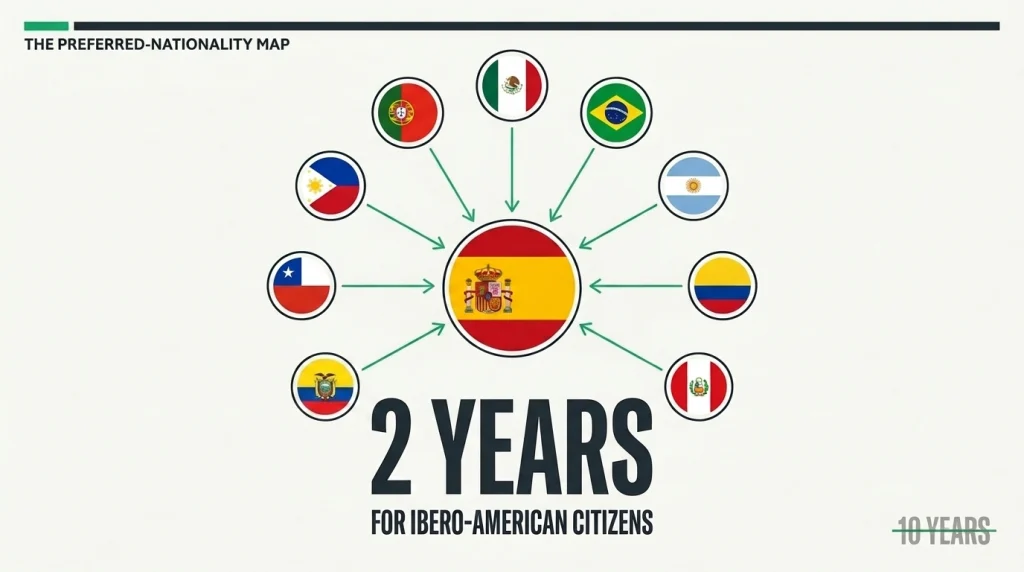
The benefit attaches to nationality de origen, so a passport acquired through naturalization elsewhere does not open the two-year door, a distinction Spanish courts have repeatedly confirmed.
In practice, the track’s popularity mirrors the eligibility list: most applicants “come from the Philippines and Ibero-American countries, including Brazil,” says Krista Victorio of Orience, a Barcelona-based firm. Decisions that once took one to two years now arrive in roughly eight to ten months, she notes, after a Ministry of Justice overhaul briefly pushed waits down to three or four months in mid-2024.
The common stumbling block is not the language or civics exams, where the real difficulty is merely securing a test date, but demonstrating continuous legal residence, a concept Spanish law “does not provide a precise definition of,” Victorio says, leaving it open to the authorities’ interpretation. Her rule of thumb: no absences from Spain longer than three consecutive months.
Portugal preserved its preference through the harshest nationality reform in Europe this year. The new Nationality Law, in force since May 19, raised the ordinary naturalization requirement from five years to ten, but nationals of the Community of Portuguese Language Countries (CPLP) and of EU member states qualify after seven.

The CPLP comprises Brazil, Angola, Mozambique, Cape Verde, Guinea-Bissau, São Tomé and Príncipe, Equatorial Guinea, and Timor-Leste, alongside Portugal itself. Together with the 26 other EU member states, that puts nationals of some 35 countries on the seven-year track, with Brazilians by far the largest cohort among Portugal’s naturalization applicants.
The Brazilian lead is visible in practice. “We are observing an increase in new clients from Brazil; however, CPLP clients are still a small minority of the subscribers for our golden-visa-eligible fund,” says Pedro Oliveira of Optimize Investment Partners, a Lisbon-based fund manager. “Interest from other CPLP and EU countries has not materialized.”
Applications filed on or before May 18, 2026, remain under the prior regime, though only filed applications are protected; accrued residence years alone are not. The reform also tightened birthright citizenship: children born in Portugal to foreign parents now acquire nationality only if one parent has at least five years of prior legal residence, up from one year, and with no preferential tier for CPLP parents.
Oliveira doubts the language exemption moves the needle much, though; it carried over from the previous golden visa regime, and he finds non-CPLP clients rarely treat the language as a burden: “Most of our clients are interested in doing the Portuguese language course and learning a bit of the language of the country they spend time in every year.”
The EU-Citizen Tier
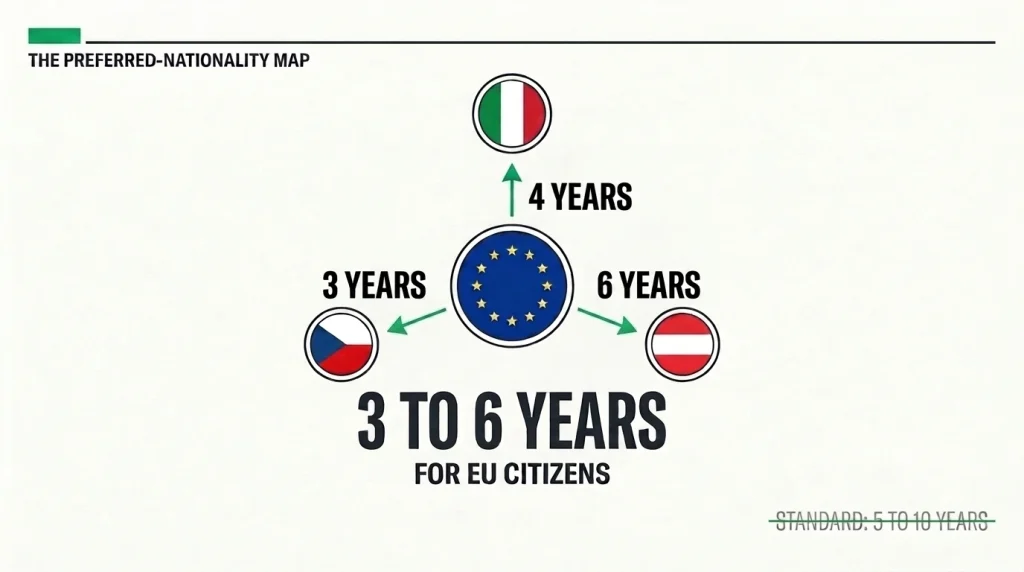
Italy’s Law 91/1992 grants EU citizens naturalization after four years of legal residence under Article 9, against ten years for third-country nationals. The B1 Italian language requirement applies to everyone.
Czechia asks EU, EEA, and Swiss citizens for three years of permanent residence rather than the standard five under its 2013 Citizenship Act, with a ten-year total residence alternative for those who reached permanent status late. Slovaks receive a further concession: an exemption from the Czech language exam.
Austria, whose ten-year rule is among the strictest in Western Europe, lets EEA citizens apply after six years. Germany is the counterexample: its short-lived three-year fast track, scrapped in October 2025, was merit-based rather than nationality-based, and Berlin has never offered EU citizens a shorter path.
Hungary, Bulgaria, and Romania operate their own accelerated regimes, but those attach to ethnicity or descent rather than to the citizenship itself. They belong to the citizenship by descent family, a different legal animal.
The Nordic Fast Lane
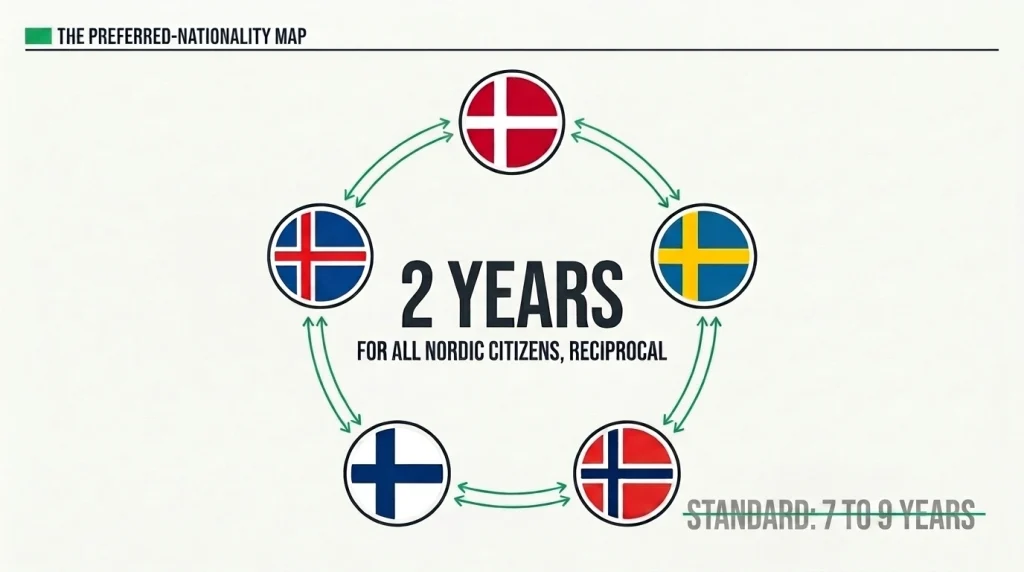
The five Nordic states operate the most complete reciprocal system anywhere, a product of citizenship cooperation that has run alongside the Nordic Passport Union since the 1950s.
Each grants the others’ citizens naturalization after two years of residence, except Iceland, which asks for four under its Nationality Act.
That gap to the ordinary track keeps widening. Sweden’s new citizenship law, in force since June 6, raised the general requirement from five years to eight while leaving the Nordic two-year rule untouched.
Denmark demands nine years of continuous residence from most applicants but two from Nordic citizens, and Norway and Finland both moved to eight-year general rules in recent years while keeping their Nordic figure at two.
A parallel mechanism runs alongside naturalization: acquisition by declaration. Natural-born Nordic citizens can claim Finnish citizenship by declaration after five years of residence and Danish or Norwegian citizenship after seven, an entitlement processed without the discretion that attaches to ordinary grants.
Latin America: The Mirror Image
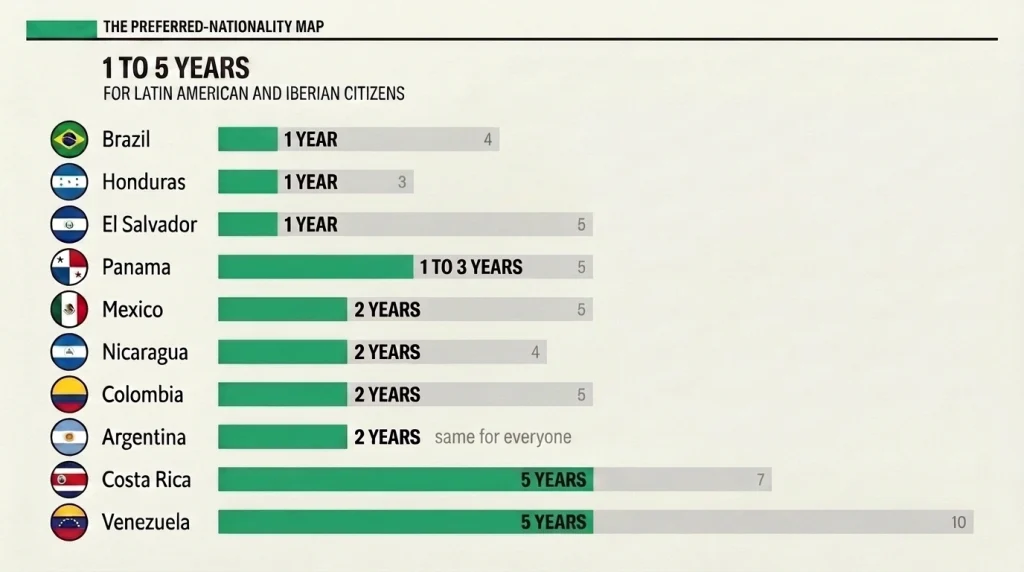
Latin American constitutions return Spain’s favor, and then some. Brazil’s Article 12 grants nationals of Portuguese-speaking countries naturalization after a single uninterrupted year of residence, plus proof of good moral character, against four years on the ordinary track, and the Ministry of Justice waives the Portuguese exam for them.
The route runs through permanent residency, which CPLP citizens also reach faster: two years of temporary residence on a CPLP visa against four for real estate investors, notes Francisco Litvay of Settee, while “immediate PR” via business investment followed by one year in the country remains the quickest sequence.
The one-year track is common across Central America: Honduras naturalizes Central Americans by birth after one year of residence and Spaniards and Ibero-Americans by birth after two, while El Salvador’s constitution grants Spaniards and Hispano-Americans of origin a one-year track.
Mexico’s Ley de Nacionalidad cuts its five-year requirement to two for natural-born nationals of Latin American countries and the Iberian Peninsula, a route the foreign ministry administers as a dedicated naturalization category.
Costa Rica works the same two-tier logic at a slower tempo. Article 14 of its Constitution asks five years of official residence from Central Americans, Spaniards, and Ibero-Americans by birth, versus seven for everyone else, including kin-country nationals who acquired that nationality by naturalization rather than at birth.
Colombia moves at a similar pace since tightening its rules in 2023: five years of domicile counted from the issuance of the applicant’s Resident Visa, reduced to two where reciprocity applies, as it currently does for Spaniards, Mexicans, Salvadorans, and Hondurans.
Nicaragua’s naturalization law sets the general requirement at four years of permanent residence but halves it to two for nationals of Latin American and Iberian Peninsula countries. Central Americans by origin enjoy a further concession: they may opt for Nicaraguan nationality without renouncing their original one, an exemption the 2025 constitutional amendments preserved.
Panama runs the region’s purest reciprocity model. Article 10 of its Constitution admits natural-born nationals of Spain and Latin American states to naturalization on whatever terms their home country would impose on a Panamanian, which in practice means as little as one year for Salvadorans, two for Spaniards and Mexicans, and three for Uruguayans, against five years on the ordinary track.
Venezuela halves its ten-year requirement to five for nationals of Spain, Portugal, Italy, Latin America, and the Caribbean.
Argentina applies that timeline to all nationalities equally, offering no preference.
The Commonwealth Caribbean’s Registration Route
In the English-speaking Caribbean, the preference is procedural rather than merely temporal. Independence-era constitutions and citizenship acts allow Commonwealth citizens to acquire nationality by registration, an entitlement-style mechanism, while other foreigners face discretionary naturalization.
St. Vincent and the Grenadines illustrates the model. Commonwealth citizens ordinarily resident for seven years may register as citizens under the Citizenship Act of 1984, whereas ordinary naturalization contemplates roughly nine years of residence or government service and rests on ministerial discretion.
Comparable Commonwealth registration provisions survive across the region, though each act sets its own residence period and several have tightened quietly, so the statute in force should be checked before advising.
One structural point is often misunderstood: CARICOM free movement confers no citizenship rights, and Trinidad and Tobago’s foreign ministry states plainly that a CARICOM national wishing to settle permanently must apply under the host state’s ordinary residency or citizenship law.
The distinction between mobility rights and naturalization rights runs through every settlement bloc IMI tracks.
Reading the Map
Three rules emerge from the statutes. First, most Ibero-American preferences attach to nationality by origin, so acquiring a qualifying passport through a citizenship or residency by investment program does not reliably unlock the discount.
Brazil is the live example. The constitutional wording covers those “natural from” Portuguese-speaking countries, which Litvay reads as citizens by origin only. His firm has fielded multiple inquiries about using São Tomé and Príncipe’s citizenship program as a shortcut to the one-year track and has told them it would not stand on paper, though no CBI citizen has yet tested it: “We welcome volunteers to test it out in practice.”
Second, the preferences are proving more durable than the general timelines around them. Portugal, Sweden, Finland, and Norway all lengthened their ordinary tracks within the past two years while leaving their kinship lanes at or near the old figures, suggesting legislators view these provisions as diplomatic architecture rather than migration policy.
Third, the discounts compound with settlement blocs. A Colombian who naturalizes in Spain after two years acquires EU-wide free movement, and a Portuguese national in Brazil reaches one of Latin America’s strongest passports in one.
For anyone holding, or eligible for, a preferred nationality, the fastest citizenship strategy available is often not an investment program at all.
For the full country-by-country matrix, see the IMI Citizenship Catalog, which tracks preferred-nationality provisions across 195 states.



