

Nauru issued 221 passports from 98 approved applications under its citizenship by investment (CBI) program by November 13. The figures come from a November 19 media release by the program office. New citizens came from 42 countries, and applications were arriving at an average of 25 a month.
Those figures came two years after the program’s launch at the 2024 UN climate conference in Baku and 18 months after it opened for applications. In all, 205 applications reached the office in those 18 months, or about 11 a month.
The government created the program to fund Nauru’s economic development and climate resilience. President David Adeang described it earlier this year as proof that a nation’s trajectory can change “with innovative thinking and the support of our people.”
CEO Edward Clark credited the “modifications we made midway through this journey” for the program’s second-year growth.
February overhaul
Those modifications included a February 2026 overhaul that cut fees and knocked US$25,000 off the US$115,000 contribution for principal applicants. It also lifted age limits and dependency requirements for children and parents and opened eligibility to married children and siblings.
That discount initially applied to applications filed before June 30, 2026. The program later extended it to applications filed before December 31, according to its website. Contributions averaged US$91,682 per application in 2026, excluding fees, according to the program office.
Jeremy Savory, founder and CEO of Savory & Partners, expected the end of the discount to test demand. “We will see what the numbers look like once the limited-time offer ends next month, unless they do an Antigua and roll it over into next year.”
Antigua and Barbuda extended its US$100,000 limited-time offer in 2018. The discounted price remained until 2024, when the country raised the minimum contribution to US$230,000.
Bigger families
Applications averaged 2.9 people in 2026, up from 2.3 in 2025, a jump Clark put down to “the adjustments we made to the family inclusion policies.”
More than 60% of applications included a dependent, and more than 35 involved families of five or more. The largest, a family of nine, included siblings.
Fewer refusals
Due diligence led the office to decline around 20% of applications in the program’s first year. Clark tied the falling rejection rate to agents who had come to “understand our process” and put the approval rate at 90.6%.
That figure can only cover files that had reached a decision, since the 98 approvals amount to 48% of the 205 applications received. Neither the release nor Clark gave a count of refused files.
Rejections remained the sticking point for Savory: “The rate has come down from one in five to one in ten, but that is still higher than any other jurisdiction.”
Gulf demand
Chinese nationals accounted for the largest share of early applications, followed by stateless applicants, whose approvals the program office had twice publicized. China’s share fell in 2026 as more applications came from the Gulf, though the release gave no percentages.
Applications in 2026 came from “a much broader range of nationalities,” and Clark welcomed “greater engagement across our agent network.”
Savory traced the early Chinese demand to geography: “Proximity draws Chinese clients, which is why they went to Vanuatu and still do.”
He linked the wider spread of nationalities to the price cut, with the program “attracting a broader regional mix, probably because the price became more competitive.”
Jennifer Harding-Marlin, founder of JH Marlin Law, said more people now ask her about Nauru when they consider a second citizenship. “The lower fees and broader family eligibility have made it a practical option for more families,” she said.
Neutrality also comes up in those conversations, according to Harding-Marlin, who credited the program’s due diligence with giving it credibility.
Processing
Applicants waited an average of 155 days, roughly five months, from submission to delivery of their citizenship documents, and the fastest file took 96 days. The program’s website advertised a typical processing time of three to four months at the time of publication.
Files received in May, June, and July 2026 moved faster, at 120.8 days on average. Approval for those files came an average of 68.9 days after formal acceptance.
Clark attributed the faster turnaround to additional investment in systems and people, which he linked to growing interest in the program. His office also worked with licensed agents so that they “better understand the documentation requirements and are able to make clean submissions.”
Speed won praise from Savory: “It is very quick, and I like that they have set out the timeline from start to finish. I notice the governments often point to processing times but what applicants and agents really want to know is the time from start to finish. The post-approval timeframes can get very stretched in certain jurisdictions to the point that they even exceed DD timeframes. ”
Headwinds
Applications fell well short of the goal Clark set in February 2025, when he described 500 applicants in the first year as a “very aspirational” target worth more than AU$60 million (approximately US$41 million), according to Radio New Zealand.
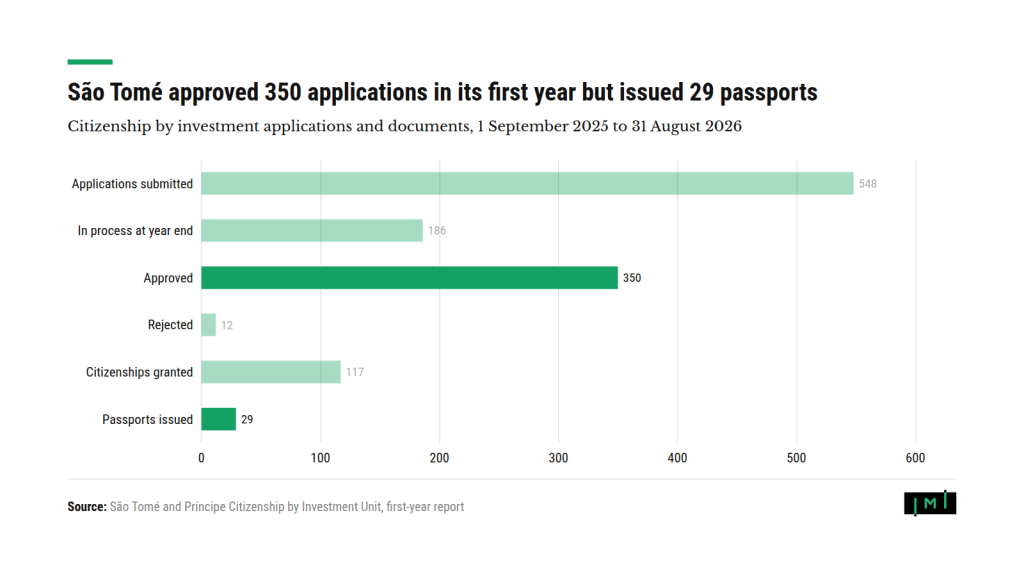
São Tomé and Príncipe opened its program in September 2025 with a US$90,000 entry price. In its first year, it took in 548 applications and approved 350, according to its first annual report.
Nauru lost visa-free access to the UK in December 2025. The Home Office imposed visa requirements on its citizens over concerns about the citizenship program, an assessment the program office disputed.
IMI program guide: Nauru Citizenship by Investment