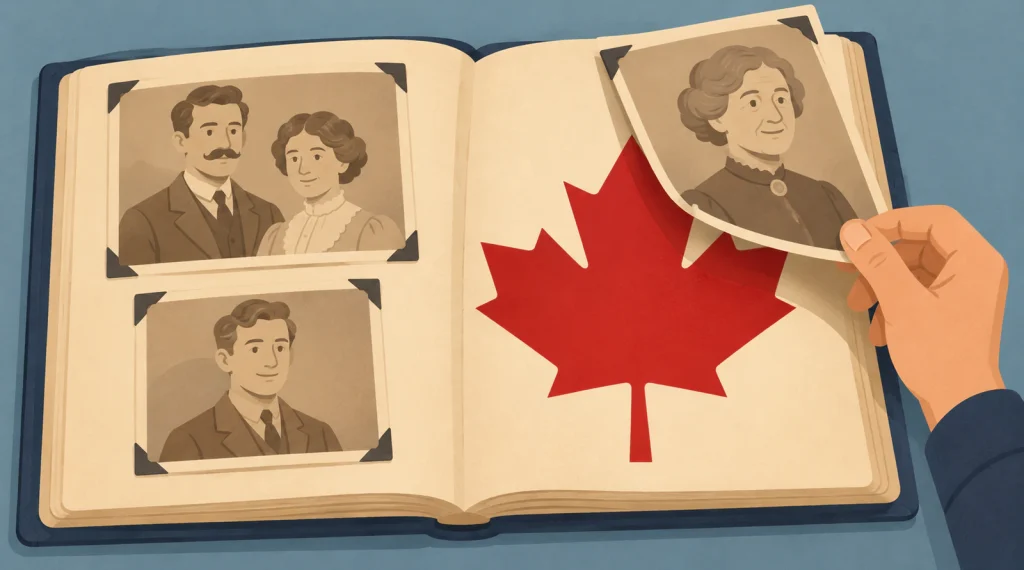
If you were born abroad before December 15, 2025, Canada counts you as a citizen when one parent was a Canadian citizen at your birth.
That parent may have become Canadian through the same rule, so the line can reach back through grandparents and great-grandparents.
Bill C-3, an amendment to the Citizenship Act, took effect on December 15, 2025 and removed the old limit of one generation born abroad.
David Lesperance, Managing Partner at Lesperance & Associates, believes that “acquisition of a Canadian citizenship can be useful to Americans in a number of ways. For some it is a first country backup plan.”
During 2026, proof became harder. Immigration, Refugees and Citizenship Canada (IRCC) now wants original records for every generation, and the wait is long.
Who is covered
Under the Act, a person born abroad is a citizen if a parent was a citizen at the birth. Bill C-3 set a new limit for births from December 15, 2025 on and left earlier births with no limit on generations.
Because the Act treats a person covered by the new rule as a citizen from birth, the chain works across generations. IRCC’s guide on proof of citizenship says that a person born abroad to a Canadian parent before that date “is automatically a Canadian citizen effective from their date of birth or the date they lost their citizenship.”
The rule also covers people “born to someone who became Canadian because of these rule changes,” according to IRCC’s page about the new rules. Those covered include:
- People born abroad before December 15, 2025 to a parent who was a citizen at the birth, in any generation.
- Children whose parent died before the change but would have become a citizen under it.
- Those who lost citizenship at 28 under an older rule, often called “Lost Canadians.” They had not applied to retain it, or had applied and failed.
- Anyone who lost citizenship under older laws for any reason other than renouncing it or having it revoked for fraud.
For older family lines, IRCC sets one more condition. It requires that the parent or earlier ancestor “became, or would have become, a Canadian citizen on or after January 1, 1947 (on or after April 1, 1949, in Newfoundland).”
Canadian citizenship began as a legal status on January 1, 1947, when the Canadian Citizenship Act came into force.
The Act leaves out anyone who renounced Canadian citizenship, and anyone whose citizenship was revoked for fraud, false representation, or concealment of material circumstances. It also leaves out a person who became a citizen by grant and later renounced.
Citizenship under C-3 counts from birth, but the Act gives no rights or duties under any other law for the years before the change. It also bars claims for damages for that period.
Living abroad as a Canadian

Canada lets its citizens have another citizenship, and Canada asks for no report or application when they do.
People whom C-3 made citizens, and who do not want the status, can renounce it through a simplified process.
Several other countries pass citizenship down the generations, and Americans have ancestry routes to other citizenships too.
Under the Income Tax Act, Canada taxes people resident in Canada. A non-resident citizen pays Canadian income tax on income from a job or business in Canada and on sales of taxable Canadian property.
Buying property in Canada
Slava Apel, CEO at CanadaRBI, notes that “there is a potential, but not a guarantee” that a person who is Canadian through grandparents “could qualify to buy a home in Canada.”
A descendant first needs a citizenship certificate from IRCC to prove the status.
Since January 1, 2023, Canada has prohibited non-Canadians from buying residential property. The law defines a non-Canadian as a person who is not a Canadian citizen, a permanent resident, or a person registered under the Indian Act.
That definition sets no residence condition, so a citizen who lives abroad is outside the ban.
Homes outside census metropolitan areas and census agglomerations, the statistical areas around Canada’s cities and larger towns, are exempt. Some temporary residents, people with refugee protection, and non-Canadians who buy with a Canadian spouse or common-law partner are also exempt.
Under current law, the prohibition ends on January 1, 2027. On November 5, 2026, the federal budget proposed to extend it to January 1, 2029 for existing homes and to exempt new ones.
The government said it would propose legislation for the change.
Travel and ESTA
Dual Canadian citizens need a valid Canadian passport to board a flight to Canada. IRCC makes two exceptions.
Canadian-American citizens can fly on a valid US passport with proof of Canadian citizenship, and may face extra screening.
Other dual citizens whose flight leaves within ten days can request a special authorization to board. They need a valid passport from a visa-exempt country and must meet one of IRCC’s conditions, such as having already received a citizenship certificate.
Travelers who visit the United States under its Visa Waiver Program need an approval through the Electronic System for Travel Authorization (ESTA).
Since June 2026, former US citizens have been refused ESTA approvals and told to apply for a visa instead, immigration lawyers report.
For Americans who are thinking of giving up US citizenship, Lesperance notes that Canadians need no US visa and “avoid the recent ESTA issue as Canadians do not need to apply for ESTAs.”
Giving up US citizenship
Americans who give up citizenship can be treated as covered expatriates. Any one of three tests applies.
Two of them are a net worth of US$2 million or more, and a high average income tax bill over the five years before.
The third catches anyone who cannot certify that they met every US tax duty for those five years.
A covered expatriate pays an exit tax on gains in assets not yet sold, above an exempt amount. A US citizen or resident who receives a gift or bequest from them also pays tax on it.
US law lifts the net worth and income tax tests for some people who were citizens of the United States and another country at birth.
On the day they give up US citizenship, they must be a citizen and a tax resident of the other country.
They must also have been a US resident, counted by days spent there, in no more than ten of the last 15 tax years. The third test applies to them as well.
Lesperance argues that “with sophisticated pre-expatriation planning, since the individual is deemed to be a citizen from birth, Canada can be used to avoid the covered expatriate status,” and with it the exit tax and the tax on gifts and bequests.
Voting from abroad
Under the Canada Elections Act, a citizen must have lived in Canada at some point before applying to the International Register of Electors. A descendant who never lived in Canada cannot vote from abroad.
Background
Before C-3, a Canadian parent could pass citizenship to a child born abroad if the parent was born in Canada or naturalized before the birth. This was known as the first-generation limit.
On December 19, 2023, the Ontario Superior Court of Justice declared key provisions of that limit unconstitutional in Bjorkquist v Canada (Attorney General). The federal government chose not to appeal, and the court gave Parliament several extensions to fix the law.
A first bill, C-71, died when Parliament was prorogued. Bill C-3 received royal assent on November 20, 2025, before the court’s last extension ended.
Border towns
Some Americans may have a Canadian link they never knew about. CIC News, a news site on Canadian immigration, has reported that families in some US border towns went to Canadian hospitals to give birth.
Its example was St. Stephen, New Brunswick, across the river from Calais, Maine. According to CIC News, roughly a third of babies born at St. Stephen’s former Chipman Memorial Hospital in the 1940s reportedly had American mothers.
It also cited research finding that many children from Point Roberts, Washington, were born in Vancouver hospitals.
Any child born in Canada is Canadian under the Act, and the mother’s nationality makes no difference. A narrow exception covers children of foreign diplomats, foreign government employees, and some international organization staff, when neither parent is a citizen or permanent resident.
That child’s own children, born in the United States, are the first generation born abroad, which Canada recognized before C-3. Bill C-3 reaches the generations after them, as long as each person was born before December 15, 2025.
A border baby born before January 1, 1947 must meet IRCC’s 1947 condition. It asks whether that person became, or would have become, a citizen on or after that date.
The Act also counts as citizens people born in Canada before 1947 who lost British subject status and did not become citizens on that day.
Each birth in the chain needs its own record, including the Canadian hospital birth, under IRCC’s document rules.
Children born since the change
For a child born abroad on or after December 15, 2025, the rule is narrower. When the Canadian parent was also born abroad, a citizen parent needs at least 1,095 days in Canada before the birth.
The 1,095 days (three years) are cumulative, so they do not need to fall in one stretch. They count before the birth, and the family proves them when it applies for the child’s certificate.
A parent working abroad for the Canadian Armed Forces, the federal public administration, or a provincial public service at the birth is exempt. Staff hired locally abroad do not qualify for it.
A child who fails the test can become a permanent resident of Canada and then apply for a grant of citizenship.
Adopted children never become citizens automatically. The immigration minister must, on application, grant citizenship to a person adopted as a minor by a Canadian, if the adoption meets five conditions.
Under the Act, the adoption must have served the child’s best interests and created a parent-child relationship in fact. It must also have followed the laws of both countries, respected international adoption rules, and not been mainly a way to gain status.
C-3 opened that grant to people adopted abroad beyond the first generation before December 15, 2025. For adoptions from that date, a citizen parent who was born abroad needs the same 1,095 days in Canada before the adoption.
Proving it

Citizenship by descent needs no grant. IRCC says anyone who thinks C-3 made them a citizen “must apply for a citizenship certificate to find out for sure.”
The certificate costs CA$75 and is not a travel document. Some applicants can file online, and others file on paper by mail or through a Canadian embassy, high commission, or consulate.
For applicants outside Canada and the United States who file through a mission, IRCC tells them to add three to four months for mailing.
IRCC’s page on how to apply lists what it asks for:
- Authentic, reliable, and verifiable documents for every generation back to the Canadian ancestor.
- Records from the original authority, such as a civil registry or a vital statistics office.
- Official records alongside any third-party material, such as genealogy website pages, which cannot support an application alone.
- A written explanation, with proof of the attempts made, where an original record cannot be found.
- Substitutes where a birth record is missing, such as hospital, baptismal, or census records, ship manifests, and foreign birth certificates.
With the certificate in hand, IRCC tells new citizens to apply for a Canadian passport before they travel to Canada.
In October 2026, IRCC’s online tool showed 34 months for a new proof application, CIC News reported.
That figure covers every proof application, including people seeking replacement documents and children of parents born in Canada. The same tool counted 130,700 people waiting for a decision.
IRCC confirmed to CBC News in November that it pauses a permanent residence application while it assesses a proof application from the same person. If IRCC confirms citizenship, it treats the permanent residence application as withdrawn.
The June suspension
On June 13, 2026, the Registrar of Canadian Citizenship ordered some C-3 citizens to surrender their certificates within 15 days.
The letters cited documents that did not come from original source authorities, or no explanation of why such documents were missing.
IRCC stopped finalizing new C-3 applications. Affected people could continue to live and work in Canada, but they could not use their Canadian passports.
By the end of June, IRCC said it had reviewed about 6,500 applications received after C-3. It had first flagged 100 certificates, reinstated a third of them, and left 67 suspended.
IRCC admitted that its guidance on acceptable documents “was unclear and may have contributed to certificates being issued without sufficient evidence.”
CIC News reported in September that IRCC finished the review at the end of June and resumed processing.
Under the Citizenship Regulations, the Registrar must demand a certificate back when there is reason to believe the person may not be entitled to it. Once the immigration minister decides the person is not entitled, the Registrar must cancel it.
The suspension left the Act itself unchanged.
How many people
IRCC approved 4,075 proof applications under C-3 from December 15, 2025 to March 31, 2026. Of those, 1,955 went to people born in the United States.
By the end of August, IRCC had approved 7,900 certificate applications under C-3, according to IRCC figures that CBC News published in November.
Another 22,570 people born abroad to a Canadian parent received certificates over the same months outside C-3.
The Parliamentary Budget Officer estimated that the earlier bill, C-71, would affect around 115,000 people over five years.
That estimate rested mainly on people born abroad between February 15, 1977 and April 17, 1981, their children, later second-generation births, and adoptees. It does not count descendants of people who left Canada generations ago, the group behind the border-town stories.
In briefing notes prepared for the House of Commons immigration committee’s meeting of October 2, 2025, IRCC said it did not use the estimate. It expected “tens of thousands (and not hundreds of thousands)” of people to be affected by C-3.