Prime Minister Terrance Drew announced on November 13 that Saint Kitts and Nevis will wind down its citizenship by investment (CBI) program, the world’s oldest, on a timeline his government is negotiating with the European Union.
“Saint Kitts and Nevis will wind down its Citizenship by Investment Program responsibly on a timeline now being negotiated with the European Union,” Drew said in a national address broadcast at 6:30 p.m. local time. He confirmed that he had formally communicated the government’s position to Brussels.
The program will accept applications under strict regulatory standards until the two sides agree on a final application deadline, according to the Prime Minister.
“Nothing changes tonight for any person who lawfully holds our citizenship,” he said, adding that citizens at home and abroad would retain their existing travel arrangements.
Brussels and banks
Drew said the decision followed talks with the EU and other international partners, and that it aims to protect visa-free travel and the federation’s access to the global financial system. Regulation (EU) 2025/2441, in force since December 30, 2025, lets the EU treat an investor citizenship program as grounds for suspending visa-free access, he noted.
In June 2026, the European Commission wrote to Basseterre inviting the federation to wind down its program over a transitional period to preserve visa-free travel to the Schengen area, Drew said. Antigua and Barbuda’s government, the first to disclose its copy, said the Commission asked for a phase-out by June 1, 2028.
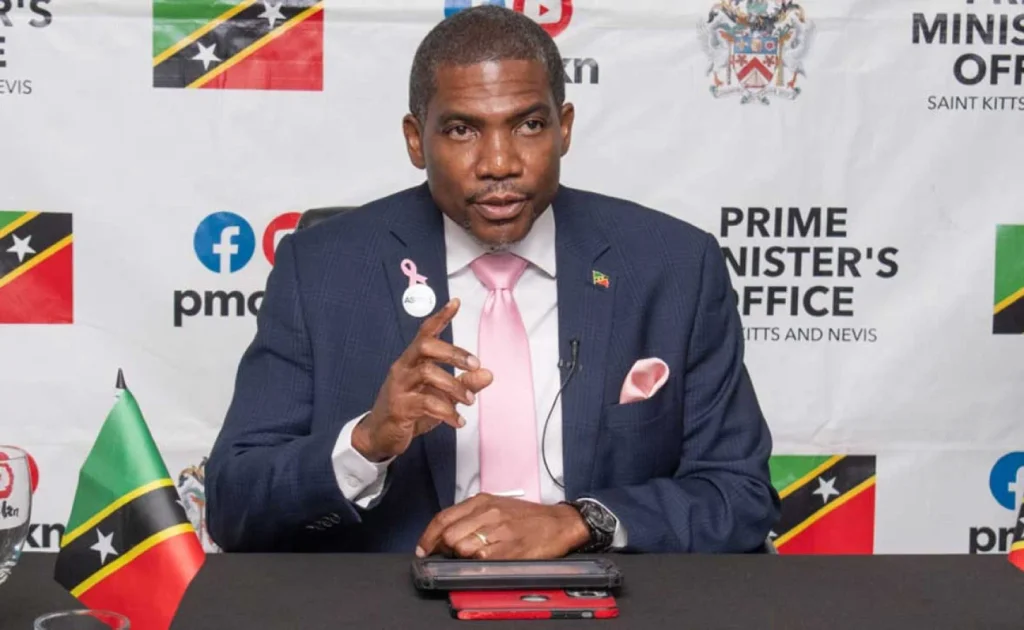
Mark Brantley, the Premier of Nevis and the federal Leader of the Opposition, told reporters in July that the EU was “hell-bent” on closing the region’s programs.
The Prime Minister warned that continued friction over CBI could expose the federation to closer scrutiny from international financial institutions and endanger its correspondent banking relationships, the accounts local banks maintain with foreign lenders to settle cross-border payments. A rupture of that kind, he said, could disrupt international transactions, remittances, credit card payments, and the ability of local businesses to pay for imported goods.
“No responsible leader would gamble with that. I will not gamble with that,” Drew told viewers.
He had previewed the argument at his November 5 roundtable, where he said the possibility of financial blacklisting warranted more attention than the risk to visa-free travel.
Applicants and agents
The government will not allow discounts or a rush to process applications before the program closes, Drew said.
“There will be no rush, no discounts, and no fire sale. Our citizenship will never again be sold cheaply on the basis of buyer meets seller,” he declared.
In 2025, the government revoked 13 citizenships and blacklisted two marketing firms after the Citizenship by Investment Unit (CIU) accused them of marketing citizenship “below statutory minimums.”
His closing remarks offered valedictory thanks to developers, agents, and service providers who had worked with the program in good faith. He also told investor citizens around the world that they remain welcome in the federation.
Those whose applications predate April 14, 2026, must complete biometric enrollment by July 31, 2027, under rules the CIU confirmed in March, or the federation will stop accepting their CBI passports for international travel.
CIU employees will continue working, Drew said, and the government will redeploy them to lead a renewed push for foreign direct investment (FDI), drawing on their experience with international investors.
Revenue record
Drew traced the program to the Citizenship Act of 1984, saying it first attracted buyers of second homes and government bonds before it expanded after the 2008 global financial crisis. CBI became a pillar of the economy once the federation shut down its sugar sector and turned to services.
The program generated approximately EC$6.5 billion (about US$2.4 billion at the Eastern Caribbean dollar’s fixed rate) between 2008 and 2025, about half of all the cash the federal government collected over the period, according to figures Drew presented.
That money helped pay for the federation’s recovery from the COVID-19 pandemic, along with roads, schools, affordable housing, and private developments such as the Park Hyatt hotel, he said. It is also helping to finance the new Basseterre High School and Creative Arts Center.
He conceded the attendant risk of dependence, warning that no country could guarantee indefinite demand for its citizenship. CBI’s share of government revenue fell from as much as 70% in 2022 to less than 20% in 2026, he said, a decline he attributed to diversification.
In an October 2024 national address, the same speech in which he disclosed a 60% fall in CBI revenue, Drew told the country that “the Saint Kitts and Nevis CBI program has been saved.”
On Friday, he credited his reforms with the US Treasury’s withdrawal in February of a 2014 Financial Crimes Enforcement Network (FinCEN) advisory on the program, and with regaining partial visa-free access to Canada.
IMF figures
Drew cited the International Monetary Fund’s (IMF) May 2026 assessment of the federation, saying the Fund found debt sustainability intact and the banking system broadly stable. He added that the IMF put CBI income at approximately 6% of gross domestic product (GDP) in 2025, and that the economy grew that year.
The same IMF report recorded a fiscal deficit that widened to 11.7% of GDP in 2025 as CBI revenue declined further. Public debt reached 58.4% of GDP, close to the 60% regional benchmark.
IMF staff counted CBI fees at 25.8% of GDP in 2022, against 5.3% in 2025. Their tables also project that general government deposits, the public sector’s cash buffer, will fall to 3.0% of GDP in 2026 from 31.0% in 2021.
Lower CBI receipts will require more careful management of public spending, the Prime Minister acknowledged, but he forswore tax increases and said the government would expand economic activity instead.
“Raising taxes is not part of that plan,” he said.
At the November 5 roundtable, Drew told reporters that his government had discussed bridging finance to manage the transition and hoped to bring CBI’s share of the budget below 10% in 2027.
Diversification plans
The government will accelerate its Sustainable Island State Agenda, Drew said, focusing on FDI, renewable energy, digital transformation, tourism, and the creative economy. Partners in that effort include the European Commission, Taiwan, the US, Ireland, Saudi Arabia, and Italy, as well as the Caribbean Development Bank, the Inter-American Development Bank, and the Green Climate Fund, according to Drew.
Those discussions cover the Nevis geothermal project, geothermal exploration on Saint Kitts, a proposed electricity link between the two islands, regional sea links, and new fiber-optic infrastructure. His talks with the Commission also addressed support under the EU’s Global Gateway Strategy for the federation’s economic transition, the Prime Minister said.
He met an EU delegation on November 12, the day before the address, to discuss geothermal energy and digital transformation.
Drew also pointed to the Sovereign Wealth and Resilience Fund, which the federation established through legislation in 2026, as a buffer against future economic shocks.
“For 20 years, part of our economy was built on the value of our past. The next 20 years will be built on the value of our people,” he said.
Regional responses
Antigua and Barbuda has offered to end its program by the end of 2030 if the EU helps fund the transition, and Saint Lucia’s Philip J. Pierre said on November 9 that his government had answered the Commission in writing without disclosing the letter.
Grenada’s newly re-elected Prime Minister Dickon Mitchell wants to “maintain both” CBI and Schengen access, and Dominica, which pledged on October 28 to “communicate further” with the EU by November 12, has not said publicly whether it did.