A decade ago, working out how to live and invest across borders meant relying on rumor, a handful of specialist contacts, and whatever a government happened to publish.
That problem is solved. Thresholds, processing times, and due diligence standards now sit in public databases, side-by-side comparison tables, and thousands of hours of free video.
The pressure behind the demand has climbed just as fast. Borders have tightened, tax authorities have grown less patient, financial reporting reaches further into private structures than it did five years ago, and the assumptions that held for a generation of internationally mobile families no longer hold.
IMI’s own research places American applicants among the largest buyer groups in the citizenship by investment (CBI) market, a position they did not hold three years ago.
Information, in other words, has become abundant. A plan that survives the next rule change has not.
The Part the Guides Skip
A second citizenship, a residence permit, an account in a foreign bank, a company in a third jurisdiction: each is documented at length in isolation. Difficulty arrives in the combination, and in the order the pieces are assembled.
Which steps apply, and when, depends on facts that shift household by household. Whether the applicant holds US citizenship, whether the capital sits in a corporate or a personal account, and whether the family intends to relocate or simply hold the option in reserve all push the answer in different directions.
Getting the sequence wrong is expensive. An investor who exits a qualifying investment on the wrong date can lose the residency and the tax treatment together, and neither is simple to recover once the filing is made.
Political risk sits on top of all of it. In December 2025, US Senator Bernie Moreno introduced a bill that would require American dual nationals to surrender one passport or the other, a proposal with long odds in committee, though its arrival told investors plenty about which way the conversation is drifting.
That is the case for building something durable rather than reactive. A structure assembled around one year’s rules tends not to survive the next set.
What a Room Does That a Search Bar Cannot
There is a difference between reading about a decision and spending four days among people who have already lived through one. The second produces the detail nobody writes down, the bank that turned them away, the accountant who missed a filing, the jurisdiction that looked ideal on paper and proved unworkable in practice.

This is the argument for a live event in a market saturated with free content. Information is cheap and everywhere; judgment about which piece of it applies to you remains scarce.
It is also the argument for a particular kind of event. The seminar circuit runs on inspiration, and inspiration is not what an investor needs when the question is where to file and by when.
Four Days in Cancun
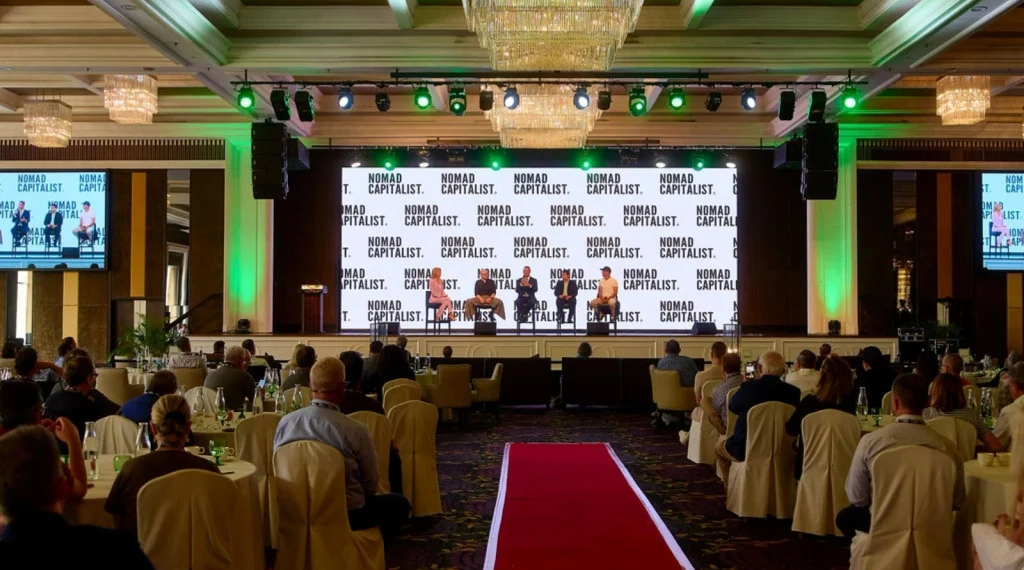
Nomad Capitalist Live runs November 4 to 7 at the Hilton Cancun All-Inclusive Resort, on a secluded stretch of the Mayan coastline. Resilience is the organizing theme this year, built on the view that the coming decade will reward the people who put durable structures in place early.
The program is organized around six areas that tend to arrive together in practice: wealth preservation, internationalization, mobility, strategic relocation, offshore structuring, and global opportunity. Guests tend to arrive mid-decision rather than merely curious, which sets the level the conversations run at.

More than 35 speakers are scheduled, drawn from politics, macro finance, and the practice of international structuring itself. Vicente Fox Quesada, former President of Mexico, and Kwasi Kwarteng, former UK Chancellor of the Exchequer, headline the political bench, while Mauricio Hoyos, chief executive and Shark Tank Colombia investor, delivers the keynote.
Danielle DiMartino Booth, a former Federal Reserve advisor, anchors the economics side alongside Doug Casey, Jeffrey Tucker, Lynette Zang, and global macro investor Jay Pelosky. Sohrab Ahmari, Cyrus Janssen, Eric Weiner, and Juan Pablo Escobar round out a program that leans as much on geopolitics as on tax.
Robert Kiyosaki, speaking after a previous edition, found he had “met more interesting people in a half day than in a year.”
What the Four Days Actually Look Like
Sessions run in 30-minute blocks across all four days, a format returning guests single out for keeping the pace up and the stage fresh. Between them, the schedule makes room for a welcome cocktail party, networking breakfasts and lunches, meet-and-greets with selected speakers, and a gala dinner.
A VIP tier adds private breakfasts with keynote speakers, a dedicated host making introductions, front-row seating, a lounge, and an extra half-day strategy session. The VIP allocation runs to 15 seats.
Guests are expected from more than 40 countries, which is the point. Useful conversations at an event like this tend to happen with someone whose home jurisdiction looks nothing like yours.
Booking
You can book directly through the event site, and four days in Cancun will put you in front of the people actually making these decisions rather than writing about them.
General admission covers every session across the four days, the welcome cocktail party, networking breakfasts and lunches, meet-and-greets with selected speakers, and the gala dinner. The VIP tier runs to 15 seats and adds private breakfasts with the keynote speakers, a host making introductions on your behalf, lounge access, and the half-day strategy session.
Both tiers are on sale now at nomadcapitalist.com/live. Booking for a group, or want to know exactly what a seat covers before you commit? The events team answers directly at live@nomadcapitalist.com.