Canadian citizens could win the right to live and work visa-free across the European Union, according to the Wall Street Journal. Two officials familiar with the matter told the paper that Prime Minister Mark Carney has pursued the question with EU leaders, most often with French President Emmanuel Macron.
That disclosure sat inside a broader Sunday report claiming Ottawa is exploring “associate member” status, a category that does not exist and that Brussels would have to invent. Denials followed within hours. Nobody denied the mobility discussions.
Freedom of movement inside the EU and the European Economic Area (EEA) attaches to nationality rather than to residence permits. Throughout, the paper’s account refers to Canadians, which would place Canadian citizenship rather than permanent residence at the center of any eventual arrangement.
Ottawa’s denial
Carney answered on the Toronto International Film Festival red carpet on Sunday evening. “We’re not looking to become a member of the European Union,” he told reporters, casting the objective instead as “a unique alliance between Canada and the European Union.” He put the grounds simply: “We share the same values, we have the same priorities, and we have very complementary strengths.”
Hours earlier, a senior government source had told CTV News the reporting overstates what is happening. Deeper engagement with Europe, that source said, builds on the framework the two sides launched at the 20th Canada-EU Summit in June 2025.

A second official, speaking to CBC News on a not-for-attribution basis, said Ottawa had weighed the “associate member” label among a few others and had not proposed it. Ottawa is not trying to trade independence for access, in that official’s account, and cares less about the label than about what deeper ties deliver. The Globe and Mail reported that Brussels put the term forward, and that naming the relationship at all is premature.
The mobility question
Carney has raised the prospect of visa-free living and working repeatedly, most often with Macron, on the account of the two officials the paper cited. Macron’s press office did not respond to a request for comment.
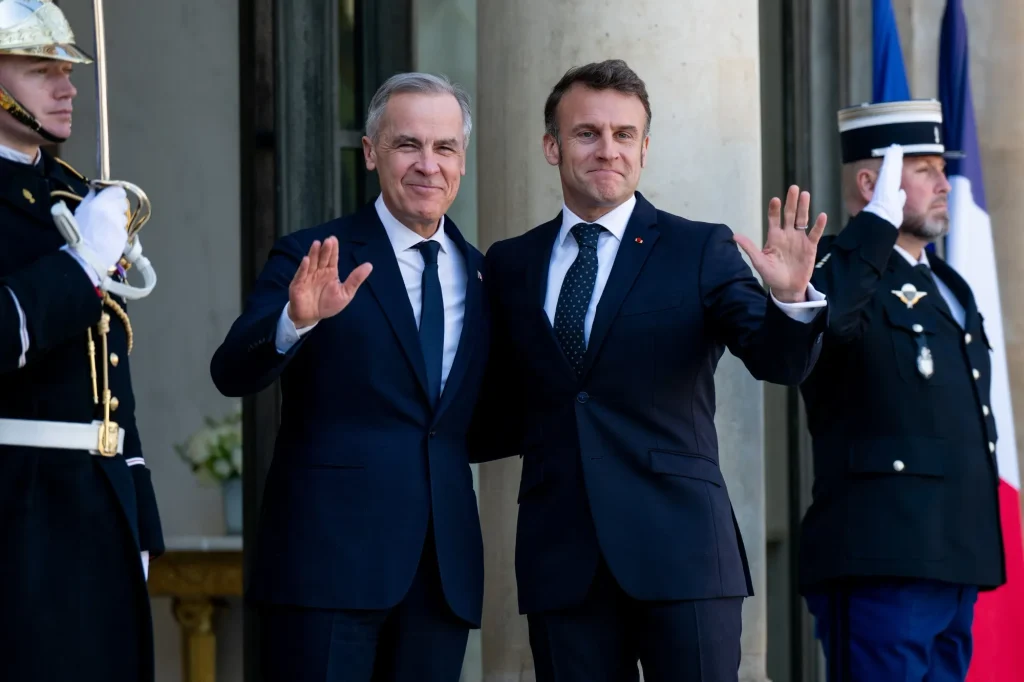
Talks on the wider relationship cover free movement of goods, services, and workers in strategic supply chains, among them energy, artificial intelligence, defense, and critical minerals. Shifting the EU border outward is how the paper characterized the intended effect.
Undersea cables, cloud storage, and satellite networks appear on the same agenda, alongside data centers the two sides would build together and infrastructure to carry Canadian energy to Europe. Neither side has agreed to any of it.
Charlie Maggi, founder and CEO of The Open World, reads the development as “politically significant, but still highly speculative.” Macron “cannot decide this alone,” in his account, and any arrangement “would require broader EU agreement.”
A narrower version looks likelier to him than a general one. “Some Canadians, particularly in strategic sectors, could eventually be allowed to live and work in the EU,” he says. Full access for all Canadians “seems unlikely in the short term.”
Brussels’ framing
Geneviève Tuts, the EU’s ambassador to Canada, sketched the shape of the future relationship five days before the report appeared. “What we have in mind is something different from what we have with other countries,” she told the Canadian Press. “That will be something unique.”
Tuts ruled out a copy of the bloc’s arrangements with Switzerland, Norway, or the United Kingdom, and expects the Strasbourg visit to open discussions rather than conclude a deal. Brussels would then consult the 27 member states, and Ottawa the provinces and territories.
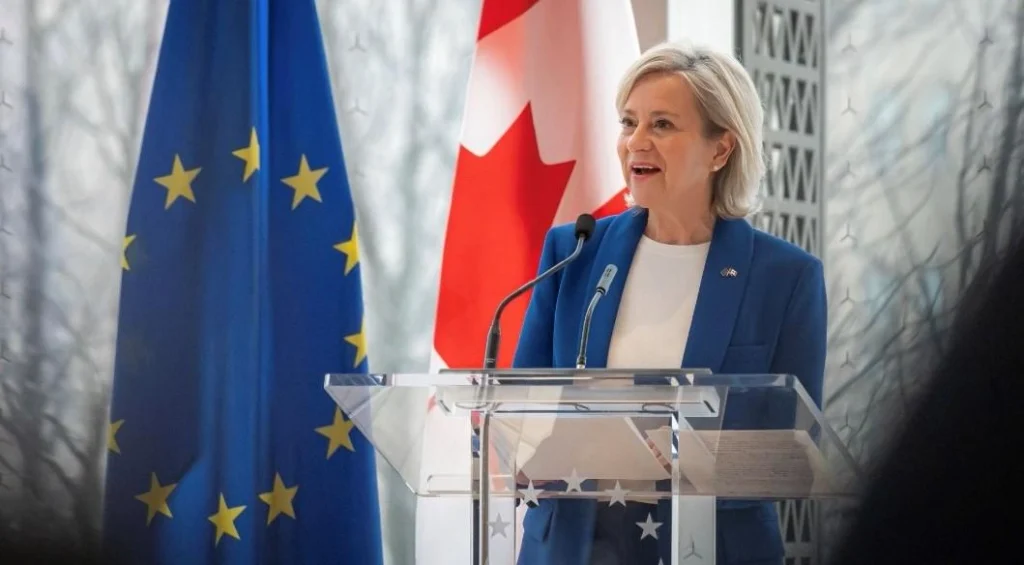
The European Parliament moved first. In March it adopted a resolution calling for deeper cooperation with Canada by 482 votes to 108, with 42 abstentions.
“Canada is perhaps the most European country outside Europe,” said the rapporteur, German member of the European Parliament Tobias Cremer. “And today, we can say it is more European than ever, because of our shared strategic interests and the common challenges we face.” He ended on a demand: “It is high time for this close strategic alignment to be translated into a deeper Euro-Canadian alliance.”
Finnish President Alexander Stubb, who speaks with Carney regularly, raised the idea in June at Eurelectric’s Power Summit, in a speech arguing for a larger European Union. “Wouldn’t it be lovely if Canada was the 28th state of the European Union rather than the 51st state of the United States,” Stubb said.
The itinerary
The prime minister’s office has him in Strasbourg and Liverpool from September 15 to 17. European Parliament President Roberta Metsola issued the invitation to address the chamber.
He will also attend European Commission President Ursula von der Leyen’s State of the European Union address. In Liverpool, he meets UK Prime Minister Andy Burnham for the first time.
Carney framed the trip in the release announcing it: “In a more dangerous and divided world, Canada and our European partners are moving ever closer.” Shared values, complementary strengths, and common interests amount, in that statement, to “the strong foundation on which we can build a stronger future.”
Saint-Pierre-et-Miquelon, the French archipelago off Newfoundland, hosts Carney and Macron on September 20, in a first for a sitting Canadian prime minister. “Canada and France share more than a border,” Carney said in that announcement, naming artificial intelligence, critical minerals, and energy as the areas to deepen.
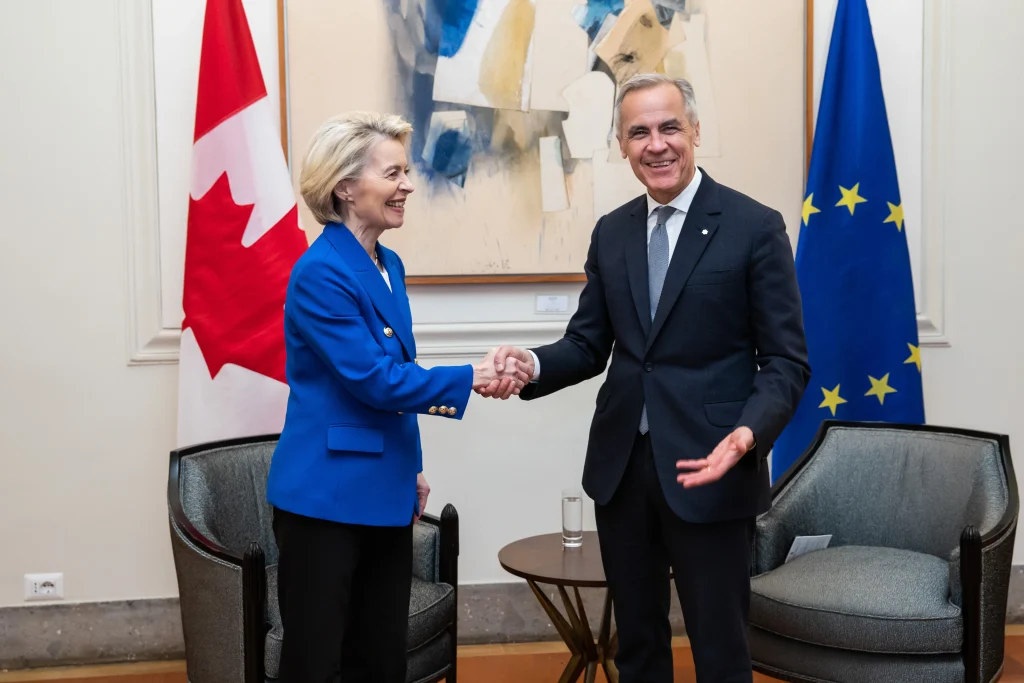
Macron’s office cast the stop as a symbol of “the strength of the relationship that unites our two countries.” Ottawa then hosts the Canada-EU Summit on October 29 and 30.
Already built
February brought Canada into the EU’s Security Action for Europe (SAFE) initiative on the margins of the Munich Security Conference, the first non-European country to join. Bilateral trade in goods and services reached approximately C$178 billion in 2025. That makes the EU Canada’s second-largest trading partner, and its second-largest source of foreign direct investment after the United States.
The Comprehensive Economic and Trade Agreement (CETA), by contrast, has governed most tariff-free Canada-EU trade only provisionally since 2017. Ten member states had still not ratified it when Parliament voted in March, and the resolution urged them to move before the deal’s tenth anniversary in 2027.
Serhan Aysever, managing partner at Beyond Global Partners, puts the constraint on the European side. “Getting 27 EU Member States to agree on and ratify a framework is no small task,” he says.
On his reading, any such arrangement would require “a significant policy shift around free movement, residence and employment rights for a non-EU country.” Moving from political ambition to a legally binding, EU-wide deal would take “a serious and potentially lengthy policy process.”
Domestic resistance
Conservative leader Pierre Poilievre attacked the report on X. “Mark Carney could not be more out of touch,” he wrote.
Poilievre asked whether European border policies would apply in Canada and whether small businesses would end up “buried under the red tape of Eurocrats.” Sovereignty was his real target: “The Welland welder did not elect a Eurocrat to regulate our steel.”
His closing line left no ambiguity: “We will NEVER be the 51st U.S. state. And we will NEVER be the 28th EU state.” He would put those questions to the government directly, except that the House of Commons sits in recess until September 21.
Achim Hurrelmann of Carleton University’s Centre for European Studies is “not really sure if the substance will actually justify the new label.” A March survey of 4,000 respondents by Spark Advocacy found one in four Canadians considered formal EU membership a good idea, with a further 58% calling it worth exploring. The poll ran online and therefore carries no margin of error.
The passport
Broader rights to live and work across the EU would “significantly enhance the value of the Canadian passport,” in Aysever’s assessment. That would make Canadian citizenship “even more attractive to internationally mobile families and investors.”
Canadian naturalization currently requires 1,095 days of physical presence within a rolling five-year window, alongside tax filings and proficiency in English or French. Nothing in the reporting so far addresses whether any mobility right would extend to permanent residents as well as citizens.