The heads of government of the five Eastern Caribbean states operating citizenship by investment (CBI) programs met in Roseau, Dominica, on July 10 and agreed to send a high-level mission to Brussels.
Their joint statement is the region’s first collective response since the European Commission wrote to all five demanding a phase-out of their programs by June 1, 2028.
Dominica’s Prime Minister, Roosevelt Skerrit, chaired the meeting, joined by Philip J. Pierre of Saint Lucia, Gaston Browne of Antigua & Barbuda, Dickon Mitchell of Grenada, and Dr. Terrance Drew of Saint Kitts & Nevis. Godwin Friday of Saint Vincent and the Grenadines, whose government plans to launch its own CBI program this year, also attended.
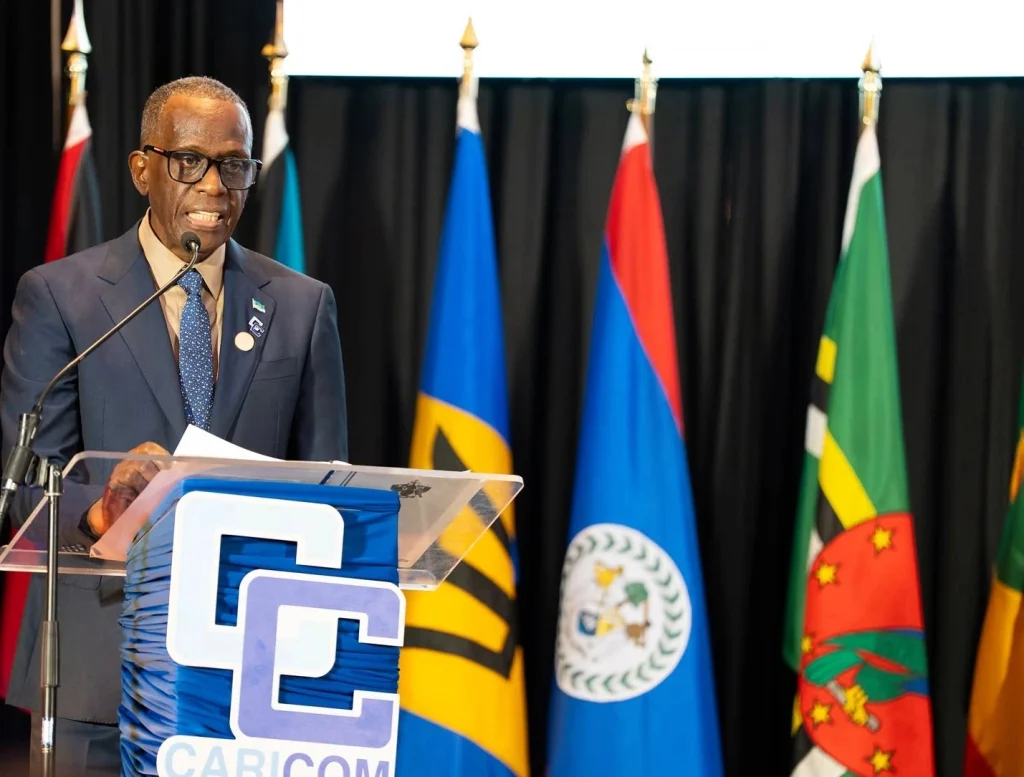
Published through Dominica’s Office of the Prime Minister, the statement commits the leaders to “a high-level mission to Brussels at the earliest appropriate opportunity” to engage directly with the presidents of the European Commission and the European Council and with the EU’s High Representative for Foreign Affairs and Security Policy. A coordinated outreach program to “key European capitals” will run alongside it.
Foreign ministers, ministers responsible for CBI, ambassadors, and senior officials received instructions to coordinate closely and to present “a unified regional position in all engagements with European counterparts.”

Replacement Revenues as the Price of Any Wind-Down
CBI programs, the leaders noted, “have become an important pillar of economic resilience and development financing for small island developing states.” The statement credits program revenues with funding climate resilience, disaster recovery, infrastructure, and fiscal stability while reducing dependence on what it calls “unsustainable borrowing.”
Their core demand follows from that framing. “Any transition affecting a significant source of national development financing must be accompanied by a comprehensive framework that safeguards economic stability, protects development gains already achieved, and supports the creation of sustainable alternative sources of financing,” the leaders write.

Talks with Brussels, the leaders agreed, should also cover “enhanced development cooperation, strategic investment partnerships, climate resilience financing, economic diversification initiatives,” and other measures capable of “facilitating any future arrangements that may be agreed between the parties.”
That position echoes Antigua & Barbuda’s complaint last week that no EU offer to date is “quantified, binding, or explicitly framed as replacement revenues.”
What the Statement Does Not Say
Nowhere does the text mention the June 1, 2028 date, the Schengen area, or the interim vetting measures the Commission’s letters reportedly require by September 2026. Absent, too, is any echo of Browne’s declaration that Antigua & Barbuda “will not be pressured” into a unilateral phase-out.
Its register stays conciliatory throughout. The leaders “welcome the European Commission’s commitment to continued engagement and technical dialogue” and want any future framework guided by “proportionality, partnership, shared responsibility, and sustainable development.”

Solutions, they write, should reflect “the legitimate policy objectives of the European Union” alongside the development needs of small island states; their closing line expresses confidence that “balanced and durable solutions can be achieved.”
Read as a negotiating document, the statement contests the terms of a transition, not the premise of one.
Six Months of Escalation
Brussels’ revised visa suspension mechanism entered into force on December 30, 2025, adding the operation of investor citizenship programs to the grounds for suspending a country’s visa waiver.
In its eighth report under the mechanism, published that same month, the Commission stated that Caribbean programs constitute a suspension ground in themselves and urged tighter vetting “pending the discontinuation” of the programs.
Letters signed by Magnus Brunner, the EU Commissioner for Internal Affairs and Migration, followed on June 25, offering a 24-month transition period. Antigua & Barbuda was the first to confirm receipt publicly, saying all five CBI states received similar correspondence.
Responses will feed into the Commission’s next visa suspension mechanism report, planned for December 2026. Meanwhile, the leaders rehearse a reform record spanning due diligence, information sharing, and transparency, pointing to the regional regulator they established as evidence of “harmonized regulation, enhanced compliance, and continuous improvement” across the five programs.
Friday’s presence in Roseau carries its own signal. The joint statement lists him apart from the five “participating” states, yet the leader planning to enter the CBI market attended the region’s first summit on the EU’s demand to exit it.