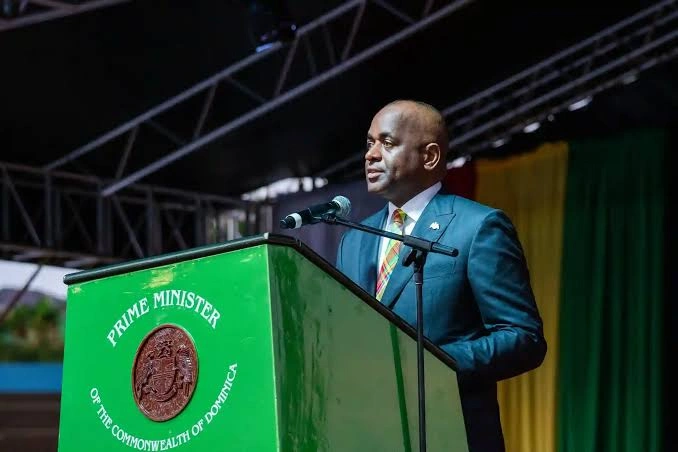
Dominica’s Prime Minister Roosevelt Skerrit wants the Eastern Caribbean delegation in Brussels before the end of September. Speaking at a news conference in Roseau on Wednesday, he told reporters that no date has been fixed.
The plan, Skerrit told reporters in remarks carried by the Caribbean Media Corporation (CMC), was “to have a meeting towards the end of September,” though “we haven’t pinned down the date.” He added that the matter had been discussed with the European Commission and with its president, Ursula von der Leyen.
What the delegation is for
Meeting in Roseau on July 10, the five heads of government agreed to send a high-level mission to Brussels “at the earliest appropriate opportunity.” Their joint statement named three counterparts: The presidents of the European Commission and the European Council, plus the High Representative of the Union for Foreign Affairs and Security Policy.
What the delegation would carry was set out in the same text. Engagements would seek to convey “the unique vulnerabilities and development realities of small island developing states,” and to reach “practical and mutually beneficial solutions to the issues identified by the European Union.”
Behind that meeting sits a letter dated June 25 from Magnus Brunner, the EU Commissioner for Internal Affairs and Migration. It asked Antigua & Barbuda to wind down its citizenship by investment (CBI) program by June 1, 2028, and offered a 24-month transition. Antigua published its copy on July 7, and the other four governments have not published theirs.

September’s other deadlines
Interim measures fall due this month under the Commission’s letter. Two were specified: Full exclusion of applicants subject to EU restrictive measures, and reinforced vetting for applicants of all nationalities.
The regional regulator is due in the same window. At its 113th meeting on July 10, the Eastern Caribbean Central Bank’s Monetary Council recorded that the Eastern Caribbean Citizenship by Investment Regulatory Authority (ECCIRA) remained on track for a September launch. Grenada hosts its headquarters.
Responses to the phase-out request feed into the Commission’s next report under the visa suspension mechanism, expected in December. That report, rather than the 2028 deadline, is what the delegation is racing.
A warmer account than the neighbors give
Skerrit’s description of the relationship ran generous throughout. He wanted “to publicly thank the European Commission,” whose officials have been “very respectful, I must say.”
Brussels, in his account, grasps what the programs are worth. Officials there understand “the importance of the CBI programme to our economies,” and have approached the matter “from that perspective.”
Friction has not gone, and he did not pretend otherwise. The Commission retains “certain concerns,” and the five will “continue to sit down with them” to address those, over an exchange he called “profoundly mutually respectful.”
Colleagues elsewhere in the region have chosen sharper words. Saint Lucia’s Deputy Prime Minister, Ernest Hilaire, detected “a change in the mood of the Commission” in July, from wanting the programs fixed to wanting them ended. Nevis Premier Mark Brantley put it flatly: “They are hell-bent on closing down these programs.”

The sixth name on the list
CMC’s wire copy has counted six leaders, Saint Vincent and the Grenadines included. That country operates no CBI program, at least not yet.
Prime Minister Godwin Friday did attend the Roseau meeting. July’s joint statement listed him apart from the five “participating” states, and his government has said it intends to launch a program of its own.
The rule Brussels is invoking
Regulation (EU) 2025/2441 appeared in the Official Journal on December 10, 2025 and took effect 20 days later. It makes the operation of an investor citizenship program a self-standing ground for suspending visa-free access to the Schengen Area. How well a program is run is beside the point.
Both of September’s items sit inside the region’s own control. Governments can tighten vetting and stand up a regulator on their own timetable. The meeting that would let them argue the rest is a slot in someone else’s diary, and it is still empty.