

Spain’s Congress of Deputies on Thursday approved a bill granting Spanish nationality, and with it EU citizenship, to people born in Western Sahara while the territory was under Spanish administration. The vote passed 168 to 31 with 145 abstentions, and the text now moves to the Senate.
Estimates of the eligible population start at roughly 70,000 and approach 200,000 once descendants are counted. Western Sahara itself has about 610,000 residents, though many prospective applicants live in the Tindouf refugee camps in Algeria or elsewhere in the diaspora.
How the Law Would Work
The text declares that “exceptional circumstances” justify granting nationality by carta de naturaleza, Spain’s discretionary naturalization route, to anyone born in Western Sahara before September 29, 1977. That was the deadline of a one-year window, opened by decree after Spain’s withdrawal from the territory, for Sahrawis to opt for Spanish nationality; the new bill covers everyone born before it closed.
No legal residence in Spain is required, applications are free of charge, and authorities must resolve them within a year, under the bill.

Applicants can prove eligibility with a Spanish national identity document, even an expired one, a UN-authenticated receipt from the census compiled for the never-held independence referendum, a birth certificate, or paperwork issued by the colonial administration.

Softer evidence, including school records, pension documents, and medical files, is also admissible.
First-degree descendants of those who obtain nationality will have five years to opt in, counted from the parent’s registration in the Civil Registry. Grandchildren are excluded. The application window runs three years from entry into force, extendable by one more, and the law takes effect four months after publication in the Official State Gazette (BOE).
A second, permanent change amends Article 22.1 of the Civil Code so that any Sahrawi can naturalize after two years of legal residence rather than ten.
That places them in the same fast-track cohort as nationals of Ibero-American countries, Andorra, the Philippines, Equatorial Guinea, and Portugal, along with Sephardic Jews.
Part of a Pattern
Spain has spent a decade widening access to its nationality. Law 12/2015 opened citizenship to descendants of Sephardic Jews expelled in 1492, and the 2022 Democratic Memory Law did the same for descendants of Civil War and Franco-era exiles before its application window closed in October 2025.
This spring, the government launched a regularization that has drawn some 900,000 applications from undocumented residents, roughly double its own forecast.
Naturalization data show the cumulative effect. According to the National Statistics Institute, a record 299,732 foreign residents acquired Spanish nationality in 2025, up 18.7% year on year, with Moroccans (42,114) the largest group ahead of Colombians (37,712) and Venezuelans (36,271).
Spain was already the EU’s most prolific granter of citizenship in 2023, accounting for 22.9% of the bloc’s total, according to EU data.
Alexander Osetinskiy, partner at Valencia-based PRO-Relocation, reads the Sahrawi bill as a continuation of that arc, calling it “in line with the previous Spanish legislation, especially the Ley de Memoria Democrática,” which opened paths to nationality for descendants of those “forced to leave the country after the civil war” and for children of Spanish women who lost their citizenship by marrying abroad.
Ceuta, Morocco, and the Politics of Timing
Sumar, the junior partner in Pedro Sánchez’s coalition, drove the initiative; the governing Socialist Party (PSOE) initially rejected it before negotiating the final wording. The People’s Party (PP) abstained, arguing that Sahrawis should naturalize through the two-year residency route rather than carta de naturaleza, while far-right party Vox cast the only votes against, rejecting what it called a giveaway of nationality.
Tesh Sidi, a Sumar deputy born in the Tindouf camps and the first woman of Sahrawi origin to serve in the chamber, championed the text and framed the vote as ending a half-century of “legal and juridical limbo.”

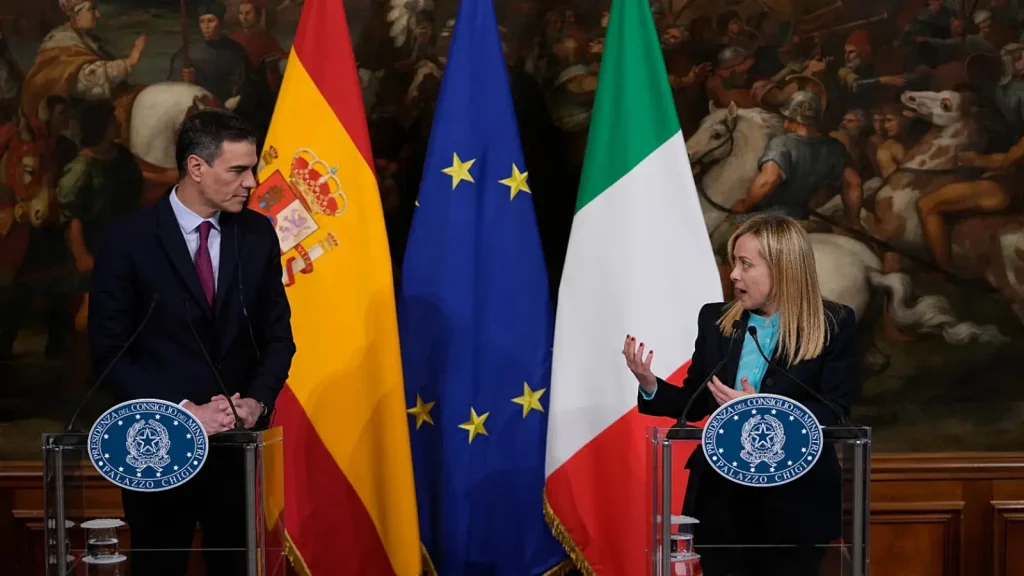
Thursday’s vote landed at the lowest point in Madrid-Rabat relations in years. In late July, more than 70,000 people crossed into the Spanish exclave of Ceuta over two days, dozens died in the attempt, and thousands remain there, an episode that also opened a rift between Madrid and Italy’s government, among other EU capitals.
Morocco, which claims sovereignty over Western Sahara and has stayed officially silent on the bill thus far, recently declared that no evidence links its authorities to the Ceuta crossings and that it will not serve as a “scapegoat” for Spanish party disputes.
Osetinskiy describes the political fault line in similar terms. The governing left presents the law as a “restoration of justice” remedying wrongs by earlier Spanish governments, he observes, while the opposition sees “an attempt to blur their voting base and fill Spain with new citizens who would tend to vote for the left.”

The bill also sits awkwardly with Spain’s own foreign policy. Madrid abandoned decades of neutrality on Western Sahara in 2022, endorsing Morocco’s autonomy plan for the territory, and PP speakers used the floor debate to demand an explanation of how mass naturalization of Sahrawis squares with that pivot.
The EU Dimension
Every passport issued under this law is also an EU passport, carrying the right to live and work anywhere in the bloc. Nationality remains a national competence, so no other capital gets a vote, yet all 26 other member states must absorb the consequences of Madrid’s decision.
The timing sharpens that tension. Spain’s partners, Italy loudest among them, are still at odds with Madrid over the handling of the Ceuta crisis, and a large new cohort of EU citizens originating from a disputed African territory hands those critics fresh ammunition.
Osetinskiy sees the friction building, warning the law “might become a trigger to even more active illegal immigration” toward Spain and other EU territories from Africa, with friction already visible in Italy’s and other member states’ reaction to Ceuta.
He frames the risk in the language the European Court of Justice (ECJ) used in its 2025 Malta ruling: that EU citizenship rests on a “special relationship of solidarity and good faith” among member states and a “genuine link” between citizen and country.
By “gradually expanding the grounds to obtain Spanish nationality to different groups of people who do not have any genuine relation with Spain,” he argues, the country “comes very close to undermining” that solidarity.
Unlike descendants of Civil War exiles, he adds, most Sahrawis neither held full citizen rights under the dictatorship nor were ethnically Spanish.
What Happens Next
The Senate takes up the text now, and the arithmetic there favors the opposition: the PP controls 141 of the chamber’s 266 seats, seven above the absolute-majority threshold, meaning it can amend or veto the bill without a single ally.

The Senate’s power is somewhat limited, since Congress can override a Senate veto with an absolute majority of its own, so upper-house resistance can delay the law rather than kill it.
Litigation looks like the likelier battlefield. On the day of the vote, Spain’s Supreme Court provisionally suspended the voting rights of certain citizens naturalized under the Democratic Memory Law, following a challenge by Vox and the group Iustitia Europa, unless they prove their families suffered exile.
Osetinskiy considers the chance of enactment “substantial,” though he views it as too early to say whether the European Commission would take issue with the law.
For now, tens of thousands of Sahrawis are possibly four months and one Senate reading away from an EU passport.



