

For generations, Europeans crossed the Atlantic in search of the American Dream. Today, that journey is beginning to reverse.
Millions of Americans are opening long-forgotten family archives, tracing ancestral villages, and rediscovering the stories, identities, and homelands that history once pushed into the shadows. In the process, many are realizing that the new American Dream may no longer lie only in moving forward, but also in looking back.
Back to Europe. Back to their roots. Back to the countries once sealed behind the Iron Curtain.
For far too long, second citizenship has looked like a privilege reserved for the wealthy. Most Americans still assume that obtaining another citizenship requires a seven-figure investment, participation in a complex residence program, or years spent living abroad.
Yet millions may already have a claim to European Union citizenship without making any such investment.
The asset is hiding in their family tree.
Slovakia is one of the clearest examples, and one of the most overlooked. This is not a niche opportunity measured in the thousands or even the hundreds of thousands. More than two million Americans may already qualify through their Slovak ancestry.
In 1990, the US Census recorded 1,882,897 Americans of Slovak ancestry. Later counts are lower, but they are not measuring the same thing. Slovak appeared as a printed example on the 1990 ancestry question and was dropped from the examples afterward, which shaped how many people wrote it down.
Those 1.9 million people did not disappear. Their children, grandchildren, and great-grandchildren still carry the ancestry, the surnames, and the family records, and smaller waves of Slovak immigration have arrived in the 36 years since. Because Slovak citizenship law now reaches great-grandchildren, the number of potentially eligible Americans is likely well above two million.
The eligibility test is usually straightforward, even when the family history is not.
A family’s connection may have survived migration, assimilation, name changes, war, communism, and the passage of time. Families may have lost the language, the documents, and even the memory of where their ancestors came from.
Yet legally, that connection may still be alive.
An applicant may qualify if at least one parent, grandparent, or great-grandparent was a Czechoslovak citizen born in the territory of present-day Slovakia. Applicants must also document the direct family line through official records and provide proof that the ancestor held Czechoslovak citizenship.
Documenting that line takes time. Citizenship certificates are issued on average within 12 months of submission, and some files have closed in six.
Removing the residence permit step should shorten that further, because the ministry no longer waits on a second institution before it can decide.
Where an ancestor left before Czechoslovakia existed, the applicant carries the burden of showing why that person can nevertheless be read in law as having held Czechoslovak citizenship. Each such case turns on its own historical circumstances and on what the archives can be made to yield.
Jonathan Lukča, a Canadian in Montreal, qualified through his grandfather, born in the eastern village of Holčíkovce. What finally closed the evidentiary chain was an original domovský list, the certificate of domicile that Czechoslovak administration used to record where a person legally belonged. From his first appointment in Ottawa to passports in his children’s hands took a little over 18 months.
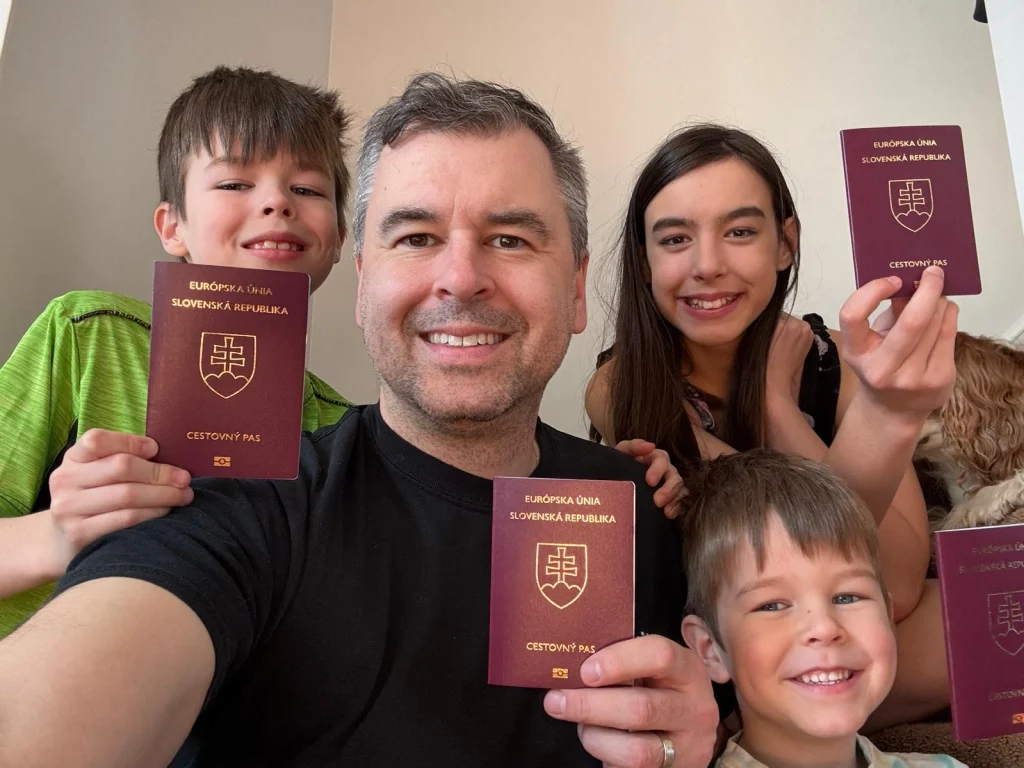
“Looking back, I realize this journey was never just about legal documents or passports,” he says. “It was also about teaching my children that their Slovak story didn’t begin with me, but in the small villages of Slovakia, in the dreams and sacrifices of their ancestors.”
He wanted to open doors, in his words, “doors that we may never walk through, but the possibilities are there and almost endless.”
How proof of demand changed the law
This pathway exists because of the historic amendment to Slovakia’s Citizenship Act that took effect on April 1, 2022. Before then, descendants could be culturally Slovak, historically Slovak, and deeply connected to the country, yet remain largely invisible in the eyes of the law.
That reform did not happen by accident. I championed it.
For nearly two years I worked with a small but fiercely committed team, advocating for legislative change and mobilizing Slovak descendants around the world.
We educated families, brought their stories into the national conversation, and built a global campaign that could no longer be ignored. Thousands signed our petition. Hundreds of Slovak descendants wrote directly to the prime minister, calling on the government to recognize families separated from Slovakia by migration, war, communism, and time.
In the Slovak Parliament, we presented the case to members of both the governing coalition and the opposition. Ministries, researchers at the Slovak Academy of Sciences, other stakeholders, and journalists at home and abroad all heard the same argument.
This became a sustained campaign to change not only the law, but also the way Slovakia understood its diaspora.
Our argument was simple: Slovak descendants are not strangers to Slovakia. They are part of its extended national family, a bridge to the wider world, and one of the country’s greatest yet most neglected assets.
The April 2022 amendment was far more than a technical legal change. It reopened the door. For the first time, many great-grandchildren of Slovak emigrants could apply for Slovak citizenship and, with it, gain full citizenship of the European Union.
Four years later, Slovakia took the next important step.

On July 15, 2026, a further amendment came into force, removing one of the most tedious bureaucratic barriers from the process. Eligible descendants are no longer required to obtain a Slovak residence permit before applying for citizenship.
That same amendment also writes the evidentiary standard into the law: Applicants must now produce a document or certificate proving that the ancestor held Czechoslovak citizenship. Responsibility now sits entirely with the Ministry of the Interior, and the Immigration Police play no further role.
This change matters not only because it simplifies the procedure, but also because of what it reveals about Slovakia’s evolving relationship with its global diaspora. The Slovak government and public administration increasingly recognize that this community is not a burden on the state, but an enormous source of value.
These descendants bring knowledge, networks, investment, professional expertise, and a genuine desire to contribute. Reconnecting with them is not only an act of historical justice. It is a strategic opportunity for Slovakia.
How it works, what it costs
Malta’s former citizenship-by-investment program placed a visible market benchmark of roughly US$1 million on access to European Union citizenship once its financial and related requirements were considered. Descent carries no equivalent price.
There are still costs associated with archival research, civil records, certified translations, apostilles, and government fees. But there is no million-dollar contribution and no mandatory property purchase.
The principal investment is proving who your family was.
A Slovak passport is not simply a better travel document. Its holder becomes a citizen of the European Union, with the right to live, work, study, and establish a business across the bloc.
For an American family, that can mean European universities, employment without visa sponsorship, and the option to relocate when economic or political circumstances at home change.
People begin this journey in search of a passport and emerge with a new understanding of themselves. The application leads them into archives, ancestral villages, family stories, language, history, and identity.
And this is not only a Slovak story. Millions of Americans with Irish, Polish, Hungarian, Croatian, German, and other European roots may possess citizenship rights they have never explored.
Several European countries extend citizenship to grandchildren, great-grandchildren, and in some cases more distant descendants. That direction of travel is not uniform, though. Italy narrowed its own descent pathway in 2025.
Many Americans already hold a claim they have never checked. Proof of it is sitting in the family archive.
The passport that matters most may be the one their family already left behind.
Images supplied by the author and published with the consent of those pictured.



