
There is a simple test every golden visa investment should face. Strip away the residency permit and ask whether the investment stands on its own: would you buy it purely for the returns, the liquidity, and the structure? Most investors never ask, because the residency benefit tends to dominate the decision.
It is easy to see why. For most applicants, the residence card is the whole point: the backup plan, the children’s schooling options, the freedom to move. Against those stakes, the investment vehicle underneath can feel like a formality.
But €500,000, the minimum for most Portuguese golden visa routes, is not a formality. Deployed well, it could compound for years. Deployed carelessly, it becomes an expensive admission ticket, and the investor spends the next decade pretending not to notice.
The Portugal Golden Opportunities Fund by Optimize Investment Partners passes the test on its numbers alone, and those numbers are worth walking through in some detail.
The Numbers Work, Even Without the Visa
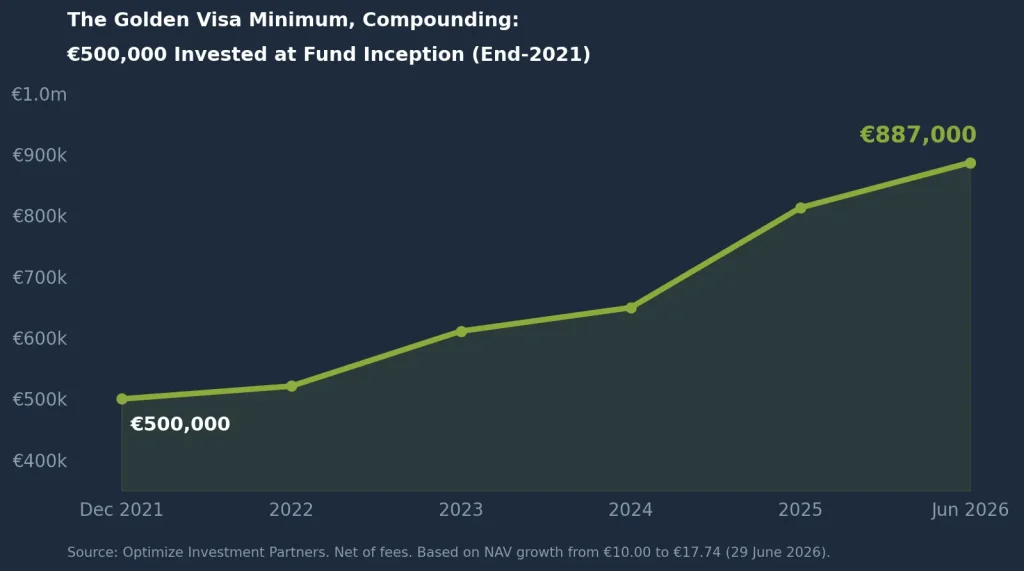
Since its inception at the end of 2021, the fund, rated risk level 4, has delivered a net annualized return of 13.6%*, outperforming the S&P 500 over the same period.
That comparison matters because the S&P 500 is precisely the benchmark most international investors would default to if the visa were not part of the equation.

The shorter horizons tell the same story. Year-to-date in 2026, the fund is up 9.1%; over the trailing 12 months, 17.6%; over 36 months, 15.9% annualized.
All figures are net of management, deposit, audit, and supervisory fees, and the fund carries a risk level of 4 on a scale of 1 to 7, placing it in the moderate risk band.*
Perhaps the plainest way to read the record is through the unit price itself. A unit that launched at €10 at the end of 2021 was worth €17.74 on 29 June 2026, and assets under management have grown to €414.8 million along the way.
What the Portfolio Actually Holds
Behind those returns sits a portfolio of listed Portuguese companies rather than the private, hard-to-value assets that populate much of the golden visa fund market.
The fund invests 80% to 100% of its assets in Portuguese-domiciled companies traded on public markets, with at least 60% in equities and the remainder in bonds. Real estate exposure is zero.
The names are familiar to anyone who follows the Lisbon exchange. As of 29 June 2026, the leading holdings were Mota-Engil (9.7%), BCP (8.5%), Galp (7.5%), CTT (5.5%), and Sonae (4.8%).
Sector weightings as of the same date spread the risk across financials (21.7%), industrials (21.5%), utilities (12.5%), materials (11.2%), and energy (9.9%). Both holdings and allocations may change over time.
Notably, approximately half of the fund’s investors are Portuguese; domestic investors with no golden visa to gain, holding the fund purely on its investment merits.
A Lisbon-based team actively manages the portfolio, drawing on direct market knowledge from operating in the markets it invests in. The results have drawn recognition beyond the performance tables, with the Portugal Golden Opportunities Fund winning the Euronext Lisbon Awards in both 2025 and 2026.
Why the Structure Matters as Much as the Returns
Returns attract attention, but structure determines whether investors can actually act on them. Here, the fund departs most sharply from the alternatives.
It is open-ended, with no lock-up period and no redemption fee. Subscriptions and redemptions process daily, settlement completes within five business days, and the portfolio prices daily on both Morningstar and the Financial Times markets platform with full holdings transparency.
Golden visa investors accustomed to five-year lock-ups and quarterly reporting windows will recognize how unusual that combination is in this market.
Regulation adds a further layer. The fund is a UCITS vehicle supervised by the Portuguese Securities Market Commission (CMVM), and it is the only Portuguese golden visa-qualifying fund registered with the U.S. Securities and Exchange Commission.
American investors can even subscribe through an Individual Retirement Account without an LLC structure, removing a complication that has long made European fund participation cumbersome for US taxpayers.
The Diversification Case
For investors who already hold broad US and European index exposure, Portugal’s listed market offers something genuinely distinct. It is not a proxy for the S&P 500 or the Euro Stoxx 50; it carries different sector weights, different macro sensitivities, and different correlation properties, which is exactly what a diversifying allocation is supposed to do.
The fund’s outperformance of the S&P 500 since inception is evidence that the thesis is working in practice rather than a prediction about what Portuguese equities will do next.
Four years is a limited window by investment standards, but it spanned meaningful global volatility and geopolitical uncertainty, and the record stands.
The Golden Visa Benefit, For Those Who Want It
None of this erases the residency case; it simply reorders it. An investment of €500,000 or more qualifies for Portugal’s golden visa program, offering a path to permanent residency after five years, Schengen visa-free travel, the right to live and work in Portugal, and the inclusion of family members.
The Portuguese passport, which covers 191 countries, follows after ten years for most nationalities, and physical presence requirements remain seven days per year.
Investors who want the residency benefit alongside the investment get both in one vehicle. Those who want only the investment can access the fund from €1,000.
Neither use case needs the other to justify it. That is the test, and this fund is one of the few in the market that passes it.
Get in touch with Optimize Investment Partners to learn more.
*Past performance is not necessarily a guide to future performance. The value of the shares can increase or decrease depending on the risk level that varies between 1 (minimum risk) and 7 (maximum risk). The fund’s Prospectus and the Sub-funds KIIDs are available on the commercializing entities. The returns mentioned are net of management and deposit fees, audit costs and supervisory fee. The figures disclosed imply the taxation borne by the collective investment undertaking and the eventual payment of capital gains tax are investors responsibility. Investing in the collective investment undertaking may result in the loss of invested capital. The disclosed annualized performance measures, calculated based on a period exceeding one year, would only be obtained if the investment was made during the entire reference period. Data last updated on June 29, 2026.