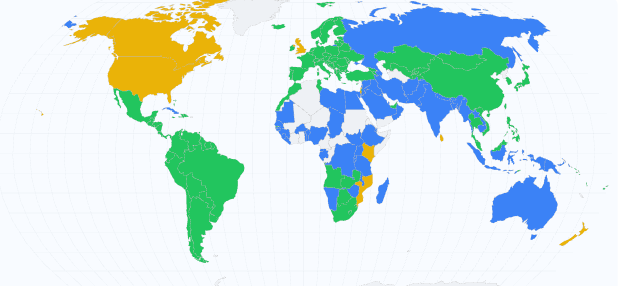
It’s easy to assume citizenship works like a membership: stop wanting it, hand back the card. In reality, no country lets you simply walk away. Renunciation is a formal legal act, and depending on the passport involved, it ranges from a modest administrative errand to possibly one of the most expensive transactions of a person’s life.
The exit door is having a consequential decade. In April 2026, the United States cut its renunciation fee by 81%, from US$2,350 to US$450, ending years of litigation over the world’s most expensive goodbye.
Two years earlier, Germany moved in the same direction from the opposite end, abolishing the renunciation requirement for naturalizing immigrants altogether.
A few rules hold everywhere. Renunciation must be voluntary, formal, and made to the state being left, not merely implied by acquiring another passport. Nearly every country refuses to process it unless the applicant already holds, or is about to receive, another nationality, a safeguard against statelessness rooted in the postwar international convention. And it is, with narrow exceptions, permanent.
From there, national approaches diverge into five recognizable patterns.

The Taxed Exit: The United States

No country monetizes departure like the United States, the only major economy that taxes its citizens wherever they live. Leaving the tax net, therefore, means leaving the citizenship, and the state has built a tollbooth at the door.
The process itself is deliberately weighty. Renunciation can only happen in person at an embassy or consulate outside the United States, typically across two separate interviews, ending in a sworn oath before a consular officer.
The file then travels to Washington for review before a Certificate of Loss of Nationality is issued, a document former citizens need for everything from visa applications to closing out their banking obligations, and one that can take months to arrive. Some posts carry appointment backlogs of a year or more.
The famous US$2,350 fee, in place since it was raised from US$450 a decade ago, fell back to US$450 on April 13, 2026, after sustained pressure and lawsuits from groups representing “accidental Americans”, people who hold US citizenship by birth but have few ties to the country.
The State Department’s own rulemaking acknowledged the cost burden the higher fee had imposed.
But wealthier renunciants face an exit tax: the tax authorities treat all worldwide assets as sold at market value the day before expatriation and tax the paper gain, with the first US$910,000 of gains exempt in 2026.
The regime captures anyone with a net worth of US$2 million or more, anyone whose average annual federal tax bill over the prior five years exceeded US$211,000, and, crucially, anyone unable to certify five years of full tax compliance, a trap that catches the merely disorganized alongside the rich.
Gifts and inheritances flowing from such “covered expatriates” to Americans can later be taxed at 40%.
Three further American peculiarities round out the picture. The names of expatriates are published quarterly in the Federal Register, a public register of the departed that no other Western country matches.
A statute on the books since the 1990s allows barring former citizens found to have renounced for tax avoidance from ever re-entering, rarely enforced but never repealed. And the United States is among the few countries that will, after repeated warnings, allow a person to renounce into statelessness.
The complex and costly process may explain why Americans are renouncing in growing numbers.
The Forced Choice: India, China, and Japan

For the nationalities that dominate global migration flows, renunciation is not a choice but a consequence. Under Indian law, citizenship is automatically terminated the moment a citizen voluntarily naturalizes elsewhere; the Indian passport becomes invalid that day, and using it afterward is a criminal offense.
What follows is an administrative ritual rather than a decision. The former citizen files a declaration through the Home Ministry’s online portal, then surrenders the physical passport at a mission or district office to receive a renunciation certificate, without which no visa or Overseas Citizen of India card will be issued.
Missions quote processing times of six to ten weeks and fees in the range of INR 7,000 to 8,000 (roughly US$80 to 95).
The OCI card is the consolation prize: lifelong visa-free entry, parity with resident Indians on residential and commercial property purchases, and the right to practice professions including medicine and law. What it does not restore is the vote, public office, government employment, or the right to buy agricultural land.
China’s rule is nearly identical in structure but harsher in its consequences. A Chinese national who has voluntarily acquired a foreign nationality loses Chinese nationality automatically by operation of law, with no certificate required, though what constitutes “settled abroad” remains undefined.
The practical sting lies in the hukou, the household registration that anchors property, schooling, and social benefits, which must be canceled, and in the fact that formal renunciation applications, where required, need approval from the Ministry of Public Security.
State functionaries and active-duty military personnel are barred from renouncing at all.
Hong Kong residents are the carve-out: they remain Chinese nationals after foreign naturalization unless they file an explicit declaration of change with the territory’s Immigration Department.
Japan holds to the same single-nationality principle but polices it loosely. Dual nationals from birth must choose by age 20, or within 2 years of acquiring a second nationality later in life, and a Japanese citizen who voluntarily naturalizes elsewhere automatically loses Japanese nationality.
Those who choose Japan are legally required to “endeavor” to shed the other nationality, a famously soft obligation, though the Justice Minister retains the power to strip nationality from those who ignore a formal notice to choose.
The Conditioned Exit: South Korea and Singapore

Some countries let citizens go, but only after collecting what they believe they are owed, which is usually military service.
South Korea is the canonical case. A male dual national must renounce by March 31 of the year he turns 18; miss that window, and the door locks until he has completed military service, been exempted, or aged into the wartime labor reserve at 38.
A special permission route opened in late 2022 for men genuinely born and raised abroad, but its five cumulative conditions are narrow, and the loss takes effect only when the Justice Ministry formally accepts the application. Women face a softer deadline of their 22nd birthday.
Singapore applies the same logic administratively. Renunciation requires being at least 21 and holding, or being about to acquire, another citizenship, and costs a modest S$35 with roughly three months of processing.
But the government may reject the renunciation of any male who enjoyed citizenship privileges while leaving National Service unserved, and its official guidance is blunt about the aftermath: renouncing without serving will seriously harm any future application to work, study, or reside in Singapore, and can even damage family members’ immigration applications.
The Blocked Exit: Argentina and the Perpetual Citizens

A small group of countries answers the renunciation question with a flat no. Argentina is the clearest: its consular services state plainly that Argentine nationality, whether native or acquired, is irrenounceable, and that any attempted renunciation operates only as a suspension of political rights. The nationality itself survives for life.
The rule creates a curious diplomatic workaround. Argentines naturalizing in single-nationality countries cannot comply with demands to shed their original citizenship, so Argentine consulates issue certificates attesting to the irrevocability, and destination countries must decide whether to accept the impossibility.
Morocco and Iran occupy similar territory in practice, permitting exit only with discretionary government authorization that is rarely granted, and China, as noted, bars its officials and soldiers from leaving at all.
The Administrative Exit: The United Kingdom

The British model shows what renunciation looks like stripped of punishment. A declaration is filed online or by post, a fee of £513 is paid, and once the Home Secretary registers the declaration, citizenship ends on that date. No interviews, no oath, no tax event.
The safeguards are procedural rather than punitive. The declarant must already hold another nationality or be about to acquire one, and if the expected citizenship does not materialize within six months of registration, the renunciation is void and the person remains British.
Someone who renounces to gain or retain another nationality has a one-time right to resume British citizenship later; renouncing for any other reason leaves resumption to the Home Secretary’s discretion.
Renunciation extinguishes the right of abode, and any prior immigration status does not revive. A former citizen wishing to stay in the UK must apply under the immigration rules like any other foreigner, which is why the Home Office allows a settlement application to be filed alongside the renunciation itself.
Considerations Before the Exit
Across all five patterns, the same disciplines apply. Sequencing comes first: the replacement citizenship must be secured, physically in hand, before the renunciation oath, because gaps between the two are where statelessness, travel paralysis, and banking failures live.
Renunciation also settles nothing retroactively: tax debts, military liabilities, and legal obligations incurred as a citizen survive the loss of the passport, and the United States will still expect its final filings after the oath is sworn.
Nor does it guarantee a way back: the UK’s one-time resumption right is generous by global standards, India offers OCI but never restoration by right, and an American who renounces must start again as any other foreign visa applicant, with no assurance of admission.
The final consideration is legislative. The US fee fell 81% in a single rulemaking; Germany erased its renunciation requirement overnight; Korea opened its special permission window only after a constitutional challenge.
Exit rules are policy, and policy moves. Anyone planning a renunciation should treat today’s rules as a snapshot, not a promise.