
Spain ended its golden visa on April 3, 2025. Investors who want European residence without moving to Spain now need another country.
In a new video, Krista Victorio of Orience argues that Spain “moved from granting residency for capital to granting residency for income and talent.” She sets out two Spanish visas for people who move there on proven income or savings.
For investors who will not relocate, she makes the case for Italy’s Investor Visa.
Housing Politics Ended Spain’s Golden Visa
Spain created the golden visa in 2013, during a long economic crisis, to draw foreign capital into the country. Its property route required that investors buy Spanish property worth at least €500,000.
Spanish law let investors renew the permit even after spending more than six months a year abroad. Spain had granted 14,576 golden visas for property purchases since the law passed in 2013, the government said in 2024.
The government moved to end the program in 2024, arguing that these purchases pushed up house prices and fed speculation. Organic Law 1/2025 removed the options for government debt, company shares, investment funds, bank deposits, property, and business projects of general interest.
Investors approved before April 3, 2025, can renew under the rules that applied when they received their permits.
The Non-Lucrative Visa Is Built for People Who Move
The Non-Lucrative Visa lets you live in Spain on your own means, as long as you do not work. It suits retirees and people who live on investment or rental income.
The program measures your funds against Spain’s public income benchmark, the Indicador Público de Renta de Efectos Múltiples (IPREM). You must show funds equal to four times IPREM for each month of the permit.
For a single applicant, that comes to €28,800 a year, and each dependent adds €7,200. Those figures follow from an IPREM of €600 a month, the level that applies in 2026.
Your initial permit lasts one year, and each renewal lasts two years. At every renewal, you show enough funds for the full period of the renewed permit.
To renew, you must live in Spain for more than 183 days in each calendar year. That threshold also makes you a Spanish tax resident, so plan your tax position before you arrive.
After five years of continuous legal residence, you can apply for long-term residence. Absences of up to six months at a time, and ten months in total, do not break the five years.
Most applicants can naturalize after ten years of legal residence. For nationals of Ibero-American countries and a few others, the wait is two years.

The Digital Nomad Visa Covers Remote Workers
Spain’s second route is the Digital Nomad Visa, created by the Startup Act at the end of 2022. It is for remote employees and freelancers who work for companies outside Spain.
In 2026, the program requires that you earn at least €2,849 a month, which is 200% of Spain’s yearly minimum wage divided by 12.
Employees must work for companies based outside Spain. If you freelance, up to 20% of your work can come from Spanish clients.
You also need a recognized degree or vocational qualification, or at least three years of professional experience. Your work relationship must go back at least three months, and the company must have existed for at least a year.
Remote employees on this visa can also opt into the Beckham regime, a special tax regime for people who move to Spain for work. It taxes employment income at a flat 24% on up to €600,000 a year, and at 47% above that.
Spain taxes your other Spanish-source income under its non-resident rules. Foreign income that does not come from employment falls outside Spanish tax.
The regime covers the year you become a Spanish tax resident and the following five years. It is open to people who were not Spanish tax residents in the previous five years.
Both Spanish routes are built for people who live in Spain. Victorio says the investor who wants European status without relocating is the profile her clients ask about “more than any other.”
For that investor, she points to Italy.

Italy Approves You Before You Invest
Italy created its Investor Visa in its 2017 budget law.
The program reverses the order that Spain used, so you apply before you invest.
You start with an online application for a nulla osta, a certificate of no impediment, and you invest nothing at that stage. Once you receive it, you have six months to apply for the visa at an Italian consulate.
After you arrive, you have eight working days to request a residence permit and three months to complete the investment.
The permit lets you live in Italy and work there as an employee or self-employed, according to the ministry’s guidance. It also allows visa-free trips within the Schengen area of up to 90 days in any 180-day period.
The permit is valid for two years, and you can renew it for three years at a time while the investment remains in place. Since a 2026 change to Italian law, you must apply for renewal at least 90 days before the permit expires.
Italian law exempts investor permits from its rules on continuous presence for five years after the permit is issued. Those rules bar the renewal of a permit of two years or more after an unbroken absence of more than half its validity.
Four Investments Qualify
At €250,000, you can invest in an Italian innovative startup, a young company registered in a special section of Italy’s companies register.
The €500,000 route covers shares in an Italian company or units in an Italian venture capital fund, maintained for at least two years.
A donation of €1 million to a public-interest project in culture, education, immigration management, scientific research, or heritage also qualifies. The €2 million route requires that you invest in Italian government bonds for at least two years.
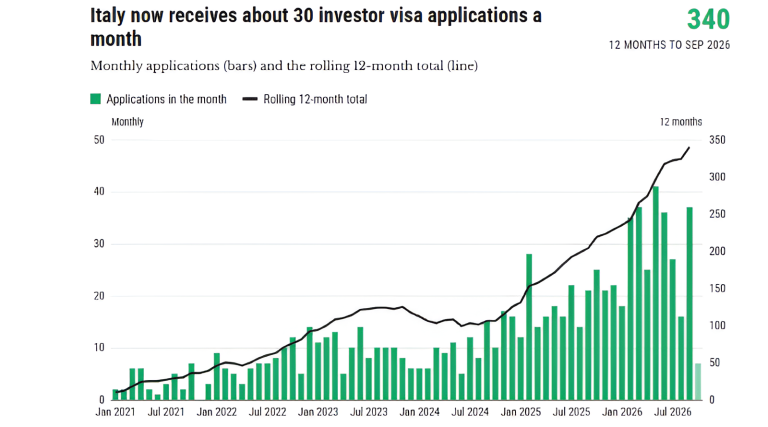
Italy received 209 Investor Visa applications in 2025 through the start of December, up 63.3% on 2024.
The Permit and Citizenship Follow Different Rules
Victorio draws the line this way: “The flexibility applies to the residence card; the passport demands commitment.”
You can apply for Italy’s long-term residence permit after five years of legal residence. Absences do not break the five years as long as none lasts six consecutive months and they add up to ten months or less.
Investors can naturalize after ten years of legal residence, provided they are registered residents and speak Italian at B1 level.
Victorio Expects the Rules to Tighten
Having watched Spain’s program end from the inside, Victorio argues that “these programs always get more restrictive and more expensive.” In her words, “Investors follow open doors.”
Orience advises investors on Spain’s income-based visas, Italy’s Investor Visa, and other residence and citizenship by investment programs. You can contact Orience to discuss your options.