

Most property investors don’t buy where the best opportunity is. They invest where their attention happens to be.
Where they live. Where they have family. Where they speak the language. Where a broker is currently pitching them.
That is understandable, but it is also severely limiting.
If you could buy property in any city in the world, how would you know where to start?
For all you know, the best long-term opportunity might not be Lisbon, Dubai, Miami, Madrid, or London.

It may be some city you have barely thought about.
One city may offer high rental yields but weak governance. Another may be clean, safe, and liquid, but expensive and mature. A third may look cheap on paper but be difficult for foreigners to access, finance, manage, or eventually exit. Comparing these markets properly requires more than asking whether property is “cheap” or “expensive.”
That is why we built the Global Property Scoreboard (GPS).
GPS evaluates the long-term attractiveness of cities for residential real estate investment from the perspective of global investors.
It is designed to help internationally mobile investors, residence and citizenship advisors, family offices, and globally minded property buyers compare cities across a broad set of fundamentals.


The tool is available to IMI Pro and IMI Sovereigns members.
What GPS is designed to measure
GPS is not a short-term trading signal. It does not try to predict next quarter’s apartment prices, nor does it claim that the highest-ranked city is automatically the right choice for every investor.
Instead, it asks a more practical question:
How attractive is this city as a long-term property investment market for a foreign investor, considering return potential, access, friction, resilience, and structural demand?
That means GPS looks beyond simple price growth or rental yield. A city can be cheap and high-yielding but still score poorly if foreign buyers face heavy restrictions, the currency is unstable, title enforcement is weak, or liquidity is thin. Conversely, a mature developed market may have modest upside but still rank well if it offers strong rule of law, deep rental demand, clear ownership rights, and low operational friction.
This matters because international investors do not all optimize for the same thing. Some are comfortable investing in difficult frontier markets if the potential upside is high. Others prefer clean title, stable institutions, easy banking, and a lower-friction exit, even if that means accepting lower yields or less dramatic capital appreciation.
GPS is therefore best understood as a decision-support tool, not a universal prescription.
The methodology
GPS scores each city across 42 factors grouped into seven sections:
- Property: valuation, yields, supply pipeline, liquidity, vacancy risk, mortgage penetration, and rental-market fundamentals.
- Demand: urbanization, population growth, migration, tourism depth, mobile wealth inflows, age structure, and human capital.
- Access: ownership structure, banking practicality, currency stability, and flight connectivity.
- Costs: rental income tax, property tax, capital gains tax, and round-trip transaction costs.
- Governance: rule of law, corruption control, judicial effectiveness, property rights, and business freedom.
- Resilience: peace and stability, regional conflict exposure, climate and natural disaster risk, food security, and energy security.
- Macro: income level, projected growth, public debt, and infrastructure competitiveness.
The score weighting is intentionally simple: Property accounts for 30%, Demand for 20%, and the other five sections for 10% each. Metrics inside each section are equally weighted.
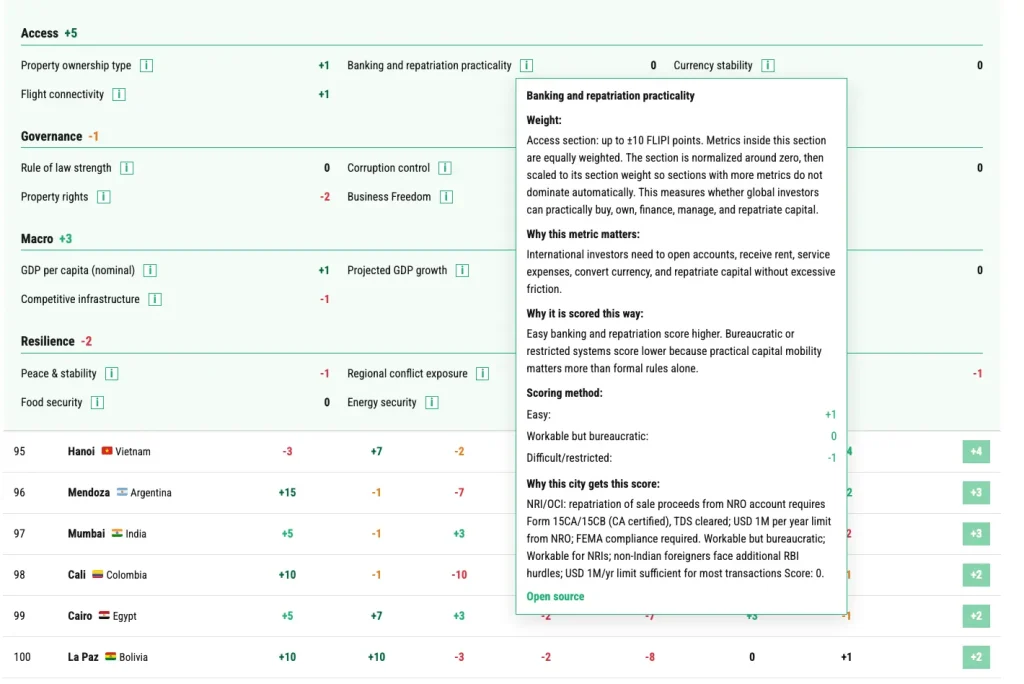
This weighting reflects the purpose of GPS. Property fundamentals and demand matter most because GPS is ultimately about long-term real estate performance. Access, costs, governance, resilience, and macro conditions still matter, but they are supporting dimensions rather than the core object being measured.
GPS also accounts for foreign ownership limitations. Closed markets are not ranked. Restricted markets remain in the table, but incur a city-specific Foreign Ownership Limitations Penalty depending on the severity of the restrictions.
A light restriction, such as foreign ownership limited to broadly usable designated zones, is treated differently from a regime where foreigners need residency, government approval, or face far narrower access.
The ranking is indicative, not absolute
No index can know an investor’s personal constraints, risk tolerance, tax position, financing options, or local network.
For one investor, a market with high friction may be attractive precisely because the barriers keep competition away. For another, the same friction may be disqualifying. A developer, a yield investor, a lifestyle buyer, a citizenship-by-investment participant, and a family office preserving capital may all look at the same city and reach different conclusions.
That is why GPS includes filters rather than merely presenting a single leaderboard. Users can screen for the factors that matter most to them, including foreign ownership rules, rental yield, short-term rental treatment, rental income tax, governance quality, resilience, and other metrics.
In other words, GPS does not say: “Buy here.” It says: “Here are the fundamentals. Now filter them according to your own strategy.”
Markets that stand out
Several cities stand out in the current dataset, but for different reasons.
Lima is a good example of an emerging-market opportunity. It benefits from relative affordability, long-term urban demand, and the possibility of catch-up growth. It is not a frictionless market, and investors need to understand governance and operational risks. But for those willing to accept emerging-market complexity, Lima’s fundamentals are more interesting than many casual observers might assume.
Helsinki represents a different type of investable market. It is not a high-octane frontier opportunity, nor is it likely to offer the same upside profile as a fast-growing emerging city. Its appeal lies instead in institutional quality, rule of law, stability, infrastructure, and lower operational ambiguity. For investors who value predictability and low friction, Helsinki scores well for reasons very different from Lima.
Abu Dhabi stands out for yet another reason. It combines strong infrastructure, capital inflows, safety, high connectivity, and a clear position within a wealthy Gulf economy. At the same time, it is not an unrestricted market. Foreign ownership is limited to designated areas, and regional geopolitical exposure must be taken seriously. For the right investor, however, those limitations may be acceptable given the city’s broader strengths.
These examples show why GPS is more useful than a simple ranking. Lima, Helsinki, and Abu Dhabi can all be attractive, but in fundamentally different ways.
Who should use GPS?
GPS is especially useful for internationally mobile investors who are comparing real estate markets across borders and want a structured way to separate signal from anecdote.
It should also be helpful for investment migration advisors. Real estate remains central to many residence and citizenship strategies, but the quality of the underlying property market varies widely. A visa-eligible property is not automatically a good investment, and the index helps make that distinction clearer.
Family offices, wealth managers, and cross-border tax planners may also find GPS useful when evaluating where mobile capital is likely to flow. Markets that attract globally mobile entrepreneurs, retirees, high earners, and family capital can benefit from a demand base that is not fully captured by domestic income or population figures alone.
Finally, GPS is useful for investors who already know a market well but want to test their assumptions. If a city scores surprisingly high or low, the value is not merely in the final number. The value is in seeing which factors are responsible.
A starting point for better questions
GPS is not intended to replace local due diligence. Investors still need legal advice, tax advice, transaction support, neighborhood-level analysis, and a realistic understanding of liquidity and rental demand.
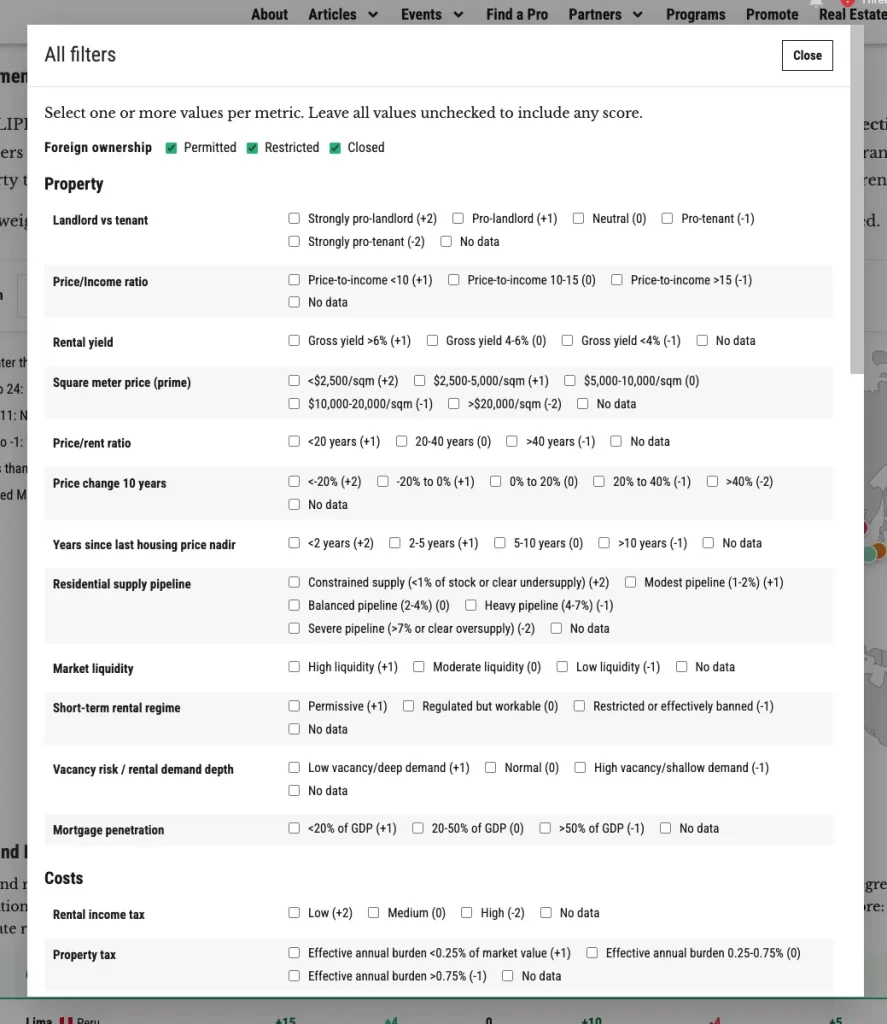
But before reaching that stage, investors need a way to compare cities consistently. That is what GPS provides.
It gives users a structured framework for asking better questions: Is the market cheap for a reason? Is the yield real? Can foreigners actually buy? Is the demand broad or narrow? Is the legal system reliable? Is the city resilient enough for a long holding period? Are wealthy mobile investors moving in or out?
The answers will not be the same for every investor. That is precisely the point.
GPS gives members the data, scoring framework, and filters needed to decide which markets fit their own strategy.



