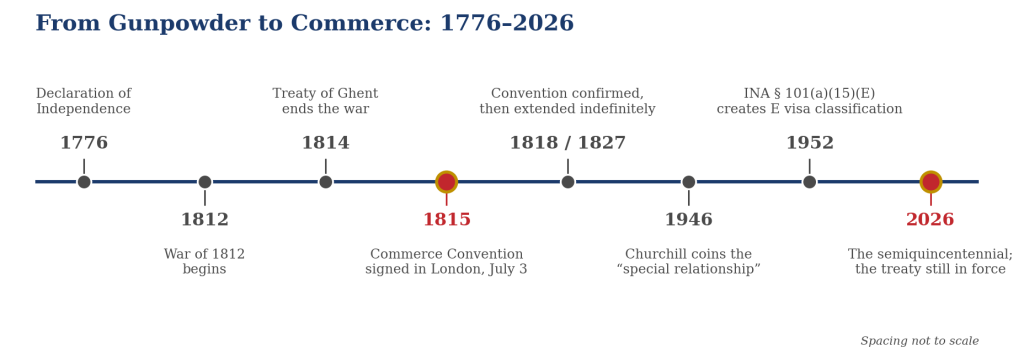
On July 4, 2026, the United States of America marks 250 years since the Declaration of Independence. Anniversaries invite sentimentality, and the “special relationship” between the United States and the United Kingdom attracts more sentimentality than most. Yet the most durable piece of that relationship is not a speech, a summit photograph, or a phrase coined for an after-dinner audience. It is a commerce treaty signed in London on July 3, 1815, and it is still doing a full day’s work, carrying British investors through the doors of the U.S. Embassy in London week after week.
That instrument, the Convention to Regulate Commerce and Navigation between the United States and His Britannic Majesty, 8 Stat. 228 (1815), predates the telephone, the Statue of Liberty, and the entirety of modern U.S. immigration law. It was concluded on behalf of the Prince Regent, later King George IV, and it remains the legal foundation of the E-1 treaty trader and E-2 treaty investor categories for British nationals. The semiquincentennial arrives, rather neatly, one day after the treaty’s 211th anniversary.
I. From Gunpowder to Commerce in Under Five Months
The timeline is quite remarkable. The War of 1812 formally ended with the Treaty of Ghent, signed on December 24, 1814, with ratifications exchanged in February 1815. Less than five months later, plenipotentiaries for the two governments met in London and concluded a commerce convention on July 3, 1815; we know it today, rather more prosaically, as the E-2 treaty. Article IV of the Convention of 1818 confirmed it for a further ten years, and a convention of 1827 extended it indefinitely.
It has never been abrogated. Two countries that had burned each other’s public buildings within living memory of the signatories built a commercial channel that has outlasted every government on both sides of the Atlantic.
The treaty carrying British investors to America today was signed three years after the two countries were at war, and it has outlasted every government on both sides.

Congress supplied the modern statutory hook more than a century later. Section 101(a)(15)(E) of the Immigration and Nationality Act conditions treaty trader and treaty investor classification on the existence of a qualifying treaty of commerce and navigation between the United States and the applicant’s country of nationality.
The State Department’s treaty country list at 9 FAM 402.9-10 records the United Kingdom’s effective date as July 3, 1815; it is the oldest entry on the list. The treaty carrying British investors to America today was signed three years after the two countries were at war, and it has outlasted every government on both sides.
II. The Quirks Nobody Warns British Clients About
The 1815 Convention is generous in its longevity and stingy in its geography. Under the State Department’s interpretation set out at 9 FAM 402.9, the Convention applies only to British territory in Europe, meaning the British Isles (except the Republic of Ireland), the Channel Islands, and Gibraltar, and only to “inhabitants” of that territory.
An “inhabitant,” as the term is used in the Convention, is one who resides actually and permanently in a given place and has his domicile there. Two consequences flow from this, and both trip up applicants with tiresome regularity.
Foremost, a British passport alone is not enough. The applicant must hold United Kingdom nationality and must actually reside in the qualifying territory. A British citizen who has spent the last decade in Dubai or Singapore does not qualify until residence in the United Kingdom is genuinely re-established.
Consular practice in London reflects the rule: applicants are routinely asked to document residence with tenancy agreements, council tax records, payroll documents, and utility bills. It is one of the few visa categories in which a gas bill can be outcome-determinative.
Next, Commonwealth nationality does not assist. Under the FAM, individuals holding the nationality of Commonwealth countries other than the United Kingdom do not qualify for treaty trader or treaty investor status under this treaty, however British their institutions, courts, or breakfast habits may be.
III. Shared Bones: The Common Law Inheritance
Are the two legal systems similar? At the foundations, yes. Both are built on the English common law: binding precedent, adversarial procedure, trial by jury, habeas corpus, and due process concepts traceable back to the Magna Carta of 1215. An American lawyer can read an English judgment without a translator, and the reverse is equally true. The same cannot be said of a civil law code commentary.
Where the two systems part company is at the constitutional level. The Founding Fathers, having had their fill of parliamentary supremacy as colonial subjects, gave the United States a written constitution and, since Marbury v. Madison, 5 U.S. 137 (1803), a doctrine of judicial review under which courts may strike down legislation.
The United Kingdom has an uncodified constitution and operates on parliamentary sovereignty. Thus, no court may invalidate an Act of Parliament. For immigration practitioners the distinction is practical, not theoretical: it dictates where, and how, an agency decision can be attacked.
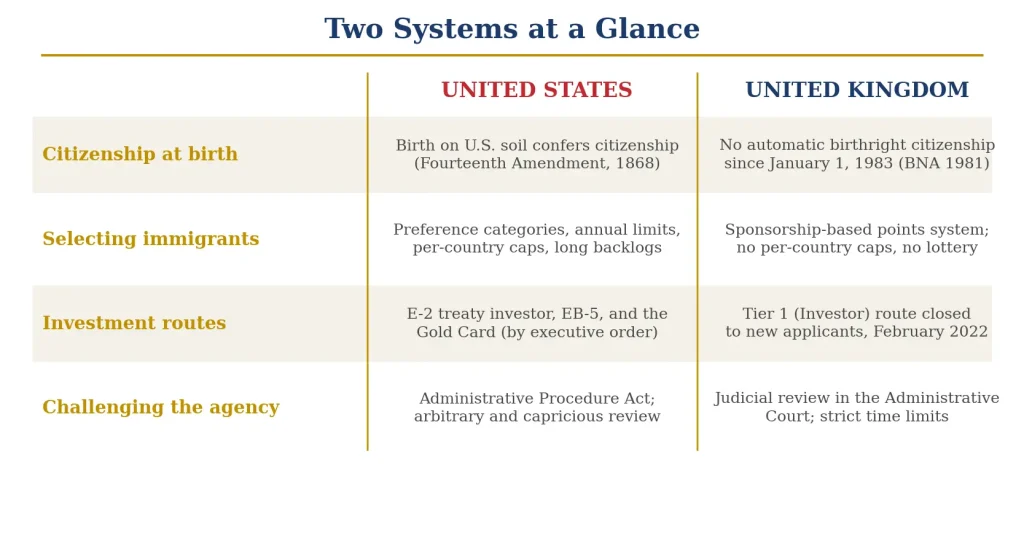
Challenges to U.S. agency action proceed under the Administrative Procedure Act, with its familiar arbitrary and capricious standard, while the UK equivalent is judicial review in the Administrative Court, a narrower and considerably faster procedure with strict time limits.
IV. Similar Roots, Very Different Immigration Systems
So, is the immigration law similar? Candidly, no. The two systems share a vocabulary and increasingly little else.
Begin with citizenship. The United States confers citizenship by birth on U.S. soil under the Fourteenth Amendment, ratified in 1868. The United Kingdom abandoned automatic birthright citizenship when the British Nationality Act 1981 came into force on January 1, 1983; a child born in the UK today acquires British citizenship at birth only if a parent is a British citizen or settled in the UK.
Selection systems diverge just as sharply. The United States allocates immigrant visas through family and employment preference categories subject to annual numerical limits and per-country caps, a structure dating to the Immigration and Nationality Act of 1952 as amended in 1965 and 1990, and one that produces backlogs measured in years and, for some nationalities, decades. The United Kingdom operates a sponsorship-based points system with no per-country caps and no diversity lottery.
Investment migration is where the paths separate entirely. The United Kingdom closed its Tier 1 (Investor) route in February 2022. The United States, by contrast, retains both the E-2 nonimmigrant investor route and the EB-5 immigrant investor program, and has added a third door.
The Trump Gold Card arrived via Executive Order 14351 of September 19, 2025 (an executive order, note, not an act of Congress, a distinction now being tested in federal court) and has been open for applications since December 18, 2025. It offers permanent residence through the existing EB-1 and EB-2 categories in exchange for a $1 million gift to the federal government with a $2 million corporate sponsorship version. And here is the detail worth savoring on an anniversary weekend: there is no reciprocal UK treaty route for American investors.
An American entrepreneur wishing to establish a business in Britain must qualify under the UK’s domestic business immigration rules. The 1815 Convention, in practice, runs one way.
V. Special: Where It Is Written Down
A point of housekeeping about the brand itself. The phrase “special relationship” entered common usage with Winston Churchill’s speech at Fulton, Missouri in March 1946, which makes the partnership, as marketed, a mere eighty years old this year. For the first 170 of the 250 years, relations ranged from open war to studied indifference. As marriages go, one that spent its first seventeen decades somewhere between litigation and not speaking deserves a measure of credit for exchanging anniversary cards at all!
This has not been a gentle year for the relationship, and the numbers say so with unusual candor. A 2026 Gallup survey recorded American favorability toward the United Kingdom at 76 percent, the lowest figure on record and down eight points from 84 percent in 2025, with the steepest fall among Republicans, whose favorable view of Britain dropped from 84 percent to 64 percent in a single year.
The remarks have kept pace with the polling; the President observed in March 2026, after London declined to endorse the strikes on Iran, that Britain’s current leadership is no Winston Churchill. Nor is the introspection one-sided. Polling by The Economist and YouGov on the eve of the semiquincentennial found that fewer than half of Americans describe themselves as very proud of their nationality, and roughly two-thirds believe the country’s best years are behind it. Both parties to this marriage, in short, arrive at the anniversary in a mood.
London, for its part, has been quietly rearranging the furniture. At a Downing Street press conference on April 1, 2026, Prime Minister Keir Starmer stated that Britain’s long-term national interest requires “closer partnership with our allies in Europe and with the European Union,” a statement widely read as a reorientation away from Washington. For investors and the advisers who serve them, that tilt is not an abstraction. A Britain drawing closer to Europe changes the calculus on where transatlantic families base themselves, structure their businesses, and hold their residence rights, and it is exactly the kind of shift that rewards having counsel on both sides of the water.
None of it, however, matters to the Convention. Politics wobble; treaties endure. This week, as the United States turns 250, a British investor can still present a business plan at the U.S. Embassy in London and seek entry under a document concluded on behalf of the Prince Regent in the summer of 1815. After two and a half centuries of independence, the most special part of the special relationship may simply be the part that is written down.