Deck: The 6-3 ruling shuts an executive route to ending jus soli, though a concurrence leaves a statutory question open for Congress.
The Supreme Court struck down Executive Order 14160 on June 30, holding that children born on United States soil to parents unlawfully or temporarily present are citizens at birth under the Fourteenth Amendment.
Its ruling in Trump v. Barbara preserves birthright citizenship as a constitutional guarantee and forecloses, for now, the administration’s attempt to end it by executive action. Lower courts had blocked the order, titled Protecting the Meaning and Value of American Citizenship, and it never took effect.
Chief Justice John Roberts wrote for the Court, joined by Justices Sotomayor, Kagan, Barrett, and Jackson. Only five members adopted that constitutional reasoning.
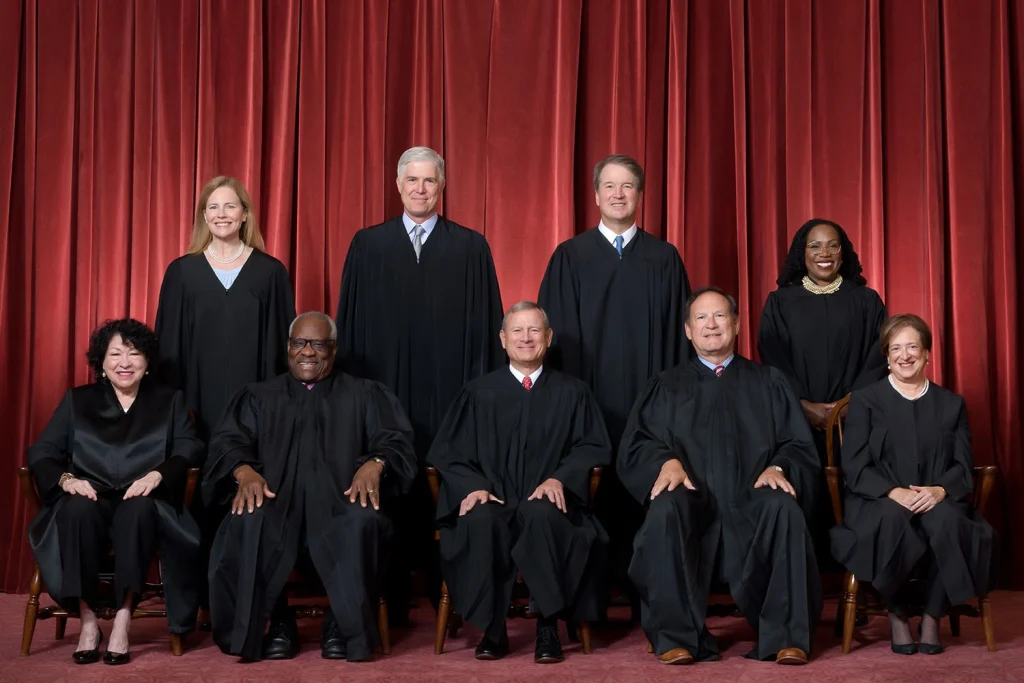
Back row, left to right: Associate Justice Amy Coney Barrett, Associate Justice Neil M. Gorsuch, Associate Justice Brett M. Kavanaugh, and Associate Justice Ketanji Brown Jackson.
Justice Kavanaugh supplied the sixth vote against the order but rested on statutory grounds, suggesting Congress retains authority to act. Thomas, Gorsuch, and Alito dissented.
The government had not sought to overturn Wong Kim Ark, the 1898 ruling that recognized citizenship for a child born in San Francisco to Chinese parents. It argued instead that “domicile” was the operative test, placing children of temporary or unlawful residents outside the clause. Roberts found “scant evidence for this dramatically revisionist view.”
“Citizenship, then and now, was the right to have rights,” Roberts wrote, describing the Fourteenth Amendment as a promise its framers extended to “every free-born person in this land.” He closed the opinion: “We keep that promise today.”
David Lesperance, Managing Director of Lesperance & Associates, had expected the result. “What was surprising was that the decision was not unanimous,” he said. “The dissenting judges did not appear to have a coherent theory supporting their position, but they put their reasoning on the record nonetheless.”
Lawyers for the American Civil Liberties Union, which brought the challenge, welcomed the ruling. Its deputy director for immigrants’ rights, Cody Wofsy, told NBC News the Court had “rejected it and rejected it emphatically,” and did not expect a second attempt.
Trump reacted within hours, urging Congress on Truth Social to legislate on citizenship, and House Speaker Mike Johnson told reporters the chamber would take up the question. Whether that path exists is contested. John Eastman, the now-disbarred former Trump lawyer who built the argument against birthright citizenship, told CNN he does not “think Congress can fix this, unless the court revisits the question.”
Lesperance saw only one durable route left for opponents. “For those Americans who feel birthright citizenship should not exist, then their next step will be to organize a constitutional amendment,” he said.
“This is quite a heavy lift, requiring a two-thirds vote in both the House of Representatives and the Senate or a convention to propose amendments called by Congress at the request of two-thirds of the state legislatures. Then three-quarters of the states must ratify the amendment.”
What the Ruling Means for Birth Tourism
The decision leaves untouched the legal basis for birth tourism, the practice of traveling to the United States to give birth so that a child acquires citizenship by jus soli. Had the government’s domicile theory prevailed, that pathway would have narrowed sharply.
Unconditional birthright citizenship survives in a limited group of countries, most of them in the Americas. For now, the United States remains firmly among them.