
Saint Vincent and the Grenadines forfeited at least US$1 billion in citizenship by investment (CBI) revenue over the past decade, Prime Minister Godwin Friday estimated during a radio interview on April 10. Speaking on Hot 97 FM, he cited conversations with Caribbean counterparts whose countries operate CBI programs.
One unnamed prime minister, asked to put a figure on what SVG could have earned, cited EC$200 million per year. At the Eastern Caribbean Central Bank’s fixed exchange rate of EC$2.70 to one US dollar, that translates to approximately US$74 million annually.
Friday’s US$1 billion estimate implies higher earnings potential over a ten-year horizon, though he did not detail the calculation. By comparison, Dominica’s CBI program generated approximately US$232 million in a single year at its peak, according to IMF data, while Grenada’s program brought in EC$298 million through the first three quarters of 2025 alone.
He described CBI as a “debt-free, tax-free way in which to raise revenue,” contrasting it with the Unity Labour Party’s (ULP) reliance on borrowing. A US$78 million hospital under construction at Arnos Vale, he noted, required a US$100 million loan from Taiwan under the previous government.
Dominica featured prominently in his argument. That country is building its first international airport largely with CBI proceeds, a US$370 million project that ranks as the largest contracted construction in Eastern Caribbean history.
“They’re looking at us like say, ‘boy, what an opportunity you guys missed,'” Friday said of his exchanges with regional peers. He called the ULP’s refusal to adopt CBI “the opportunity cost from that reckless decision that they made.”
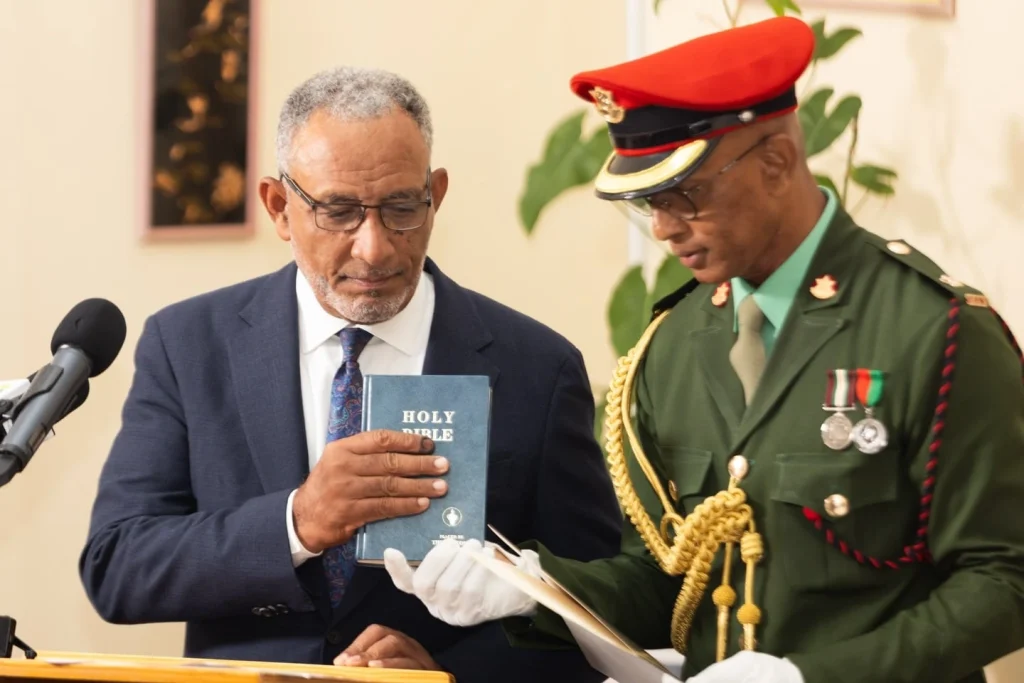
Gonsalves Maintains Opposition
Former Prime Minister Ralph Gonsalves, voted out in November after 24 years in power, continues to oppose CBI from the opposition benches. During the February budget debate, he likened CBI revenue to cocaine and called on Caribbean states to acknowledge that “the end is nigh” for such programs.
Asked why Vincentians had accepted the anti-CBI narrative for so long, Friday was blunt. “There are some people they stand in the mountain, and they shout loudly, and everybody else, and some people believed it, and we lost out as a consequence,” he said.
Even Gonsalves’ ideological allies appear to have soured on his stance. A senior Saint Lucia Labour Party official, a sister party of the ULP, reportedly told a local radio host that SVG under the previous government had embarrassed itself regionally. “We were making all these big pronouncements. We’re talking like we’re a big shot, but on the ground, everybody can see what it was,” the host recounted the official as saying.
Gonsalves has previously claimed that the United States directly advised the New Democratic Party (NDP) administration against pursuing CBI. He has also alleged that international investment migration firms financed the NDP’s campaign, an accusation the party denies.

Broader Economic Package
Friday positioned CBI as one element within a wider set of economic initiatives. Hotel investments are expected this year, and the government plans to revive the Ottley Hall Marina and Shipyard, a flagship project of the last NDP administration (1984 to 2001) that fell into disrepair under the ULP.
To address immediate cost-of-living pressures, the government has nearly doubled public assistance payments from EC$280 to EC$500, according to the St Vincent Times. A task force comprising government officials, private sector representatives, and labor groups is scheduled to meet around April 24 to develop strategies for mitigating fuel costs.
Some election promises have been deferred, Friday acknowledged, citing global conditions. “It would be irresponsible to simply disregard what’s happening in the world and simply do whatever you like,” he said, though he added that deferrals would not take the administration off its “strategic objective” of managing the country’s finances while expanding opportunity.
Program on Track for Mid-2026
SVG’s planned CBI program, as previously reported, will feature mandatory residency requirements and a legislatively ring-fenced investment fund. All proceeds are to flow through the Saint Vincent and the Grenadines Investment Fund (SVGIF), barring funds from recurrent spending or political discretion.
Friday has described the initiative as a “sovereign capital mobilization strategy” rather than a pure revenue exercise. His 2026 budget projected US$10 million in CBI revenue for the current fiscal year, reflecting the partial-year nature of a mid-year launch.
SVG remains the only independent member of the Organisation of Eastern Caribbean States (OECS) without a CBI program. Whether it will sign the regional Memorandum of Agreement and adhere to the established Caribbean minimum contribution of US$200,000 remains an open question.