

European Commission President Ursula von der Leyen invited Canada on Wednesday to become the EU’s first associate member. The line was absent from her prepared State of the Union text, according to NPR, which reviewed the remarks; she added it with Prime Minister Mark Carney in the Strasbourg chamber, and he received a standing ovation.
Later that evening, US President Donald Trump called the idea “laughable,” speaking to reporters on the tarmac after landing at Charlotte Douglas International Airport in North Carolina.
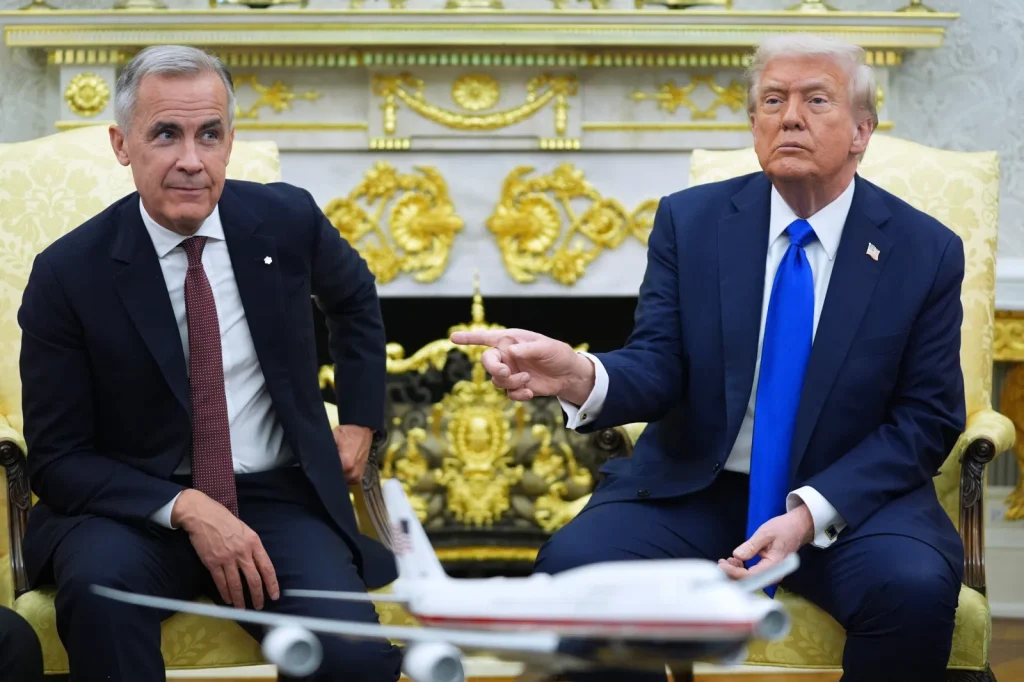
If he judges it “a hostile act,” he said, he will “put very serious tariffs or stop trading with Europe on many things”; a good intention, by contrast, is “fine.”
He named no tariff rates, no products, and no test for hostility. The same day, he signed a memorandum removing Canadian goods from US federal procurement, which the White House called retaliation for Ottawa’s “Buy Canadian” policy.
From leak to podium
Three days earlier, the Wall Street Journal had reported that Ottawa and Brussels were discussing live-and-work rights for Canadians. Officials on both sides disputed the “associate member” label while leaving the mobility talks undenied. Now von der Leyen has said the words herself.

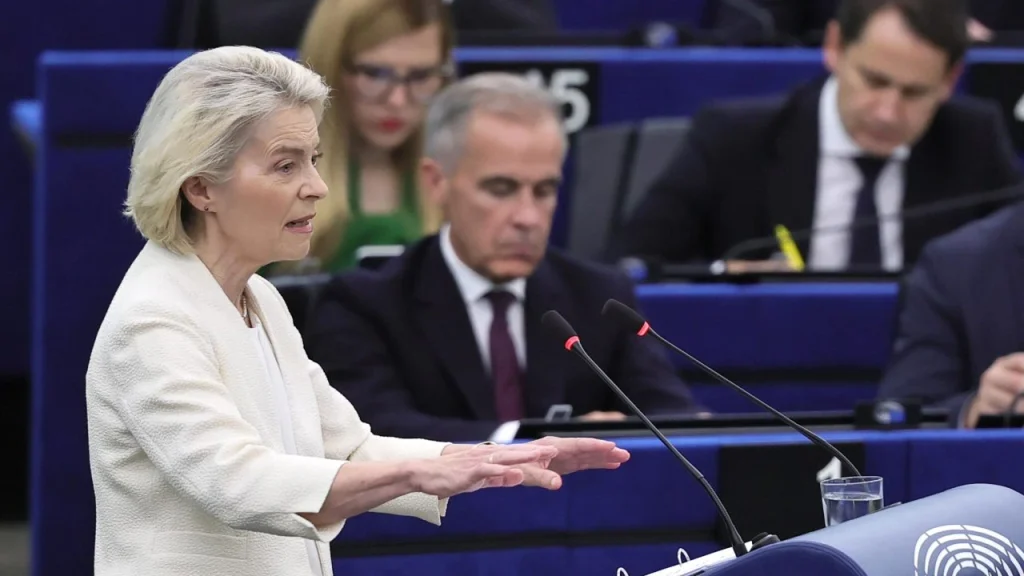
Her “Alliance for the Future” would move beyond the Comprehensive Economic and Trade Agreement (CETA) into technology, defense industrial bases, energy, critical minerals, and the Arctic. No such membership category exists in the EU treaties; member states would have to create one and ratify it.
Carney’s office welcomed a “far stronger, more ambitious alliance” without saying Canada would take the status. The readout spoke of securing “strategic autonomy through deep cooperation in the full range of strategic capabilities.”
Carney had set the tone on Tuesday at the Canada Investment Summit in Toronto, hours before flying to Europe. “Nostalgia is not a strategy,” he told investors, promising a Canada that emerges from the dispute “stronger, more resilient, more independent” while staying open to a deal with Washington “when it is the right time.”
He addressed Americans directly. “We will always be neighbors,” he said, and “when those opportunities return, Canada will be an even better partner.” About 80% of trade between the two countries remains tariff-free, by his count.
“Our Churchill”
Eric Major, CEO of Latitude Group and a Canadian, thinks Carney “is doing all the right things.” “He’s our Churchill at this moment in time,” Major says, facing “an existential challenge, being threatened by no less than the largest economy of the world, which wants to make us its next state.”
Trump’s tariff threat does not worry him. The president is “nothing less than a bully,” and any threat aimed at Canada’s diversification “will be futile,” because the effort has “the backing and support of the rest of the world.”

Ties to the American market “were a smart thing, a good thing, for the longest time,” he says. “But the world changes, and so do countries.” Canada “got caught with a change in a partner that is becoming less and less so with each passing day.”
Von der Leyen called the offer “a partnership not against anyone else, but for our common strength,” and European Parliament President Roberta Metsola told Euronews she did not fear retaliation from Washington.
French Foreign Minister Jean-Noël Barrot said: “It is the sovereign choice of states to join their destinies together.”
Brendan Metcalfe of MyLatinLife, also Canadian, thinks the American position works against American interests. “The US wants Canada to be a vassal state. But Canada has other ideas,” he says. “Deep down, they probably respect the chess move.”

He expects Ottawa to accept the offer. “It seems like we instigated it. Carney has been flying to Europe a lot more than European delegates have been flying to Canada.”
Mobility goes unmentioned
Von der Leyen’s list of joint projects said nothing about the movement of people. The live-and-work rights that a Canadian official described to the Associated Press last week, and that Carney has reportedly raised with French President Emmanuel Macron, were absent from the speech.
Some Canadians are already moving to Europe in measurable numbers. Eurostat counted about 15,700 first residence permits issued to Canadians across the EU in 2025, against some 44,000 for Britons and more than 90,000 for Americans. Canadian visits to Europe rose 13.6% last year to roughly 4.8 million, up 579,000, according to Statistics Canada.
Europeans visit Canada in large numbers but rarely move there. Europe is Canada’s biggest source of overseas visitors, and the United Kingdom, France, and Germany sent more than 300,000 people in August 2025 alone. Yet only one in ten immigrants who settled in Canada between 2016 and 2021 came from Europe, down from six in ten in 1971.
Canada and the United States have far more people moving between them. About 828,000 Canadian-born people lived in the US in 2023, according to US Census Bureau data, a stock that has hovered near 800,000 for four decades, and Canada’s 2021 Census counted 256,085 US-born immigrants.
Canadians took 29.1 million trips south in 2025, albeit a quarter fewer than the year before, and over the summer months more Americans visited Canada than Canadians visited the United States.

Ottawa has also tested the appetite for northbound talent. When Canada’s immigration authorities (IRCC) opened an open work permit stream for US H-1B visa holders on July 16, 2023, its 10,000-application cap was reached the next day. Budget 2025 promised a successor, an accelerated pathway for H-1B holders aimed at healthcare, research, and advanced industries, which IRCC has yet to open.
Major does not expect the associate membership offer to include visa-free mobility. “The details haven’t been fleshed out,” he says, but he anticipates “some overture in the realm of trade and the realm of defense, possibly some alignment in foreign policy matters,” and not much more.
Mobility is a different order of commitment, in his view. “I don’t see it at this stage spilling into the realm of mobility or settlement rights,” because for the EU that “is a much bigger set of requirements that ultimately compels a full integration into the economic union, which Canada will not do.”
Metcalfe assumes the opposite. If the status “gives Canadians the right to live, work, and study in the EU,” he says, “it will make the Canadian passport much more valuable.” Joining a supranational settlement bloc “usually makes a passport more valuable,” and “most value accrues to Canada on passport strength.”
EU citizenship would gain “a little bit,” he adds. Economically, the benefit may run toward Europe, which “needs access to oil and natural resources we have.”
The same logic cuts against Europe’s residence programs. “I suppose it would lower demand from Canadians for European golden visas,” Metcalfe says. “Canadians have been a growing market in investment migration, so if they no longer need golden visas, that will have an impact.” He does not expect visa-free mobility any time soon, though, putting it atleast “years away.”
The appetite
If it does come to pass he expects Canadians to embrace it. “Canadians want this,” Metcalfe says. “Remember we have six-plus months of winter and many would like to live somewhere warmer.”
He points to precedents: Canadian law and medical students in the UK and Ireland, working holiday visas to Australia, and a “massive brain drain to the USA.”
Europeans coming the other way would be welcomed too, “especially if it means we can therefore reduce immigration from third-world countries.”
Today, “the only Europeans that come to Canada are the French who go to Quebec,” under France’s visa and tuition arrangements with the province.
Some Europeans would take the trade. “Many Europeans think Europe is going the wrong direction and North America is leapfrogging ahead,” he says. “The ambitious ones who want to be near innovation and tech should go to Canada.”
Still to be decided
Nothing announced so far says whether any mobility right would cover permanent residents or only citizens. Canadian naturalization requires 1,095 days of physical presence within a rolling five-year window. If citizenship carries the rights, that becomes the price of two continents.
Major is proud of the direction regardless. “It’s lovely to see the rest of the world open its arms to Canada, including the EU,” he says. “But the devil will be in the details.”



