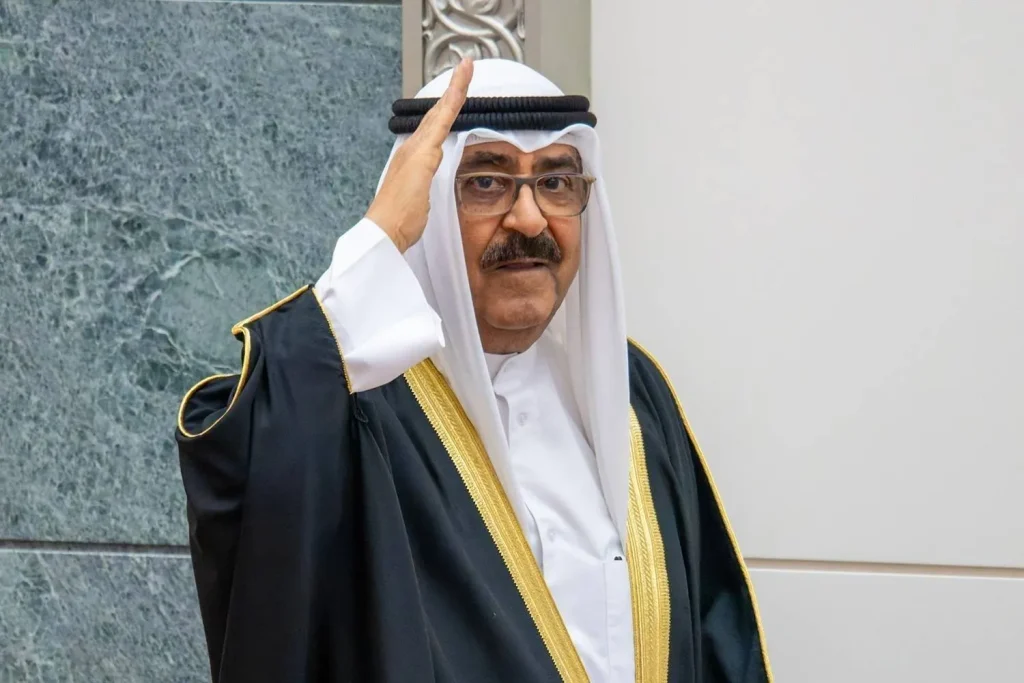
Kuwait’s Emir, Sheikh Mishal Al-Ahmad Al-Jaber Al-Sabah, issued Decree-Law No. 79 of 2026 on Sunday, 23 August. The decree adds a paragraph to Article 7 of the 1959 Nationality Law.
That paragraph bars anyone who acquired Kuwaiti nationality by naturalization from voting, standing for election, or accepting appointment to any representative body.
Publication followed the next day in the official gazette Kuwait Al-Youm, in the supplement to issue 1805, and the decree took effect on publication.
Kuwait News Agency (KUNA) issued an English rendering of the new paragraph. It reads, “a person who has acquired Kuwaiti nationality by naturalization shall not have the right to vote, stand for election, or be appointed to any representative body.”
Naturalized Kuwaitis had been able to vote 30 years after acquiring nationality, according to AFP. Kuwaiti law already closed candidacy and appointment to parliamentary bodies to them, so the operative change is the ballot itself.

Three further amendments travel with the voting ban
Article One replaces Clause 4 of Article 14. Kuwaitis now forfeit nationality if they deliberately add to a nationality file, their own or someone else’s, a person who is not their child or descendant. That finding must come from the Higher Committee for Kuwaiti Nationality Investigation or from a final judicial ruling.
The new clause also reaches the offender’s children or descendants, where they knew of the forgery and never reported it. Liability runs down the family line rather than stopping with whoever committed the act.
A second limb of Article One replaces Article 19, so that the Interior Ministry now issues the nationality certificate electronically instead of on paper. Technical requirements for issuance, storage, use, validity checks, and cancellation will follow in a ministerial decision.
Under Article Three, the electronic certificate carries the same legal force as the paper version. It substitutes for the paper document wherever legislation requires one to obtain a service or benefit. Two closing articles handle the housekeeping: One repeals conflicting provisions, and the other charges the Prime Minister and ministers with implementation.
The constitutional argument rests on a provision about candidates, not voters
The explanatory memorandum accompanying the decree grounds the new paragraph in Article 82 of the Constitution. That article requires that a member of the National Assembly hold Kuwaiti nationality by origin. Barring naturalized citizens, the memorandum reasons, keeps the selection of the people’s representatives with those who hold nationality by origin.

As the memorandum itself describes it, Article 82 governs who may sit in the Assembly. Decree-Law 79 travels considerably further, to who may cast a ballot and to appointment to any representative body, a category broad enough to include municipal seats.

Legislating without an assembly
The memorandum explains why the change arrives as a decree-law rather than a statute. An Amiri Order of 10 May 2024 provides, at its Article 4, that laws take the form of decree-laws.
That order dissolved the National Assembly and suspended some constitutional articles for a period not exceeding four years. In a televised address the Emir said the suspension would allow a revision of the democratic process in its entirety, according to KUNA. Suspension therefore runs to May 2028.
No assembly currently sits, and the government has not called an election. Kuwait has therefore barred a group of citizens from a vote that nobody can yet schedule.
71,059 nationality files by mid-April
Cancellations have run at scale since March 2024. The Newsroom Initiative, an independent tracker monitoring revocation decrees as they appear in the gazette, counted 71,059 cases as of 15 April 2026, according to New Lines Magazine. That equals 4.6% of a citizen population of 1.545 million.
Along the way the government abolished naturalization by marriage, which applied only to women, and cancelled the citizenships it had granted to wives since 1987, per AFP. Dual nationals formed a separate category, because Kuwait does not permit dual citizenship. Revocations passed 12,000 by December 2024, then climbed again when the committee referred another 5,800 files.
April brought the heavier instrument. Decree-Law No. 52 of 2026, published on 13 April, classified nationality decrees as acts of sovereignty beyond judicial review. Jurisdiction over nationality offenses passed exclusively to the Public Prosecution.
That earlier decree is what the August memorandum says the new one completes.
Kuwait was importing capital across the same period, opening a 15-year residency track for investors in late 2025. Eligibility turns on the merits of the underlying project rather than a single financial threshold. No GCC state runs a citizenship by investment program.
Whether a rollback of rights can be temporary
Anastasia Barna, CEO of One World Migration, does not defend the principle: “Revoking the right to vote from naturalized people is not right. It affects trust, and it is a serious issue.”
She reads Kuwait as an attempt at containment rather than a settled answer on who belongs. “If you are talking about 70,000 or 75,000 nationality files in a country with roughly 1.5 million citizens, that is not 3,000 and it is not 5,000,” Barna says. “At that scale it can decide an election.”
Her precedent is Hungary, and it reached her own family. In early 2021 the US Department of Homeland Security (DHS) revoked outstanding Electronic System for Travel Authorization (ESTA) approvals from Hungarian passport holders born outside Hungary. It refused new applications from the same group.
“My husband was born in Hungary, so he only needed the electronic authorization,” Barna says. “My daughter is a Hungarian citizen, but her place of birth is Moscow, so she needed a full visa. For me that was nonsense.”
DHS acted over Hungary’s simplified naturalization procedure, which granted citizenship to close to one million people between 2011 and 2020. The procedure lacked adequate measures to verify identities, according to the US Embassy in Budapest. Washington went further in August 2023, cutting ESTA validity for every Hungarian national to one year and a single entry.
Both restrictions came off on 11 September 2025, after DHS concluded that Hungary had addressed the vulnerabilities. Barna treats the reversal as the point.
“Hungary closed it in September 2025, and now naturalized and non-naturalized citizens have the same right,” she says. “If a problem touches 2,000 people, that is one thing. When it reaches 5% or 7% of society, you clean it first.”
Nothing in Decree-Law 79 of 2026 supports that reading. Its final article sets the commencement date and stops. Neither the decree nor its memorandum contains a sunset clause, a review date, or any mechanism for restoring the franchise.
Citizenship as a jurisdictional risk
Enis Sljivo, Managing Partner at Ancova Capital, says the case “raises a bigger question” for him personally. “How permanent is citizenship if the rights attached to it can change later?”
“For wealthy and internationally mobile families, a passport is often seen as the safest layer of their planning,” Sljivo says. “But keeping the passport does not necessarily mean keeping the same rights.”
His conclusion is a selection criterion rather than a warning: “This is why choosing a second citizenship should go far beyond visa-free access or speed of approval. The legal stability of the country matters just as much. Citizenship, like wealth, carries jurisdictional risk.”
Serhan Aysever, Managing Partner at Beyond Global Partners, arrives at a similar place from the practitioner’s side, with a caution attached.
A second nationality, in his reading, earns its cost through optionality: Another jurisdiction to live, work, or educate children in, and another legal and economic system to draw on. It adds a set of options rather than replacing the ones a family already holds.
That caution is the sharper half of his point. Citizenship should be “a long-term strategic decision rather than a reaction to a single political development,” Aysever says. Jurisdiction and route need weighing against a family’s existing nationality, source of wealth, business interests, and mobility needs, through regulated programs only.
On that logic, the Kuwaiti decree is a reason to examine the question rather than an argument for any particular answer.