
A €250,000 investment may open the door to European residency, but it rarely represents the full financial commitment. Depending on the country and investment route, applicants may also face government fees, transaction expenses, recurring investment costs, and charges when they eventually exit.
These costs differ considerably across Europe’s residency-by-investment programs. A property purchase in Greece carries different financial obligations from a regulated fund investment in Portugal. Italy offers several investment routes with relatively limited government application fees, while Malta combines property requirements with substantial non-refundable contributions.
For investors comparing programs, the important question is not simply which country has the lowest entry threshold. It is how much capital must be committed, which expenses are non-refundable, what it costs to maintain the investment, and what happens when the investor decides to exit.
A practical comparison can be organized around four factors:
- Minimum qualifying investment or contribution: The capital required to meet the program’s eligibility criteria.
- Initial government and transaction costs: The fees and expenses associated with applying and completing the investment.
- Ongoing holding and maintenance costs: The recurring financial commitments involved in maintaining the investment and residency status.
- Potential exit costs: The expenses, restrictions, and financial considerations associated with selling or withdrawing the investment.
Together, these four factors offer a more useful picture of the financial commitment than the headline investment amount alone.*
Greece: Property Costs Begin Before the Purchase Is Complete
Greece remains one of Europe’s most established property-based Golden Visa destinations. Its investment thresholds vary according to the location and type of property, making the choice of asset particularly important.
1. Minimum qualifying investment
The standard real estate investment threshold is €800,000 in Attica, Thessaloniki, Mykonos, Santorini, and islands with populations exceeding 3,100. In other eligible areas, the threshold is €400,000 for Greece Golden Visa eligibility.
A €250,000 route remains available for qualifying properties involving a conversion to residential use or the restoration of listed buildings, subject to specific program requirements.
2. Initial government and transaction costs
Beyond the purchase price, investors must budget for property transfer tax, notary fees, legal services, registration expenses, and Golden Visa application fees.
Greece’s property transfer tax has become particularly relevant following the government’s proposal to increase the rate for certain international buyers.
The government announced in September that it intends to raise the rate to 15% for individual buyers who are citizens of countries outside the EU and EEA, with the measure currently expected to apply to purchases completed from July 1, 2027.
The proposal has not become law, and its final scope and potential exceptions remain subject to the legislative process.
For Golden Visa applicants, the development highlights why transaction timing and property selection can materially affect the initial cost of an investment. It is particularly important to establish whether a specific property and buyer would fall within the proposed rules.
3. Ongoing holding and maintenance costs
Property ownership comes with recurring expenses, including maintenance, insurance, property-related charges, and, where applicable, property management.
Investors planning to generate rental income should also consider the costs of managing a long-term tenancy. Golden Visa properties are subject to restrictions on short-term rentals.
Residence permit renewals introduce another expense, although the size of that commitment depends on the number of family members included in the application.
4. Potential exit costs
Selling a property can involve agency commissions, legal expenses, and other transaction-related charges.
Investors should also consider the property’s resale potential, the time required to complete a sale, and any implications for their residence status if they dispose of the qualifying investment.
The key consideration in Greece is therefore not only the purchase price, but the combined cost of acquiring, maintaining, and eventually selling an eligible property.
Portugal: Lower Property Exposure, Higher Program and Fund Costs
Portugal removed real estate investment from its Golden Visa program in October 2023. Investors now access the program through qualifying non-property routes, including regulated investment funds and cultural contributions.
1. Minimum qualifying investment
The most widely discussed routes include a €500,000 investment in an eligible fund and a €250,000 contribution to qualifying cultural or artistic projects, potentially reduced to €200,000 in eligible low-density areas.
Other qualifying routes include scientific research and business investments linked to job creation.
The distinction between an investment and a contribution matters. A fund investment offers the possibility of a financial return, while a cultural contribution is non-refundable.
2. Initial government and transaction costs
Portuguese Golden Visa carries substantial government application and residence permit fees, which can increase significantly when family members are included.
Investors must also account for legal representation, documentation, and, where applicable, fund subscription charges.
Unlike property-based routes, qualifying fund investments do not involve property purchase taxes or notary costs associated with a real estate transaction.
However, the initial expenses should be assessed separately from the €500,000 investment itself.
3. Ongoing holding and maintenance costs
For fund investors, ongoing costs may include annual management fees and other expenses specified in the fund documentation. Some funds also apply performance fees.
These costs can affect the investor’s net return over the holding period.
Applicants must also consider residence permit renewal fees and the administrative requirements involved in maintaining their status.
For cultural contribution applicants, there is no investment asset to manage or sell, although residence-related obligations and costs still apply.
4. Potential exit costs
Fund investments typically operate within a defined investment period, and the ability to withdraw capital depends on the fund’s terms and liquidity arrangements.
Investors should review the expected maturity date, redemption conditions, potential exit charges, and the possibility that the investment may return less than the original amount committed.
For Portugal, the distinction between a recoverable investment and a non-refundable contribution is one of the most important factors in comparing the total financial commitment.
Italy: Low Application Fees Do Not Eliminate Investment Costs
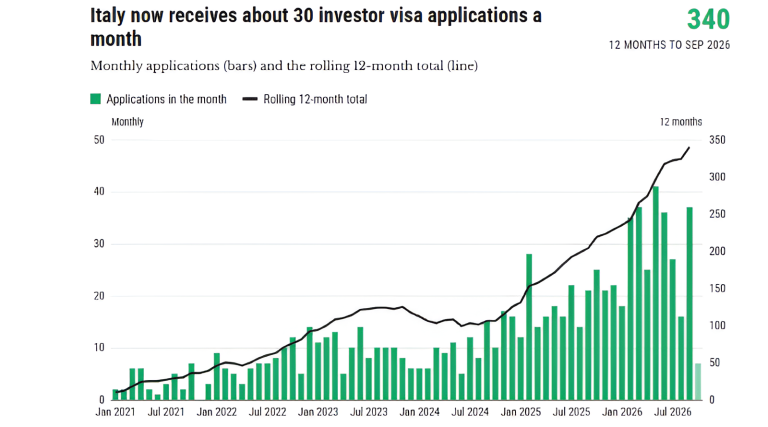
Italy Investor Visa differs from conventional property-based Golden Visa programs. It offers residency through investments in businesses, government bonds, and philanthropic initiatives rather than through the purchase of residential real estate.
1. Minimum qualifying investment
The program provides four main options:
- €250,000 in an innovative startup.
- €500,000 in an eligible Italian company.
- €2 million in Italian government bonds.
- €1 million as a qualifying philanthropic donation.
Although the €250,000 startup route offers a relatively low entry threshold, it also carries a different risk profile from government bonds or other investment categories.
2. Initial government and transaction costs
Italy’s government visa and residence permit fees are relatively modest compared with some other European investor residency programs.
However, the investment itself may require legal, financial, and administrative support, particularly when purchasing a stake in a private company or startup.
The cost of completing the transaction therefore depends heavily on the selected investment route.
3. Ongoing holding and maintenance costs
Investors must maintain their qualifying investment for the required period and comply with the conditions of their residence permit.
The financial implications vary by asset type. A business investment may involve shareholder responsibilities and ongoing professional expenses, while government bonds follow a different structure.
Investors who relocate to Italy should separately assess the personal tax and financial implications of becoming resident with qualified local advisers. These considerations depend on individual circumstances and are distinct from the Investor Visa’s application costs.
4. Potential exit costs
Italy’s investment routes carry different exit considerations.
Government bonds may offer a more clearly defined maturity structure, while investments in private companies or startups can be more difficult to sell and may involve greater uncertainty around valuation and liquidity.
A philanthropic donation, by contrast, is not intended to be recovered.
The relevant comparison is therefore not simply the amount required to qualify, but the type of asset being acquired and the investor’s ability to recover capital after meeting the program’s requirements.
Malta: A Clearer Distinction Between Contributions and Property Commitments
Malta’s Permanent Residence Programme (MPRP) differs from the other three programs by combining mandatory government contributions with a qualifying property requirement.
It offers a permanent residence framework, subject to the program’s ongoing conditions.
1. Minimum qualifying investment or contribution
Applicants must either purchase a qualifying residential property valued at a minimum of €375,000 or rent one for at least €14,000 annually.
In addition, the Malta Golden Visa requires a €37,000 government contribution and a €2,000 donation to an eligible organization.
These payments are separate from the property commitment and are non-refundable.
2. Initial government and transaction costs
Malta requires a €60,000 non-refundable administrative fee for the main applicant, with additional fees applying to certain adult dependants.
Residence card fees, professional services, and property transaction expenses must also be considered.
For buyers, the initial commitment includes property acquisition costs. Renters avoid the upfront purchase price but must budget for the required rental payments.
The distinction between refundable capital tied to a property and non-refundable program expenses is especially important in Malta.
3. Ongoing holding and maintenance costs
Applicants must maintain a qualifying property arrangement for the required period.
Property owners should budget for insurance, maintenance, and other ownership expenses. Renters must account for ongoing rental payments, including the possibility of changes in rent over time.
Health insurance and other program compliance requirements can also generate recurring costs.
4. Potential exit costs
Investors who purchase property should consider the cost of selling it, including professional fees and any applicable transaction-related charges.
Those choosing the rental route do not have a property asset to sell, but the rent paid during the qualifying period is not recoverable.
Government contributions, donations, and administrative fees are likewise non-refundable.
For Malta, the central financial decision is whether the investor prefers to commit more capital to property ownership or accept recurring rental expenses alongside the program’s fixed costs.
Comparing the Four Programs Beyond the Headline Investment
The four programs demonstrate why minimum investment thresholds cannot be compared in isolation.
Greece is primarily a property investment decision, with acquisition costs and long-term ownership expenses shaping the overall commitment.
Portugal shifts the focus toward fund structures, government fees, and the distinction between recoverable investments and non-refundable contributions.
Italy offers several investment categories, each with different levels of risk, liquidity, and potential capital recovery.
Malta combines a qualifying property requirement with significant fixed, non-refundable program costs.
An investor comparing these options should consider not only the amount required to enter a program, but also how that capital will be used, how long it must remain committed, and what additional expenses arise throughout the process.
The number of family members included in an application can also materially change the total cost, particularly in programs that charge government fees per applicant.
What Investors Should Ask Before Committing Capital
A useful cost comparison begins with four questions.
How much capital must I commit? The minimum qualifying amount is the starting point, but it is important to distinguish between capital invested in an asset and money paid as a non-refundable contribution.
What will I pay to complete the application and investment? Government fees, legal expenses, property transaction charges, and fund subscription costs can increase the initial commitment.
What will it cost to maintain the investment and residence status? Property expenses, fund management fees, residence permit renewals, and other recurring obligations should be considered over the intended holding period.
What happens when I want to exit? Liquidity restrictions, resale expenses, investment performance, and the relationship between the investment and residence status can all influence the outcome.
There is no single European Golden Visa program that is automatically the least expensive for every applicant. The answer depends on the investment route, family composition, intended holding period, and whether the applicant prioritizes capital preservation, investment returns, or long-term residence options.
Tax considerations may also affect the overall financial outcome, particularly for applicants who plan to relocate or acquire property. Because these depend on individual circumstances and local rules, they should be assessed separately with qualified tax professionals.
For international investors, understanding these four cost categories provides a more reliable basis for comparing residency programs than focusing on the minimum investment alone.
From its offices in Lisbon, Athens, Istanbul, and London, Get Golden Visa helps investors compare residency-by-investment options, understand program requirements, and navigate the application process. Its role is to support informed residency and investment decisions, working alongside independent legal, tax, and financial professionals where specialist advice is required. Schedule a consultation.
*Program thresholds, government fees, and regulatory requirements are subject to change. The figures discussed reflect the information available as of October 2026. Actual costs depend on the applicant’s circumstances, investment route, and applicable rules. This article is intended as a general overview of residency-by-investment costs and does not constitute tax, legal, or investment advice.