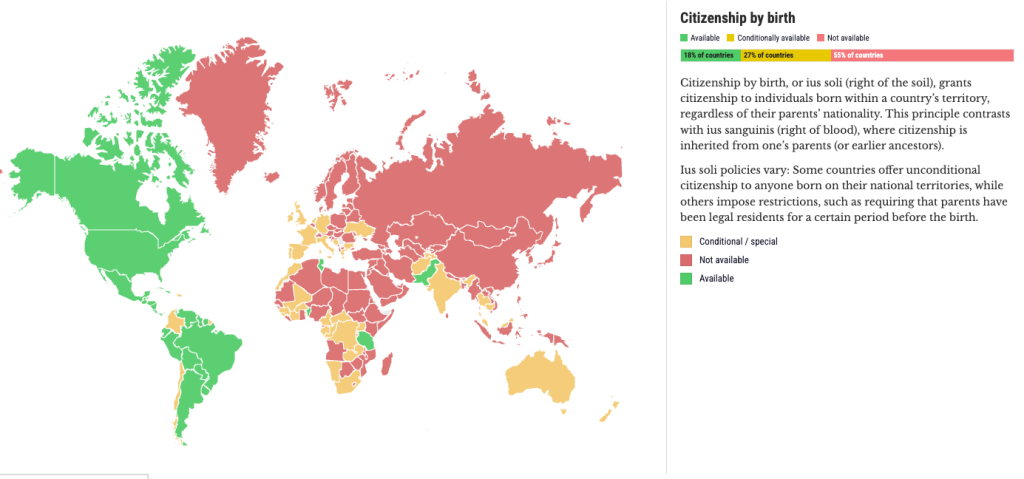
Where a child is born still decides its citizenship in 80 countries. In only 33 does birth alone settle the question, with no condition attached to the parents’ nationality or immigration status. The other 47 attach conditions, and for a globally mobile family those conditions usually decide whether a birth abroad produces a real second passport or a legal dead end.
Birthright citizenship returned to the headlines this summer when the US Supreme Court reaffirmed it on June 30, 2026, striking down the executive order that would have stripped automatic citizenship from children born to undocumented or temporary-visa parents. The ruling preserved the American version, the most prominent example of a doctrine that is retreating almost everywhere else.
Lawyers call the principle jus soli, Latin for right of the soil, which ties citizenship to your place of birth. Its opposite, jus sanguinis or right of blood, passes citizenship from parent to child regardless of where the birth happens, and it is the global default.
The clearest recent picture of who still grants jus soli comes from the Pew Research Center’s March 2026 analysis of the GLOBALCIT Citizenship Law Dataset, which classified the birth-based citizenship rules of 191 countries. That analysis is the basis for the lists below.
This guide covers where a child born on national soil becomes a citizen, split into the countries that grant it automatically and the countries that attach conditions, and it closes with the handful actually worth planning a birth around.

What automatic and conditional jus soli mean
Automatic jus soli means any child born in the country is a citizen at birth, regardless of the parents’ nationality or immigration status. The only routine exclusions are children of foreign diplomats and, in rare cases, children of an occupying force. A tourist, a student, or an undocumented migrant who gives birth in one of these 33 countries has a citizen child. This is the version a family can use by choosing where to give birth.
Conditional jus soli means birth in the country confers citizenship only when a further condition is met. The conditions differ sharply. Some countries require that a parent hold legal residence for a set number of years. Others require that a parent was also born in the country, a rule known as double jus soli.
A few restrict birthright citizenship to members of particular groups, and a few grant it to anyone born there but only on application rather than automatically.
The distinction matters most for the second category, because double jus soli does nothing for a first-generation foreign family. If the rule requires a parent to have been born in the country, and both parents were born abroad, the child does not qualify.
That rule rewards the children of earlier immigrants, not new arrivals. Read past the word “conditional” and most of these 47 countries are closed to a family that simply travels in to give birth. Read more in IMI’s Citizenship Catalog.
The 33 countries with automatic jus soli
Of the 33, 27 sit in the Americas. Birthright citizenship is written into the constitutions of the Western Hemisphere, a legacy of 19th-century settler states that needed to build populations quickly.
In the Americas: Antigua and Barbuda, Argentina, Barbados, Belize, Bolivia, Brazil, Canada, Cuba, Dominica, Ecuador, El Salvador, Grenada, Guatemala, Guyana, Honduras, Jamaica, Mexico, Nicaragua, Panama, Peru, Saint Kitts and Nevis, Saint Lucia, Saint Vincent and the Grenadines, Trinidad and Tobago, the United States, Uruguay, and Venezuela.
Outside the Americas, Pew’s classification leaves only six: Benin, Chad, Lesotho, Mozambique, Pakistan, and Tuvalu. Other trackers sort several of these differently, since the underlying statutes carry qualifications that the category labels flatten. None of the six pairs automatic jus soli with a passport strong enough to make a birth there worth pursuing for mobility.
Being on this list makes a child a citizen. It does not make the parents citizens, and it rarely helps them quickly. That gap is where most of these 33 countries fall away as a family strategy. Two factors decide which of the 33 are worth traveling for: How strong the passport is, and what the parents receive.
Brazil is the standout. Any child born in Brazil is Brazilian at birth, and a foreign parent of a Brazilian child can apply for permanent residency immediately through the family reunification category, with no minimum investment, income threshold, or language test at that stage.
Parents can then naturalize after one year of permanent residency, against the standard four-year timeline, provided they demonstrate Portuguese proficiency and a clean record. A strong regional passport, immediate residency, and a one-year path to citizenship make Brazil the one place where a birth genuinely accelerates the whole family.
The Caribbean grants automatic jus soli across the board. The five Caribbean Citizenship by Investment (CBI) countries, Antigua and Barbuda, Dominica, Grenada, Saint Kitts and Nevis, and Saint Lucia, all confer citizenship on any child born on their soil, as does Saint Vincent and the Grenadines, which has jus soli but no investment program.
For a family already moving through a CBI application, a child born in-country becomes a citizen regardless of where the parents’ file stands, a useful backstop rather than a reason to travel.
The United States and Canada issue two of the world’s most useful passports, but their birthright citizenship does little for the parents. A US-born child cannot sponsor a parent for a green card until the child turns 21, which drains the “anchor baby” idea of most of its practical force.
The 14th Amendment guarantee, reaffirmed by the Supreme Court in June 2026, secures the child’s status, not the family’s.
Argentina once offered one of the region’s quickest parental routes, with naturalization available after two years of residence.
Decree 366/2025, in force since May 2025, tightened the terms: Parents of an Argentine child now begin with temporary residency and must show sufficient means and a clean record before converting to permanent status, and the two-year clock requires uninterrupted physical presence, with any departure resetting it.
Its citizenship provisions have drawn repeated constitutional challenges: A first-instance court struck down the parental restriction in August 2025, and on June 18, 2026, a federal appeals court found the decree’s citizenship reforms unconstitutional, holding that the government could not rewrite the rules by emergency decree.
Argentine rulings of this kind bind only the parties who sued, so the tightened terms stand for everyone else. The child’s jus soli is intact, but the parents’ route is now slower than Brazil’s one-year track and more demanding than it was.
The 47 countries with conditional jus soli
Outside the automatic 33, another 47 countries grant citizenship by birth only when a condition attaches. GLOBALCIT groups them by the type of condition, and the categories can overlap where a country runs more than one rule.
A parent must be a legal resident
Roughly 14 countries take this approach, and it is the only conditional category that reliably helps a resident foreign family. Germany grants citizenship at birth to a child of foreign parents if at least one parent has held legal residence for five years and a permanent residence right, a threshold cut from eight years under the June 2024 reform.
Ireland, which ended unconditional jus soli in 2005, requires that a parent be an Irish or British citizen, a permanent resident, or legally resident for at least three of the four years before the birth. The United Kingdom, Australia, New Zealand, Thailand, and Malaysia sit in the same category.
Three of the Americas’ exceptions belong here too. Chile excludes the children of transient foreigners such as tourists and those without status, so a Chilean birth secures citizenship only for the children of legal residents.
Colombia requires that a parent be a citizen or a domiciled resident, and it opened a separate path in 2019 for children of Venezuelan parents at risk of statelessness. The Dominican Republic restricted its birthright rule in 2010 and 2013, and now requires legal residence, ending the automatic citizenship that once applied to any birth on its soil.
A parent must also have been born in the country
About two dozen countries, most in Europe and francophone Africa, apply this double jus soli rule: France, Spain, Portugal, Greece, Malta, Luxembourg, the Netherlands, Belgium, and a set of West and Central African states among them.
For a foreign family, this category is effectively closed, because it requires a parent’s own birth in the country. Several of these states pair it with a separate route. In France, a child born to foreign parents becomes French automatically at 18, provided they have lived there for five cumulative years since age 11.
Portugal grants citizenship at birth where a parent has held legal residence, a threshold its 2026 nationality overhaul raised from one year to five, in force since May 19, 2026.
Birthright limited to particular groups
Pew places five countries here, where jus soli reaches only specific populations. Liberia grants citizenship only to those of Black African descent. Haiti, Uganda, and Guinea-Bissau limit birthright acquisition along group or descent lines.
Israel sits in the category on narrower grounds: its Nationality Law gives a claim to a person born on Israeli territory who has never held any nationality, and only on application between the ages of 18 and 21 after five consecutive years of residence, which operates as a safeguard against statelessness rather than a general birthright.
Generally available, but on application
Three countries, Costa Rica, Paraguay, and Moldova, grant citizenship to anyone born on their soil without a parental condition, but the citizenship must be claimed through an application or declaration rather than arising automatically at birth.
The broader direction is toward restriction. The United Kingdom ended unconditional birthright citizenship in 1983, Australia in 1986, and Ireland in 2005, with New Zealand following in 2006, while India narrowed its rule in 1987 and again in 2004.
Portugal’s 2026 tightening and the Dominican Republic’s earlier reversal follow the same pattern. The automatic 33 is a shrinking group, not a stable one.
Which births are actually worth planning
A birth abroad is only a real citizenship strategy where two things line up: The country grants jus soli automatically, and the passport plus the parental benefit justify the effort. Measured that way, the list of genuinely useful options is short.
Brazil clears both bars and stands alone in doing so, combining a strong regional passport with immediate residency and a one-year naturalization track for the parents. For families already pursuing Caribbean CBI, a child born in-country is a bonus that locks in the child’s status, not a reason to book travel.
The United States and Canada deliver elite passports to the child while leaving the parents with little for years. The six countries outside the Americas grant automatic citizenship but attach weak passports, which removes the mobility case entirely.
The conditional 47 reward families that have already put down roots. Germany after five years of residence, Ireland after three, or any of the other residence-based countries can pass citizenship to a child born on their soil, but only once the family is established there.
The double jus soli countries are a generational play, delivering citizenship to the children of immigrants who were themselves born in the country, not to the first generation. For a family flying in, those 47 doors are mostly shut.
Geography still decides this. For all the attention birthright citizenship draws whenever a court or a parliament reopens the question, the practical map has barely moved.
A child’s citizenship at birth is easy to secure in the Americas, hard to secure almost everywhere else, and worth actively pursuing in only a handful of places, with Brazil at the front of a very short line.