

Russia’s Federation Council approved two bills on July 24 imposing 14 restrictions on citizens who hold a conviction that has entered into legal force, live outside the country, and are deemed to be evading punishment. The State Duma (Lower House of the Federal Assembly) had passed both unanimously two days earlier, and the upper house took them up as items 18 and 19 at the closing sitting of the spring session.
Neither text is law yet. President Vladimir Putin has yet to sign them, and both enter into force on the day of official publication rather than after any transition period.
Bill 1095029-8, a free-standing statute, carries the mechanism. Its companion, bill 1095042-8, threads consequential amendments through roughly a dozen existing laws, among them the Consular Charter, the Fundamentals of Notariat Legislation, and the statutes governing registration of real estate, vehicles, licensing, state services, and consumer credit.
What triggers the measures
Three conditions must coincide. A criminal sentence or an administrative penalty ruling must have entered into legal force, a competent authority must confirm that the person is evading execution of that punishment, and the person’s departure from Russia must be confirmed.
Criminal convictions qualify under any article of the Criminal Code. Administrative penalties qualify only under a closed list covering foreign-agent violations, public discrediting of the armed forces, calls for sanctions against Russia, calls to violate territorial integrity, and participation in organizations Russia has designated undesirable.


That distinction matters for how the law reads against how it has been reported. It reaches people already convicted, not people merely facing charges.
The 14 measures
Financial restrictions dominate the list. Banks must refuse credit and loan agreements, and must block access to their mobile applications and websites for money transfers. Funds and other property are frozen, with narrow exceptions.
Property and business measures follow. Registrars return applications for cadastral registration and for registration of rights to real estate without considering them. The law bars vehicle registration, restricts driving rights, and blocks registration as an individual entrepreneur or as a professional-income-tax payer.
A third group targets legal capacity. Agencies withhold state and municipal services in electronic form, refuse or suspend licenses and accreditations, and decline notarial acts on the person’s behalf. Powers of attorney no longer work, and electronic signatures are annulled with no route to a replacement.
The consular measures are the ones that reach across the border. Consulates will decline applications for a new foreign-travel passport, for registration of a marriage or a change of name, for legalization of foreign documents, and for retrieval of personal records. They will also decline applications to renounce Russian citizenship.
Withholding travel documents is among the standard levers states use to constrain movement, and it works on a delay here. A passport that cannot be renewed expires on its own schedule.
A ministry, not a prosecutor
Under the adopted text, the Ministry of Justice decides whether to apply and lift the measures, and maintains the public list on its website. Restrictions begin the day after a person’s details appear there.
Five bodies may submit candidates: the Prosecutor General’s Office, the Interior Ministry, the Federal Security Service, the Federal Bailiffs Service, and the Federal Tax Service. Confirming that the person is abroad and evading falls to the Interior Ministry.
This arrangement is new. When the Duma passed the package at first reading on December 18, the decision sat with the Prosecutor General’s Office, which would also have hosted the list.
Of 11 amendments tabled and adopted unanimously over the seven months that followed, two were described as principal. One moved the decision and the list to the Ministry of Justice, the other set out the five bodies entitled to submit candidates.
Entry into force moved as well. The Federation Council’s budget committee, reviewing the December text, recorded that its provisions would enter into force on March 1, 2026, and that implementation would require no additional federal budget spending.
Frozen funds and a special account
Frozen money goes to a special ruble account at an authorized bank, on terms the Bank of Russia will set. Close relatives without independent income may receive a monthly humanitarian allowance drawn from those funds, decided by an interagency commission whose composition Putin will approve by decree, at a level the government sets in agreement with the central bank.
Creditors are not left out. Organizations and individuals who suffer property damage because a listed person cannot perform an obligation may recover that damage, and their legal costs, through the courts from the frozen property.
Getting off the list
The measures lift on several grounds: quashing of the sentence, deferral of or release from serving it, confirmed execution, return to Russia, or death. Someone who should be delisted but is not may file a reasoned application with the Ministry of Justice, which has 20 working days to decide, and a refusal can be appealed in court.
Nothing in the package sets an outer time limit. They run until one of those grounds is met.
The case the sponsors made
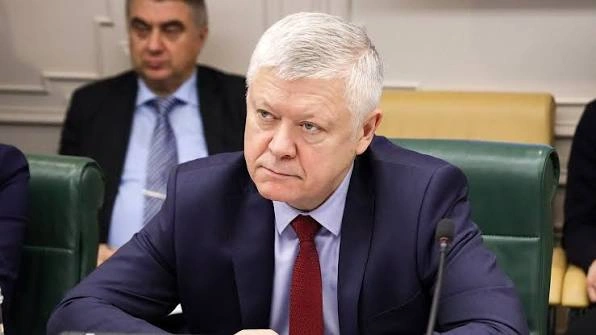
Vasily Piskarev, who chairs the Duma’s security and anti-corruption committee and its commission on foreign interference, introduced the package in December alongside Alexander Alshevskikh, Mikhail Delyagin, and others. Piskarev said at the time that 10,593 Russian citizens were on international wanted lists as of that month, most of them abroad, and that the group included fraudsters, corruption defendants, terrorists, and murderers.
Supporting materials cite Prosecutor General figures showing that foreign states refused to extradite 109 people over 11 months of 2025, after refusing 102 extradition requests in 2024.
Duma Speaker Vyacheslav Volodin framed the vote in blunter terms, describing those in scope as extremists and “traitors to our Homeland” who hide from punishment in other states while working to damage Russia. Volodin said the change would help give effect to the principle that punishment is inescapable.
A passport without its rights
First Department, a legal-aid group working with defendants in politically motivated cases, published an analysis of the bill in December and updated it this month. Its lawyers argue the design amounts to de facto deprivation of citizenship, since the state keeps its jurisdiction and its claims on the person while withdrawing much of what citizenship normally confers.
Someone who left for political reasons and is designated as evading becomes what the group calls an internally “canceled citizen,” holding a passport that has shed many of its rights and none of its obligations. The analysis notes that the passport itself is not confiscated, though an expired one cannot be replaced.
Keeping the nationality while emptying it also sidesteps a legal problem. States that revoke nationality outright risk creating statelessness, which is why most that have expanded citizenship-stripping powers confine them to dual nationals.
That analysis describes the bill rather than the adopted text, and it still identifies the Prosecutor General as decision-maker.
A second law already signed
A related measure reached the statute book last month. Putin signed a law on June 10 expanding the list of administrative offenses for which Russians abroad can be held liable and permitting seizure of their property as an interim measure. It enters into force on September 1.
The two packages originate separately, however. Tatarstan’s State Council sent the Duma a bill in 2024 on administrative liability for offenses committed abroad against Russian interests, and the June law grew out of it.
What happens next
Under Article 107 of the Russian Constitution, an adopted federal law goes to the President within five days, and he signs and promulgates it within 14 days. Counting from July 24, the outer limit falls in the second week of August, though such laws routinely move faster.
Publication on the official legal information portal is the operative event, not the signature. Watch that portal rather than the Kremlin website for the moment the restrictions become available to the Ministry of Justice.



