

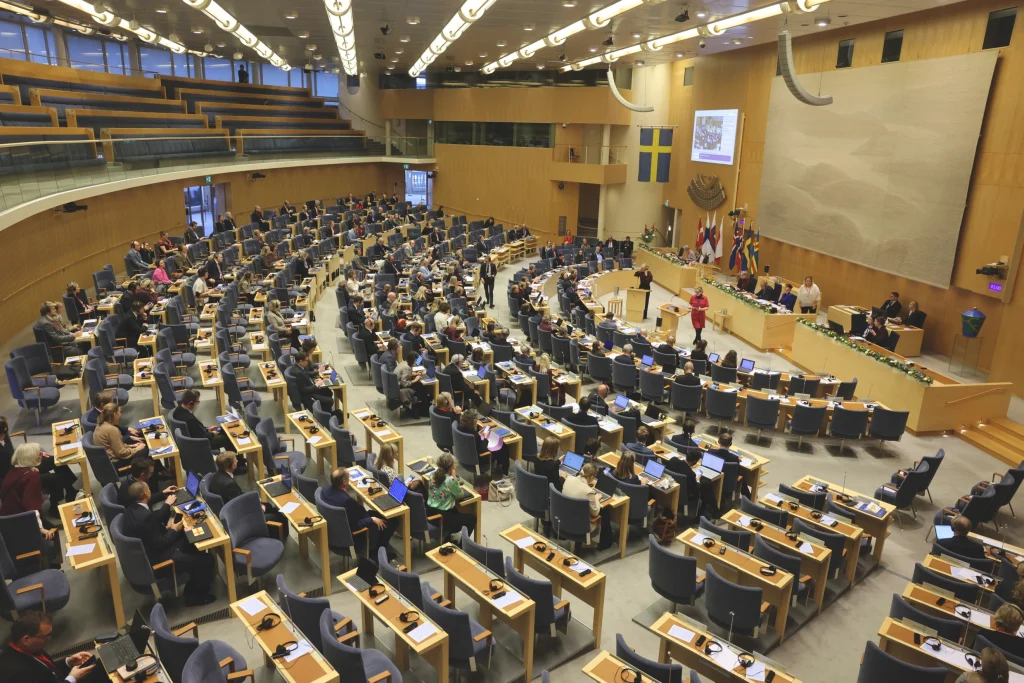
Sweden’s parliament voted on April 29 to approve the most far-reaching overhaul of the country’s citizenship law in more than 50 years. From June 6, 2026, the general residency requirement for naturalization will rise from five years to eight, and applicants will, for the first time, face mandatory language proficiency, civics knowledge, and self-sufficiency tests.
An opposition attempt to attach transitional protections for the more than 100,000 people with pending citizenship applications failed by a single vote, 147-146. The bill passed in its original form with a wide majority, backed by the three governing coalition parties and the Sweden Democrats.
Five Years to Eight, Plus Tests
Under the current rules, most foreign nationals could apply for Swedish citizenship after five years of continuous residence (hemvist). That baseline jumps to eight years under the new law.
Exceptions will apply to specific categories. Nordic citizens and former Swedish citizens will need only two years of residence; stateless persons, five years; and refugees, spouses or cohabiting partners of Swedish citizens, and young adults under 21 will face a reduced seven-year requirement. For spouses and partners, both the relationship and the Swedish partner’s citizenship must each have lasted at least five years.
A self-sufficiency criterion will also take effect immediately. According to EY’s analysis of the bill, applicants must demonstrate annual gross income of at least three inkomstbasbelopp (income base amounts), set at 83,400 SEK for 2026, yielding a threshold of 250,200 SEK per year (approximately US$27,200).

Recipients of income support for more than six months in the three years preceding the application will be disqualified, and certain subsidized employment categories will not count toward the requirement.
Language and civics knowledge requirements enter the statute on June 6, but the testing mechanisms are not yet ready. Civics knowledge tests are expected to begin in August 2026, while a citizenship test in reading and listening comprehension will take effect on October 1, 2027, at the earliest. Further tests covering other aspects of Swedish language proficiency will begin on a date the government has yet to set.
Children will no longer be bundled into a parent’s citizenship application. Under the amended law, a child’s custodian must file a separate application, with conduct requirements applying from age 15 and knowledge requirements from age 16.
Previously, certain categories of applicants, including young people who had grown up in Sweden, could acquire citizenship through a simplified notification procedure. That pathway will be abolished in most cases under the new law.
No Grandfather Clause for 100,000 in Queue
The bill’s most contentious element was never the substance of the reforms themselves, which commanded broad parliamentary support. It was the decision to apply them retroactively to all pending cases.
Swedish law assesses citizenship applications under the rules in force at the time of the decision, not the time of submission. For applicants who filed under the old five-year rule but whose cases remain unprocessed, this means their applications will be evaluated against the new eight-year standard once the law takes effect. Many will face immediate rejection.
All four opposition parties, the Social Democrats, Centre Party, Green Party, and Left Party, submitted a joint counter-motion calling for transitional rules that would have shielded pending applicants. Sweden’s Council on Legislation (Lagrådet) had also recommended their inclusion.
By a margin of one vote, the Riksdag rejected the amendment. Two former Sweden Democrat MPs who now sit as independents, Elsa Widding and Katja Nyberg, voted with the opposition, but three Liberal Party MPs who had been seen as potential rebels were absent from the chamber.

The Kvittning Breach
Within hours of the vote, opposition leaders accused the Sweden Democrats of violating Sweden’s informal parliamentary pairing system, known as kvittning. Under the convention, parties agree to hold back MPs from voting to balance out absences on the opposing side. According to the opposition, the Sweden Democrats sent two MPs who had been designated as absent under the agreement, tipping the result.
Green Party leader Amanda Lind called the move a breach of trust and demanded a revote. The Social Democrats and Centre Party joined the demand. Sweden Democrats group leader Linda Lindberg defended the decision, arguing that the importance of the legislation justified breaking from convention.
Moderate Party group leader Mattias Karlsson acknowledged the disruption but did not commit to supporting a revote. Parliamentary group leaders met on April 30, without the Sweden Democrats present, to discuss the future of the pairing system.
What Happens to Pending Applications
Sweden’s Migration Agency (Migrationsverket) currently processes a backlog of over 100,000 citizenship applications. Processing times range from several months to nearly three years.
For applicants who have lived in Sweden for five to seven years, the new rules will require that they accumulate additional residence time before they can be approved. Those who do not yet meet the income threshold or whose Swedish language proficiency falls short will face further delays, even after the required residence period is met.
The Fair Transition campaign, a grassroots movement organized by affected residents, has indicated that it plans to challenge the retroactive application of the law through Sweden’s Migration Courts and, if necessary, international courts. Should the current government lose the September 2026 general election, the group also intends to lobby its successor to revisit the issue.
Parallel Developments in Europe
Sweden’s decision to lengthen its naturalization timeline contrasts with recent moves elsewhere on the continent. Germany, in 2024, cut its standard naturalization period from eight years to five and extended dual citizenship to all nationalities for the first time. Portugal amended its nationality law the same year to let residents count their waiting time from the date of their residency application rather than the approval date, effectively shortening the path to citizenship.
On the same day as the citizenship vote, the Riksdag also approved new rules designed to make it easier for foreign researchers and doctoral students to obtain residency in Sweden. Under the parallel legislation, PhD students will be able to apply for permanent residence after three years and will have up to 18 months to find employment after completing their studies.



