

Spain’s extraordinary regularization of undocumented migrants closed on June 30 with 1,174,978 applications, more than double the government’s original forecast of roughly 500,000. By mid-June the ministry had logged 900,000 applications, and Secretary of State for Migration Pilar Cancela confirmed the final tally on July 2.
A police union has since put a far larger number into the debate. El Mundo cites immigration-branch commanders who, counting the relatives that migrants may later bring through family reunification, estimate the process could eventually touch three million people. Both figures now circulate together, and the larger one deserves scrutiny.
That three-million figure is not an official statistic. It comes from the Sindicato Profesional de Policía and from Extranjería commanders who reason that each regularized migrant will bring at least three relatives into the country. Periodista Digital, drawing on the same reporting, plainly calls it an internal calculation, not published data.
Their estimate is a multiplier, not a measurement, and Spanish law does not hand out reunification on request. A resident who wants to bring a spouse or child must already show stable income and adequate housing. That floor sits at 150% of the Indicador Público de Renta de Efectos Múltiples (IPREM), a public income benchmark, for a two-person household, with 50% more for each additional member, a bar many of the newly regularized will not clear soon.

Two-thirds of applicants are Latin American, with Colombians the largest single nationality at nearly 26%. The cohort is young and heavily male: men filed 57% of applications, 81% of applicants are under 45, and six in ten are under 34. Many work the low-wage jobs in hospitality, agriculture, construction, and care where the reunification income test bites hardest.

An application is not an approval. Of the nearly 1.2 million filings, officials had admitted 609,737 to processing by July 2, granting a provisional permit pending final review, and just 11,000 had won a definitive yes. Between the government’s original 500,000 estimate and 1.2 million applications lies the space where rejections, withdrawals, and incomplete files will settle.
Irregular arrivals to Spain have fallen sharply even as the country ran its largest regularization in two decades, down about 42% in 2025 and further in early 2026. This program addresses a stock of long-settled residents, not a flow of new entrants. That distinction undercuts the warning that it will act as an efecto llamada, or pull factor, for fresh irregular migration.
Spain’s courts have let the process run. On July 8, the Supreme Court refused to suspend the royal decree and declined to refer it to the Court of Justice of the European Union (CJEU), turning down the regional governments of Valencia and Aragón. Three magistrates had floated a cuestión prejudicial, a preliminary reference to Luxembourg, on June 30, but the full chamber judged it premature once it chose not to freeze the decree, leaving the question open for later.
A second ruling the same day trimmed the wider Immigration Regulation. That ruling struck down provisions that had automatically denied residence to relatives of Spanish citizens with a criminal record, requiring instead a case-by-case judgment of whether the person poses a real and present threat. It upheld the structure of the reform.
Administrative strain is real whatever the final total. The civil-service union CSIF warned in early July that officials had not yet loaded roughly 500,000 case files into Mercurio, the platform that handles immigration paperwork, and that offices faced collapse. To work through the backlog, the National Police opened a plan de choque, paying officers €25 an hour to volunteer for extra shifts.
Police commanders carry a separate grievance. They say the government cut the National Police out of verifying documents and criminal records, leaving the task to Migration Ministry staff they consider untrained for it, an arrangement they warn could invite fraudulent claims of kinship. Immigration officers have said flatly that “el sistema va a quebrar,” the system will break.
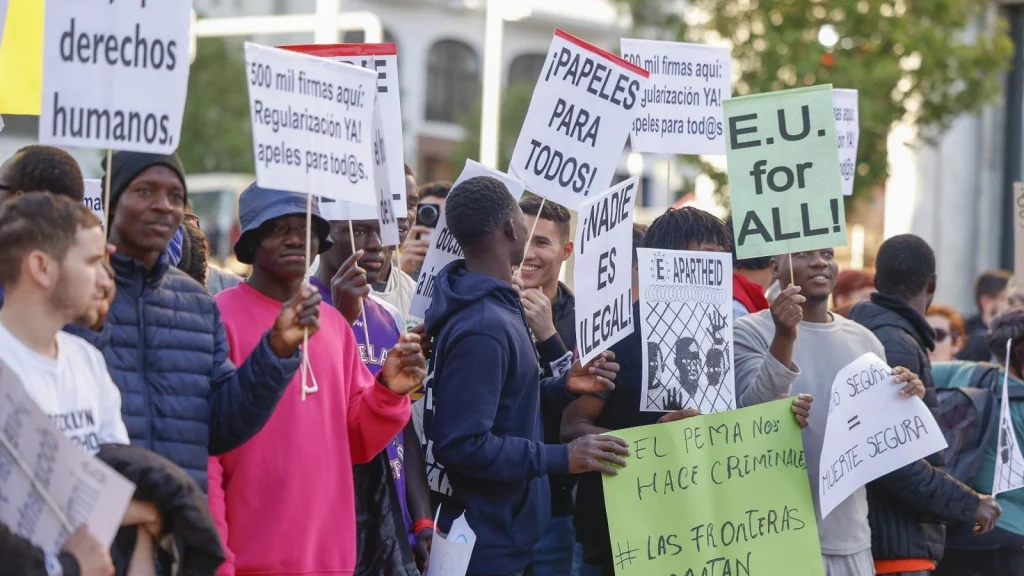
Spain’s government frames the program as fiscal repair rather than generosity. Foreign workers already made up 14.1% of Social Security contributors at the end of 2025, more than 3.1 million people, and the Inclusion Ministry argues that formalizing more of them lifts contributions and shrinks the shadow economy. Critics answer that low wages mean thin contributions, and that dependents who do not work will lean on public health and schooling without paying in.
Philippe May, Founder and CEO at EC Holdings, says that the “Spanish immigration policy makes no sense. Wealthy investors are not welcome, turned away. Undocumented, illegal immigrants without qualifications are welcome. This is not sustainable. Spain will suffer greatly, both economically and culturally.”
Whether three million ever materializes turns on variables the projection sets aside: how many applicants win approval, whether they can meet the income floor for reunification, and how long it takes to convert a one-year permit into the settled residence that reunification requires.
A new permit runs for a year and renews, while reunification rights attach to more durable status. For the Latin American majority, that durable status arrives sooner, since Ibero-American nationals reach Spanish citizenship after two years rather than ten.
The scale of Spain’s regularization is not in doubt. What remains an estimate, resting on a single assumption, is the number that has seized the debate.



