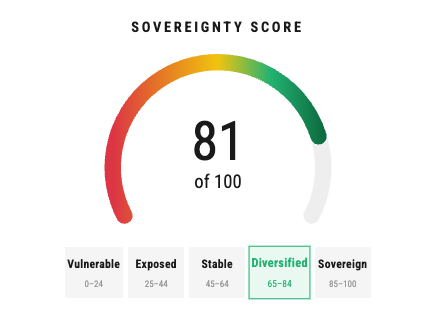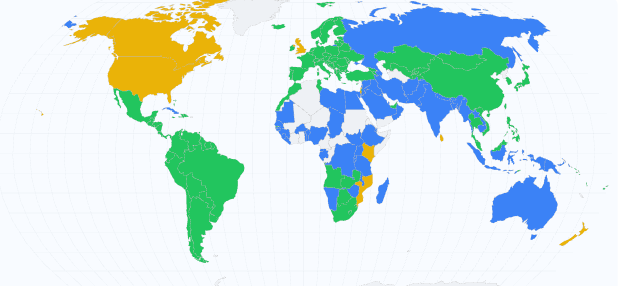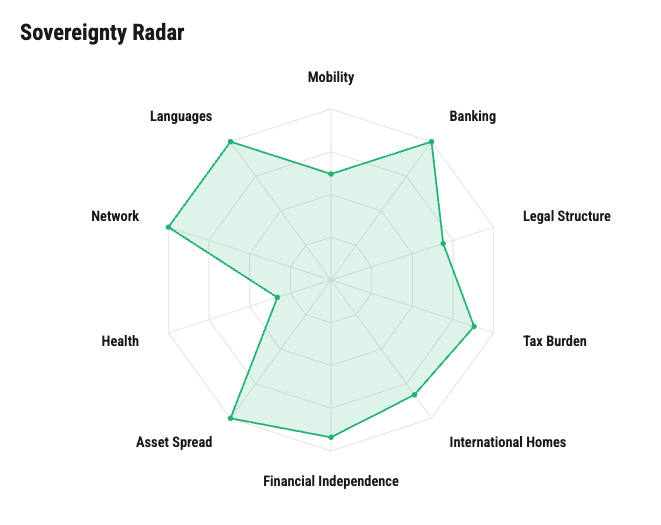
Passport rankings reduce your citizenship to a score. Singapore sits at the top of the 2026 rankings and the weakest passports trail far below, while a single number tells you how many countries you can enter without a visa. That number measures one thing your passport does.
It says nothing about the ways your passport can be used against you.
A single citizenship is a single point of failure. The government that issued your passport can revoke it, freeze your ability to leave, tax you wherever you go, call you or your children to serve, and fail to reach you when you need extraction.
Other governments can downgrade its value overnight, with no appeal available to you. None of these risks appears in a visa-free count, and every one of them traces to the same source: You depend on one sovereign, and that sovereign holds the leverage.
Seven of those failure modes matter most in 2026. Each is documented, current, and traceable to the same single point of dependence.

Your government can take your citizenship back
Citizenship feels permanent. It is not. States hold the power to revoke it, and several are using that power at a scale the history of denaturalization has rarely recorded.
Kuwait offers the clearest case. Since 2024, the country has revoked the nationality of more than 70,000 people, the count as of April 2026, publishing the names in the official gazette week after week.
Counting the dependents who lost status through them, some estimates run toward a quarter of a million, close to one in five Kuwaiti citizens. Women naturalized through marriage and holders of undisclosed second nationalities were swept in.
Those who held only Kuwaiti citizenship became stateless the moment their names appeared. Dual nationals had another country to fall back on.
The United States has moved in the same direction by different means. A June 2025 Department of Justice memo made denaturalization a top civil enforcement priority, directing government lawyers to pursue revocation of naturalized citizenship in all cases permitted by law and supported by the evidence.
Civil denaturalization carries a lower burden of proof than a criminal case, provides no right to a court-appointed lawyer, and can be filed at any point, regardless of how many decades ago a person naturalized. Filings climbed from fewer than ten a year to more than thirty in May and June 2026 alone.
A naturalized citizen with a single passport who loses it has nowhere to stand. One who also holds an original nationality simply reverts to it.
Your government controls whether you can leave
A passport is permission to exit, and the government that grants it can withdraw that permission.
In May 2026, the US State Department began proactively revoking the passports of Americans who owe child support, starting with roughly 2,700 people who owe $100,000 or more.
The legal threshold sits far lower, at $2,500, and the department has signaled the sweep will widen to everyone above it, a group that likely runs into the hundreds of thousands.
A revoked passport cannot be reactivated. If you are abroad when it happens, the most you can obtain is a limited-validity document that carries you back to the United States and no further.
Child support is one trigger among many. Exit bans, used by a range of governments in tax disputes, civil cases, and investigations, can hold a citizen inside a country’s borders with no fixed end date. When your right to travel depends on one state remaining willing to let you go, that right is conditional.
A second passport issued by another government restores an exit that your first has closed.
The tax follows the passport
Nearly every country taxes you on where you live. The United States is the rare exception that taxes on citizenship, applying to worldwide income no matter where a citizen resides, a rule in place since the Civil War. Eritrea runs a similar diaspora tax, and no other country does.
An American who has not set foot in the country for decades still files annual returns, and the IRS is weighing a change to the tax return that would ask dual citizens to identify themselves, a sign the reach is widening rather than easing. Boris Johnson, born in New York and resident in Britain since childhood, renounced his US citizenship in 2016 after the US taxed the sale of his London home.
France came close. On the night of October 24, 2025, during debate on the 2026 budget, the National Assembly voted on a measure that would have extended French tax liability to high-earning nationals for up to a decade after they moved to a lower-tax country, at a threshold of roughly €235,500 and aimed at those relocating to jurisdictions taxed at least 40% below French rates.
It failed by one vote, 131 in favor and 132 against. Taxation tied to nationality rather than residence had been floated before, in 2019 and again in 2024.
A one-vote margin on an idea that keeps returning says more about its direction than the tally alone, and France is not alone: Sweden, Finland, and Germany already tax departing residents for a period after they leave.
The tax trap connects to every other vulnerability through one fact. You cannot renounce your only citizenship. No country will let you make yourself stateless, so shedding a nationality that taxes you is only possible if you already hold another. A second passport is the precondition for ever leaving the first.
Your citizenship can conscript you
Conscription is returning to Europe. Croatia in 2026 became the tenth EU state with a compulsory draft, its first conscripts training in March. Denmark extended conscription to women in 2025, and Germany is rebuilding toward it after suspending the practice in 2011. Ukraine lowered its mobilization age during the war.
A citizen owes service to the state that claims them, and a second passport does not erase that obligation. What a second passport can and cannot do about conscription is narrower than the marketing suggests. It will not exempt you from the duties of the citizenship you already hold.
For your children, though, it can provide a second nationality and a second place to build a life outside the reach of one country’s draft, and it can shape which government has a claim on the next generation.
One government decides whether you get out
When a region destabilizes, your citizenship determines who is obligated to reach you. Consular capacity is not evenly distributed. Ireland runs more than 100 diplomatic missions for a population of five million. Many countries operate a fraction of that, and some cannot reach their citizens in a crisis at all.
The gap becomes concrete when airspace closes. During the Middle East escalations of 2025 and 2026, flight suspensions stranded travelers across the Gulf.
IMI reported that the UAE evacuated 500 of its golden visa holders when airspace shut, the first real test of a consular expansion it had announced months earlier. Governments with the reach and the will to extract people did so. Their citizens and residents got home. Others waited.
A single citizenship ties your evacuation to one government’s capacity and one government’s priorities. A second widens the set of authorities with a reason to help you.
Other governments can downgrade your passport
Even the value your passport holds today is not yours to keep. The country that issued it does not control how other countries treat it.
The United Kingdom has stripped Saint Lucia of visa-free access and revoked the same privilege for Nauru. Nauru’s citizenship by investment program was the stated driver; for Saint Lucia, the Home Office pointed mainly to a surge in asylum claims, with the investment-citizenship program a secondary concern.
A Saint Lucian who could enter Britain without a visa one month needed one the next, through no act of their own. Ireland has since cut visa-free access for Saint Kitts and Nevis, Saint Lucia, and Nicaragua, so this is not one country’s policy.
Visa-free access is a privilege the receiving state grants and can rescind, and the holder has no vote in the decision.
Border technology adds a quieter version of the same problem. As one IMI analysis argues, algorithmic screening systems are building an “invisible wall” that a passport ranking cannot measure, sorting travelers by risk profiles no visa-free count reflects. Your passport’s number can hold steady while its real utility narrows.
Your nationality can become a liability
A citizenship is also an exposure. When a country is sanctioned, its nationals inherit the consequences. Banking access narrows, transactions draw scrutiny, and assets can freeze, none of it tied to anything the individual did. Capital controls work the same way, trapping money inside a border because of where its holder is a citizen.
For anyone whose single nationality carries that kind of risk, a second citizenship in a stable, neutral jurisdiction is a hedge against a decision made in a capital far from where they live.
What a second passport actually fixes, and what it does not
A second citizenship is not the only tool, and honesty requires saying so. A residence permit in another country can expand your mobility and, in some cases, give you a base to ride out a crisis.
Patrick Peters of ClientReferrals cautions that waiting for a crisis to hit isn’t the best practice. He argues that “reality is that the best programs that are available today will either no longer be available tomorrow or be more restrictive/expensive.”
To him, a second passport or residence works if you get it “before you need it.”
He says investors aren’t just “acquiring greater global mobility,” but instead they’re “preserving options that may not be available under the same terms tomorrow.”
He points to governments increasing investment thresholds, strengthening due diligence, and modifying program benefits “with little notice,” and argues that “history has shown that those who act early typically benefit from greater certainty and more favourable conditions.”
A strong first passport already opens most borders. For travel alone, those often suffice, and IMI has covered how to raise your visa-free access without acquiring a new citizenship in detail.
What residence permits and passport strength cannot do is sever your dependence on one sovereign. They do not stop a denaturalization case. They do not end citizenship-based taxation.
They do not give you a nationality to renounce into, a second claim on consular protection, or an exit when your government revokes your passport. Only a second citizenship does that, because only a second citizenship gives another state an unconditional obligation to admit you and to count you as its own.
None of this means every single-passport holder faces imminent danger. Most never trigger a denaturalization review, owe six figures in child support, or hold a nationality heading for sanctions.
The point is narrower and harder to dismiss: A single citizenship concentrates all of these risks in one place, and the cost of that concentration falls entirely on you.