Greece has never had trouble making the case for itself as a great place to live: the climate, the food, and the coastline have been doing that work for millennia. The case it may have struggled to make following the 2008 crisis was as a place of growth and stability, and that is precisely the case the official data now makes on its behalf.
The evidence is not a matter of interpretation. Investment-grade ratings from every major agency, growth running ahead of the eurozone average, record foreign direct investment, and the fastest debt reduction in the currency bloc all point the same way.
Together they describe a country that has done something few economies ever manage: engineered a full reversal of fortune inside a single decade.
A Recovery Measured in Official Data
The scale of the turnaround is best appreciated against its starting point. Greek output contracted by roughly a quarter between 2008 and 2016, and the state financed itself through three international programs; the Golden Visa was among the first instruments Athens deployed to draw private capital back in, and foreign buyers who entered the property market in those years participated in one of Europe’s strongest subsequent recoveries.
What followed can be traced line by line through official accounts. Public debt peaked at 209.4% of GDP in 2020 and fell to 146.1% by the end of 2025, according to the European Commission’s spring 2026 forecast, which projects a further decline to about 134% by 2027.
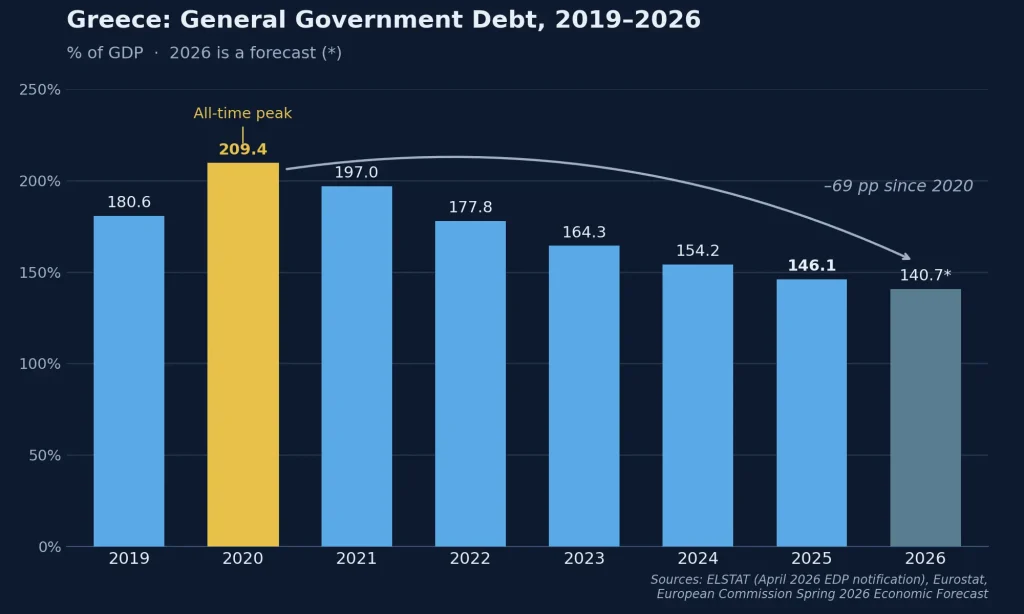
In 2025 alone, the ratio dropped by roughly eight percentage points, the fastest debt reduction in the eurozone that year.
The IMF’s March 2026 Article IV mission put Greece’s 2025 primary surplus at 4.4% of GDP, among the strongest in Europe, and projected that debt would fall to around 110% of GDP by 2031.
On the headline balance, the general government recorded a surplus of 1.7% of GDP in 2025, a year in which most large eurozone economies remained in deficit.
The state has also been paying its crisis-era loans back ahead of schedule. Greece prepaid €7.9 billion of its Greek Loan Facility obligations at the end of 2024 and has committed to further early repayments through 2028, clearing loans that were not due until the 2030s.
What the Ratings Agencies and Bond Markets Say
Greece regained investment grade from S&P in October 2023 and from Fitch in December. Moody’s, the last major agency to move, followed in March 2025, completing the country’s return to the investable universe of pension funds and insurers; S&P and Fitch have since lifted the rating a further notch to BBB.
Bond markets moved even faster than the agencies. Greek ten-year yields converged with France’s in late 2024, and the spread over German Bunds has compressed from roughly 270 basis points in mid-2022 to around 70. Few sovereign credits anywhere have re-priced so decisively in so short a period.
Net foreign direct investment (FDI) inflows reached €11.4 billion (approximately US$13.3 billion) in 2025, up 62% year on year, according to Bank of Greece data. UNCTAD’s World Investment Report recorded US$12.86 billion for the same year, a historic high that exceeded inflows into Turkey, an economy several times Greece’s size, and lifted the country’s cumulative FDI stock past US$100 billion.
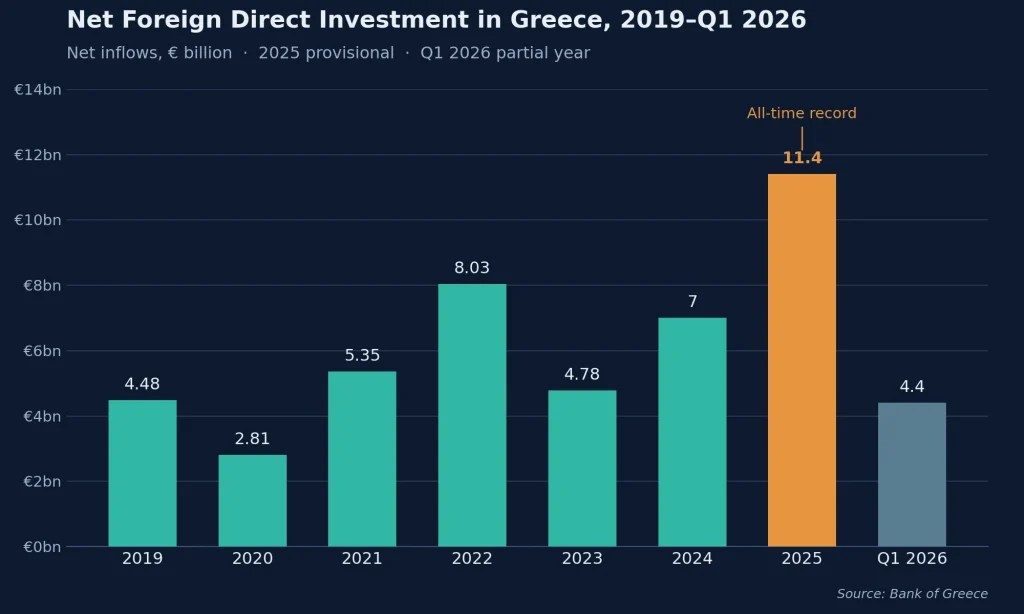
The composition of that capital keeps broadening. The Bank of Greece attributes much of the 2025 surge to energy, alongside growing flows into technology and healthcare, while projects such as The Ellinikon, the redevelopment of the former Athens airport into a residential and commercial district, anchor long-horizon institutional money.
A Safe Harbor in a Complicated Neighborhood
Stability in Greece is institutional before it is economic. The country is simultaneously a member of the EU, the eurozone, Schengen, and NATO, an anchoring few jurisdictions anywhere can match, and one that places Greek residents inside the world’s largest single market and its most established security alliance at once.
The political record supports the same conclusion. Moody’s cited Greece’s stable political environment as a factor in its 2025 upgrade, the same government has pursued a consistent fiscal course across successive terms, and defense spending is set to rise from 2.4% to 2.6% of GDP in 2026, per the European Commission, keeping Greece among the NATO members that meet the alliance’s spending benchmark.

Positioned at the junction of Europe, Asia, and Africa, Greece also functions as a predictable, Western-anchored harbor in a neighborhood where predictability is scarce, which is precisely why capital from the wider region increasingly routes through Athens.
That stability is visible in daily life, and the labor market tells the clearest story. Unemployment fell to 8.1% in May 2026, its lowest level since November 2008 and less than a third of its 2013 peak, according to seasonally adjusted Eurostat and ELSTAT data.
Tourism, the economy’s most visible sector, set records for a third straight year in 2025: 37.98 million arrivals and €23.6 billion in travel receipts, per the Bank of Greece. December arrivals alone rose 49% year on year, a sign the season now extends well beyond summer.
A growing number of visitors are choosing not to leave. Rising foreign demand for long-term residence has made Greece one of Europe’s most sought-after relocation destinations, and the primary vehicle for that demand is the program at the heart of this story.
The Golden Visa in 2026: Structure and Figures
The Greek Golden Visa grants a five-year residence permit, renewable indefinitely as long as the investment is held, with no minimum stay requirement and family coverage for spouses, children under 21, and the parents of both spouses.
Naturalization becomes possible after seven years of genuine residence, one of the shortest routes in the EU.
Since the program’s September 2024 overhaul, real estate qualifies in three tiers: €800,000 in Attica, Thessaloniki, Mykonos, Santorini, and islands with more than 3,100 inhabitants; €400,000 elsewhere; and €250,000 for commercial-to-residential conversions and restorations of listed buildings anywhere in the country.
Standard purchases must be a single property of at least 120 square meters intended for long-term use, a design that aligns investor capital with the housing stock Greece actually needs.
Non-property routes remain open at €350,000 for units in funds and securities invested in Greece, €500,000 for bank deposits or government bonds, and, since January 2025, €250,000 for qualifying startups.
Demand has held up under the higher thresholds. After a record 9,200 initial applications in 2024, roughly 7,000 arrived in 2025, still the third-highest annual total in the program’s history, while approvals nearly doubled to 8,879 as decentralized processing sharply cut waiting times.
The administration keeps strengthening the framework. Legislation proposed in January 2026 would issue residence cards with their full five-year validity from the date of issuance, and a recent circular standardized 22 procedural questions across regional offices while directing sham property offers to the tax and anti-money-laundering authorities.
Tighter enforcement is not a threat to legitimate applicants; it is what protects the program's longevity.
The Leading Real Estate Route in the EU
Portugal removed real estate from its Golden Visa in October 2023; Spain closed its program on April 3, 2025; and Ireland and the UK wound down theirs earlier still. That leaves Greece as the only major EU economy where a straightforward property purchase still anchors a residence permit, one of just eight European golden visas of any kind still operating.
For a family seeking a tangible euro-denominated asset, Schengen mobility, and a jurisdiction whose fiscal trajectory is independently audited and improving, Greece now stands largely alone in combining all three.
Tax treatment adds a further layer of flexibility. Golden Visa holders who stay for fewer than 183 days a year do not become Greek tax residents, while those who relocate may examine the non-dom regime under Law 4646/2019, which offers a flat annual tax of €100,000 on foreign-source income for up to 15 years, subject to a separate €500,000 investment.
The attractive combination has been drawing prominent names alongside the thousands of investors and family members who have obtained Greek residence through the program in recent years. Among the most visible is tennis champion Novak Djokovic, who relocated to Athens with his family in 2025 and obtained a Golden Visa through a property purchase in the southern suburbs of the capital.
A Program Anchored in a Proven Trajectory
Prudent investors will still plan around practicalities: applications move through a queue, qualifying properties are for long-term use rather than short-term rental, and returns should be modeled on the Bank of Greece's price indices and the IMF's projections rather than a broker's assumptions.
Those are the ordinary disciplines of any serious investment, and Greece's data make them easy to apply.
The larger picture is what distinguishes the country. Greece restored surpluses, repaid crisis loans ahead of schedule, regained investment-grade ratings from every major agency, and now borrows at much better rates and terms, all while the Golden Visa helps finance the recovery it was designed to support.
A golden visa is only as durable as the country issuing it, and Greece's next decade looks considerably more interesting than the last: the question for investors is no longer whether the country belongs on the shortlist, but how long it stays this accessible.
Georgaki & Partners Law Firm advises international investors on Greek residence, real estate acquisition, and investment structuring. Get in touch to learn more.