Birthplace, bloodline, residence, language, and investment all shape a child’s citizenship, and every one of those levers is cheapest, or only available, before adulthood.
A child’s citizenship can look settled at birth, decided by the country on the hospital paperwork and the passports the parents carry. In practice, it is one of the few parts of a child’s future that parents can still shape by choice, and most of those choices get harder, costlier, or close entirely once the child turns 18.
The three foundations of a child’s citizenship are all moving at once.
Where a child is born (jus soli, the right of soil), which parents they descend from (jus sanguinis, the right of blood), and whether a family pays for it (jus pecuniae, the right of money) are each being rewritten in real time, as IMI traced in Soil, Blood, and Money.
Two of those three are contracting across wealthy countries while the third keeps expanding, which rewards parents who act early and in the right order.

The levers below are the ones parents actually control. Each one works best, or only works, before adulthood.
Where a Child Is Born Still Confers a Citizenship
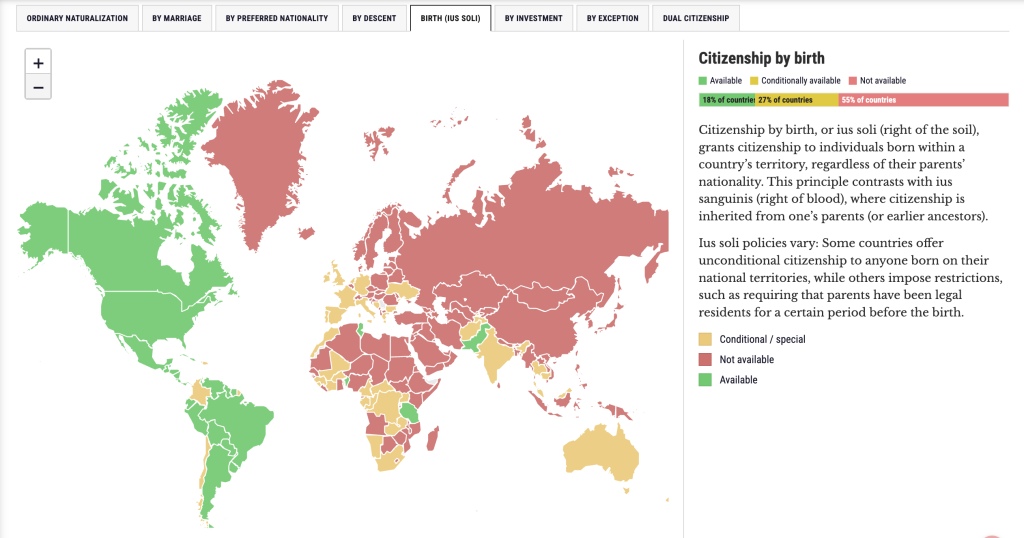
Birthplace is the one advantage that can be secured only once, at delivery, and can never be repeated. A child born in a country that grants unconditional birthright citizenship becomes a citizen at birth, whatever passports the parents hold.
That option is now concentrated in one hemisphere. Around 33 countries still apply unconditional jus soli, and nearly all of them sit in the Americas, from Canada and the United States down through Brazil, Argentina, and most of the Caribbean.
The doctrine has been retreating for decades. The United Kingdom ended unconditional birthright citizenship in 1983, Australia closed its version in 1986, and Ireland scrapped its own by referendum in the mid-2000s, which leaves the Western Hemisphere as the main place where a child’s citizenship still turns on the map rather than the family tree.
The United States remains firmly in that group. On June 30, 2026, the Supreme Court struck down an executive order that would have ended birthright citizenship for children of temporary and unlawful residents, holding that virtually anyone born on US soil is a citizen under the Fourteenth Amendment. The ruling left the legal basis for birth tourism untouched, though the political pressure on jus soli has not gone away.

Several Latin American countries add a second benefit for the parents. In Brazil, a child born in the country is Brazilian at birth, and the parents can apply for permanent residency immediately and naturalize after one year, one of the fastest family routes to a strong passport anywhere.
The Citizenships You Already Hold
Every citizenship you hold is a potential inheritance for your child. Most countries pass nationality from parent to child automatically, so a child born to a dual national can start life with two passports without anyone applying for anything.
Many parents underuse what they already hold. A parent entitled to a second citizenship through their own parents or grandparents, but who has never claimed it, is sitting on a claim their child could inherit the moment it is formalized.
Timing can decide whether that inheritance passes cleanly. In several countries, whether your child qualifies depends on your status at the time of the child’s birth, so acquiring or registering a citizenship before a child arrives, rather than after, can determine what the child receives.
Register the child promptly either way. A child who is a citizen by descent usually has to have the birth recorded with the relevant consulate or civil registry, and leaving that undone can complicate the claim years later, especially once records or witnesses become harder to find.
Ancestral Claims Are Narrowing Fast
Ancestry can hand a child a powerful passport for little more than the cost of assembling documents. Several countries in the EU and wider Single Market extend citizenship to the grandchildren, and in some cases the great-grandchildren, of their nationals, and a child who qualifies through a grandparent can hold an EU passport without the parents ever relocating.
This is the lever narrowing fastest. Italy, long the most generous descent regime in the world, capped jus sanguinis through Law 74/2025, and its Constitutional Court upheld that cap in March 2026, ending the principle that Italian citizenship could pass down an unlimited chain of generations.
The timing rewards speed. Italy’s Court of Cassation, sitting in its highest formation (the Sezioni Unite), heard arguments on April 14, 2026, over whether an ancestor who naturalized elsewhere while their child was still a minor severed the bloodline for everyone after them, and its authoritative ruling, pending at the time of writing, will govern thousands of claims.
Canada expanded descent but attached a condition for the future. Bill C-3 removed the first-generation limit in December 2025, yet for a child born abroad after December 15, 2025, a Canadian parent who was also born abroad must show at least 1,095 days (three years) of physical presence in Canada before the birth, the rule that matters most for parents deciding where a future child is born.
The documentary bar has risen sharply too. In June 2026 Canada ordered some recent recipients to surrender certificates built on unofficial genealogy records rather than certified originals, then reversed course within days, sending revalidation letters from June 19 that told most of them to keep the documents, so the lasting change is a higher evidence standard rather than a wave of cancellations.
The through line is that descent claims decay. Relatives who can attest to a lineage age and pass away, archives stay slow, and governments keep rewriting the rules, so a claim that is straightforward for a young child today can be weaker or gone by the time that child is an adult chasing it alone.
Italy’s own reform shows the age angle directly. Its genuine-link law lets an Italian parent pass citizenship to a minor child by declaration, but only inside fixed windows: three years from birth for a child born after May 24, 2025, and, for a child who was already a minor when the law took effect, a transitional deadline that has been extended to May 31, 2029.
Residence Before 18 Builds Ties Adults Cannot Manufacture
Time on the ground is the quiet lever. A child who actually lives in a country accumulates something an adult applicant cannot buy or backdate: years of physical residence, a school record, friendships, and in many systems, time that counts toward naturalization.
Residence rules increasingly turn on presence rather than paperwork. Portugal’s revised nationality law, in force since May 19, 2026, now treats a child born there to foreign parents as a citizen at birth only if at least one parent has completed five years of legal residence, up from one year under the previous rule.
That single threshold can split siblings. A child born before the parent crosses the five-year mark takes the parent’s nationality and must naturalize later, while a younger sibling born after the threshold is Portuguese from birth, a gap that turns on nothing but timing.
The same law shows why residence planning has to price in moving rules. Portugal also doubled its naturalization requirement to ten years for most applicants (seven for EU and Portuguese-speaking nationals) and now counts the clock only from the date a residence permit is issued.
For a child, the practical takeaway is to start the residence clock early. A family that establishes lawful residence while children are young gives those children the maximum runway to accrue the presence, and in some countries the automatic inclusion in a parent’s naturalization, that a late arrival never gets.
Where a Child Studies Can Anchor a Claim
Education doubles as a residence and integration strategy. Years spent in a country’s school system build the kind of demonstrable connection that immigration authorities increasingly want to see, and in some systems that time supports a naturalization or descent claim rather than sitting idle.
It also changes what a passport is worth. A child who already holds a country’s citizenship, or an EU nationality, typically studies there as a domestic student, with the local tuition rates, student finance, and work rights that non-citizens do not get.
Portugal’s new great-grandchild descent route makes the link explicit. It opens citizenship to great-grandchildren of Portuguese nationals, but only where the applicant has completed at least five years of legal residence in Portugal and can show a genuine connection to the community, exactly the kind of tie a school-age child living there builds year by year.
A Childhood Language Clears the Bar That Stops Adults
Language is the cheapest advantage to give a young child and the hardest to acquire late. A child raised speaking a country’s language reaches native or near-native fluency as a byproduct of childhood, clearing tests that stall adult applicants for years.
Those tests are becoming standard. Portugal’s naturalization process requires that applicants pass an A2 Portuguese exam and a civics test, and its descent routes for grandchildren and great-grandchildren hinge on language and a demonstrated connection to the community.
That requirement stops many adults cold, but for a child who grew up with the language at home or in school it is a formality, which is why language planning belongs in a child’s strategy long before any application is filed.
The Investment Route Adds Children Cheaply
The investment route is the one built for families. Citizenship by Investment (CBI) and Residence by Investment (RBI) programs are designed to include dependent children in the main application, usually for a fraction of the cost of a standalone acquisition.
Grenada shows the economics. Its CBI program, established under the 2013 Citizenship by Investment Act, sets a non-refundable National Transformation Fund donation of $235,000 that covers a family of up to four before government and due-diligence fees, with roughly $25,000 for each additional child beyond that, and it permits dual citizenship with no obligation to set foot on the island.
Golden visa programs work the same way. Most European residence-by-investment routes let a main applicant add a spouse and children to a single application, and a child included young can spend formative years as a resident before the parents ever qualify for citizenship.
One claim deserves scrutiny before you rely on it. Including your child now secures that child’s citizenship, but it does not guarantee the passport cascades to every future generation, because whether your grandchildren inherit it depends on the country’s descent rules, and some restrict transmission for citizens born abroad or naturalized by investment.
The Obligations Travel With the Passports
Extra passports are assets, but they are not free of strings. A citizenship acquired for a child also imports that country’s obligations, and some of those obligations land on the child rather than the parent.
Military service is the clearest example. Roughly 60 countries still conscript, and a dual-national child can fall within a second country’s call-up rules on reaching the relevant age, a liability worth checking before a passport is added, not after.
Tax and status add their own weight. A child who is a US citizen, whether by birth or descent, carries US tax-filing obligations for life, short of renouncing the citizenship, regardless of where they live, and a handful of countries that otherwise restrict dual citizenship require that a person elect a single nationality at the age of majority.
Dual nationality can also complicate custody. Where parents separate across borders, a child’s second passport can become a point of leverage, which is one more reason to document every citizenship a child holds and how it was acquired.
How to Sequence the Levers
Put together, these levers reward a deliberate order rather than a scramble at 18. Future mobility for a child is not a single passport but a portfolio, and the portfolio is easiest to assemble while the child is young.
Start with an audit of what the family already holds. List every citizenship you and your partner carry, then trace both family trees for latent claims through parents and grandparents, since those cost only paperwork and may need to be secured before another child arrives to pass down cleanly. IMI’s Citizenship Catalog maps the paths to citizenship across 195 countries if you need a reference point.
Then use the levers that depend on timing. If the family is mobile, a birth in a jus soli country or an early start on a residence clock can lock in options that a later decision forecloses.
Claim ancestral citizenships while they are still claimable. Relatives age, archives stay slow, and governments keep capping descent, so a claim that is straightforward for a child today can be impossible for that same person as an adult.
Layer residence, schooling, and language underneath. These build the genuine connection that naturalization and descent rules increasingly demand, and they turn language tests and presence requirements into formalities the child clears without effort.
Use investment to fill the gaps the family tree leaves open. A CBI or golden visa program can add a geography the bloodline does not cover, or deliver a passport in months rather than years, with children included in the same application.
Check the obligations before committing to any of it. Conscription exposure, lifelong tax filing, and forced elections at adulthood are all manageable, but only when they are mapped in advance rather than discovered later.
Handled early, this work turns a child’s citizenship from an accident of birth into a portfolio the child can actually use, opening universities, labor markets, and a credible fallback if one country stops being an option. Most of that optionality quietly disappears once the child turns 18.