For professional immigration agents and lawyers, explaining the rationale for acquiring a second citizenship or residency by investment has become increasingly complex. In the past, presenting a visa-free travel map to highlight global mobility was often sufficient.
However, as we move through 2026, with the European Union’s Entry/Exit System (EES) fully operational and geopolitical risks becoming the norm, this single metric can no longer anchor a rigorous professional proposal for high-net-worth individuals (HNWIs).
Through multi-dimensional analysis on Globevisa Group’s newly launched PassportRanking platform, an interesting set of industry data has emerged. Under traditional investment migration paradigms, Sweden and Finland are often considered to hold the “strongest passports” due to their exceptional global access (tying for first place in the Mobility index).
Yet, when the evaluation model expands from solely measuring visa-free travel to a “five-dimensional framework,” incorporating governance, security, education, and quality of life, the overall performance of these two Nordic nations shifts notably. Sweden’s overall passport ranking falls to 6th globally, while Finland drops to 8th.
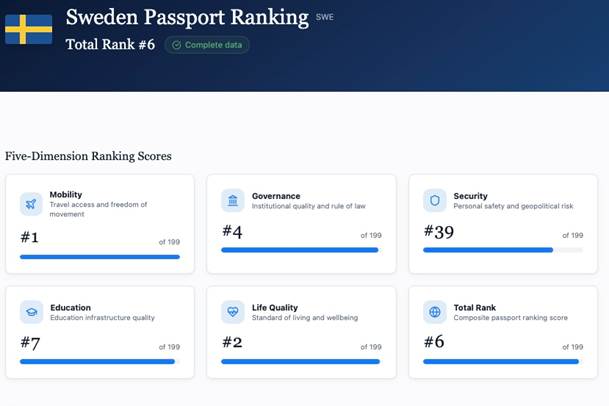
The key factor driving this discrepancy is the “Security” dimension. According to the latest data tracked by the PassportRanking platform, Sweden ranks 39th in the security index, and Finland ranks 44th. While a recent Reuters report on Sweden’s 2025 crime data indicates that gun violence and homicides have declined from their peak, public safety remains a central social issue.
Against the backdrop of a persistently tense security environment in Europe, these factors inevitably influence how high-net-worth families assess the risks associated with European residency and citizenship programs.
Consequently, for investors seeking “safe haven assets” during periods of uncertainty, this gap between security credentials and travel mobility is a core risk that must be evaluated when making dual citizenship or residency decisions in 2026.
Shifting the Focus from Travel Scope to Risk Resilience in Investment Migration
In practice, industry professionals recognize that HNW client priorities are shifting from “where can I go” to “where is it stable.”
Take Switzerland as an example. Looking solely at travel convenience (visa-free access), Switzerland ranks 12th in Mobility on the PassportRanking platform. To clients prioritizing immediate travel flexibility, it may appear less attractive than Spain or Italy (both tied for 3rd in mobility). However, Swiss residency ranks 1st globally in Governance, 3rd in Security, and 4th in Education.
This suggests that when clients pursue Swiss residency or citizenship, they are prioritizing a stable legal environment, higher public safety standards, and an established education system over mere travel convenience.
From a wealth management and consulting perspective, the value of a second passport or residency status transcends the travel document itself; it represents a comprehensive global mobility solution that offers certainty for long-term planning.
Upgrading Residency by Investment Evaluation Models Amid Policy Volatility
Why is a more complex evaluation matrix necessary for the investment migration sector? A direct reason is the increasing instability of the policy environment itself.
Consider Europe’s Golden Visa programs. Over the past year, Portugal, Greece, and Spain have all implemented various policy adjustments to their residency by investment schemes, including narrowed investment routes, raised financial thresholds, and program closures.
Within the PassportRanking platform’s logic, these changes fall under the Governance dimension. Frequent policy shifts typically signal broader challenges to institutional stability and policy continuity. For applicants requiring a long-term European residency, these indicators are often more relevant than short-term promotional messaging.
The Education dimension follows a similar logic. According to PassportRanking data, Germany ranks 1st in education, while Australia ranks 2nd. For families whose primary goal is their children’s education, the long-term value of these educational resources remains a significant draw, even if the immigration application thresholds for these countries are higher and the processing timelines longer.
The Practical Value of a Five-Dimensional Passport Ranking Model
The core value of Globevisa’s PassportRanking platform lies in consolidating traditionally fragmented evaluation factors for second citizenship and residency into an easily comparable framework. Under this system, the evaluation dimensions include:
- Mobility: Encompasses the number of visa-free destinations and additional weighting for residency rights granted by treaties (crucial for global mobility).
- Governance: Assesses the destination country’s rule of law, anti-money laundering (AML) compliance (e.g., presence on the OECD grey list), and immigration policy stability.
- Security: Evaluates social safety and geopolitical risks in the target region.
- Education: Based on the quality of public education and the presence of top-tier universities.
- Life Quality: A composite of healthcare standards, GDP per capita, and environmental factors.

This design helps investment migration professionals move beyond discussions solely focused on visa-free numbers when comparing multiple global residency options.
Instead, it integrates policy stability, social safety, educational resources, and quality of life into the assessment. When two countries offer similar levels of mobility, the governance, education, and security dimensions often become the decisive factors for an investor’s final choice.
A Holistic Tool
The investment migration industry is entering a phase that increasingly emphasizes data, stability, and long-term value.
The focus of professional consultancy is shifting from simply “processing applications” to “helping clients identify the most suitable long-term residency or citizenship by investment solutions.”
Throughout this process, an evaluation framework that simultaneously covers mobility, governance, security, education, and quality of life is becoming an increasingly vital decision-making tool.
For applicants, the ultimate value lies not merely in a higher passport ranking, but in a residency or citizenship choice that is sustainable, predictable, and aligned with their long-term planning.
We invite immigration industry professionals worldwide to utilize PassportRanking. It is more than just a leaderboard; it is a rational, professional tool designed to help you navigate complex HNW client needs in the evolving landscape of global migration.