
On February 24, 2026, the United States Department of the Treasury’s Financial Crimes Enforcement Network (FinCEN) formally rescinded Advisory FIN-2014-A004, a 2014 notice that had warned American financial institutions about the abuse of St. Kitts and Nevis citizenship by investment (CBI) program by illicit actors.
For more than a decade, that advisory had shadowed the world’s oldest CBI program, complicating banking relationships and lending ammunition to its critics.
Its rescission is not a diplomatic courtesy. It is an acknowledgment, by the world’s most consequential financial regulator, that something real has changed in St. Kitts.
Prime Minister Dr. Terrance Drew credited three years of reform, pointing specifically to the establishment of the Eastern Caribbean Citizenship by Investment Regulatory Authority (ECCIRA) as evidence of the region’s seriousness.
CIU Executive Chairman Calvin St. Juste put it plainly: “We took the advisory seriously and implemented comprehensive reforms to our due diligence processes, compliance framework, and security measures.”
What CBI Reform Looks Like
The reforms that produced the FinCEN rescission did not arrive overnight, and they were not cosmetic.
In June 2024, the National Assembly passed the Citizenship by Investment Unit Act, converting the CIU from a government department into a fully independent statutory corporation with its own Board of Governors, CEO, CFO, and a dedicated Chief Due Diligence and Anti-Money Laundering Compliance Officer. That last role is new to the organizational chart, reflecting St. Kitts’ prioritization of financial integrity as a first-order program function rather than a compliance afterthought.
Alongside structural reform came procedural ones. Due diligence checks are now commissioned by the CIU and conducted by independent professional firms from the United Kingdom, USA, and Europe. Mandatory interviews apply to all applicants and dependants aged 16 and over.
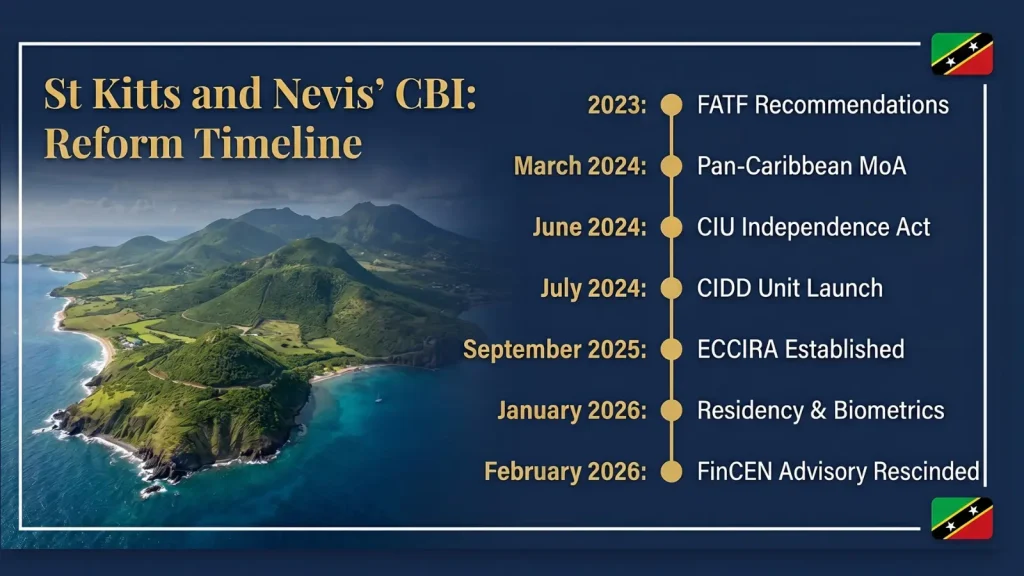
Moreover, St Kitts established a Continuing International Due Diligence (CIDD) Unit, headquartered in Europe, to monitor approved CBI citizens on an ongoing basis, flagging to the Ministry of National Security anyone under investigation abroad after receiving a St Kitts CBI passport.
The Continuing International Due Diligence (CIDD) Unit, headquartered in Europe, monitors approved CBI citizens on an ongoing basis, flagging to the Ministry of National Security anyone under investigation abroad. No other CBI program anywhere has built post-approval monitoring into its architecture.
A Regional Architecture, Not Just National Policy
Saint Kitts did not move alone. The reforms form part of a broader regional realignment that began with a March 2024 Memorandum of Agreement signed by all five Caribbean CBI nations, which established a $200,000 minimum investment floor across programs, mandatory regional interviews, shared databases of rejected applicants, and coordinated suspension of Russian and Belarusian applications.
That architecture was then given permanent institutional form. In September 2025, the Organisation of Eastern Caribbean States (OECS) heads of government agreed to establish ECCIRA, the region’s first unified supervisory body for CBI programs, based in Grenada.
ECCIRA introduced centralized vetting, standardized pricing floors, a shared registry of applicants and agents, and mandatory biometric screening at passport renewal. International partners, including the United States, the United Kingdom, and the EU, explicitly welcomed the move.
The Genuine Link Framework
The most far-reaching change is still unfolding. On January 8, 2026, the government formally announced that the program will shift from a donation-centric model to one built around genuine link requirements: structured physical presence, meaningful economic activity such as business establishment and job creation, and long-term social or civic engagement.
CIU Chairman St. Juste described this as the “most ambitious transformation” in the program’s 42-year history. The Innovation Pathway, introduced alongside the genuine-link framework, opens a route for applicants engaged in research, technology, or skills transfer.
A concierge service called “Priority One” will assist new citizens in meeting legal, fiscal, and civic obligations after approval, a signal that the government now regards citizenship as the start of a relationship rather than the conclusion of a transaction.
Where St Kitts’ Program Stands Today
The numbers tell a more nuanced story than a simple recovery. CBI revenue dropped sharply from 22% of GDP in 2023 to 8% in 2024, and the IMF’s 2026 Article IV mission estimated it fell further to approximately 5% of GDP by 2025, the short-term cost of a program in structural transition.
Applications surged 169% in Q4 2024 once the reforms were bedded in, and crucially, rejection rates rose alongside them.
The 2025 CBI Index ranked St. Kitts and Nevis the world’s best CBI program for the fifth consecutive year, awarding it a perfect ten for both ease of processing and due diligence.
Whether revenue follows the application rebound through 2026 will depend partly on how quickly the genuine-link framework beds in, but the IMF projects GDP growth accelerating to 2.2% in 2026, supported in part by a stabilizing program.
Moreover, the FinCEN rescission in February 2026, announced while PM Drew was hosting the 50th CARICOM Heads of Government meeting and holding a bilateral with US Secretary of State Marco Rubio, confirmed the direction of travel.
The EU’s scrutiny of Caribbean CBI has not abated, but Saint Kitts is better positioned than any of its regional peers to meet it.
A December 2025 EU Commission report acknowledged the steps all five nations had taken in response to earlier concerns, and the reforms Saint Kitts has since added, including ECCIRA, biometrics, and the genuine-link framework, go further still.
For investors evaluating where Caribbean citizenship stands in 2026, the question is no longer whether Saint Kitts is under pressure. It is whether the program emerging from that pressure is built to endure. Washington’s formal answer in February suggests it is.
The reforms reshaping St. Kitts & Nevis citizenship are moving fast. Getting them right requires counsel on the ground. To navigate the 2026 framework and secure your application under current rules, get in touch with Joseph Rowe Law.