
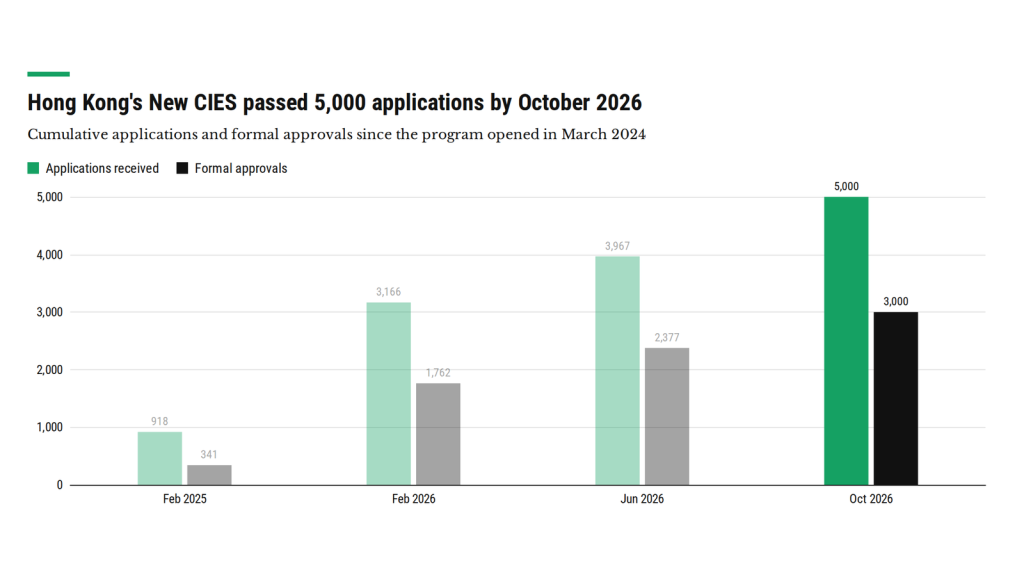
By end-October, over 3,000 applicants to Hong Kong’s New Capital Investment Entrant Scheme (New CIES) had invested and won formal approval. That compares with 1,762 on February 28, 2026.
On November 13, the Financial Services and the Treasury Bureau (FSTB) said applications had passed 5,000 over the same period. It expects them to bring more than HK$150 billion in investment to Hong Kong.
Secretary for Financial Services and the Treasury Christopher Hui gave the same figures that day at the Sing Tao Global Economic Summit 2026. He based the HK$150 billion on an investment of HK$30 million per application, if every application is approved.
From 918 to More Than 5,000
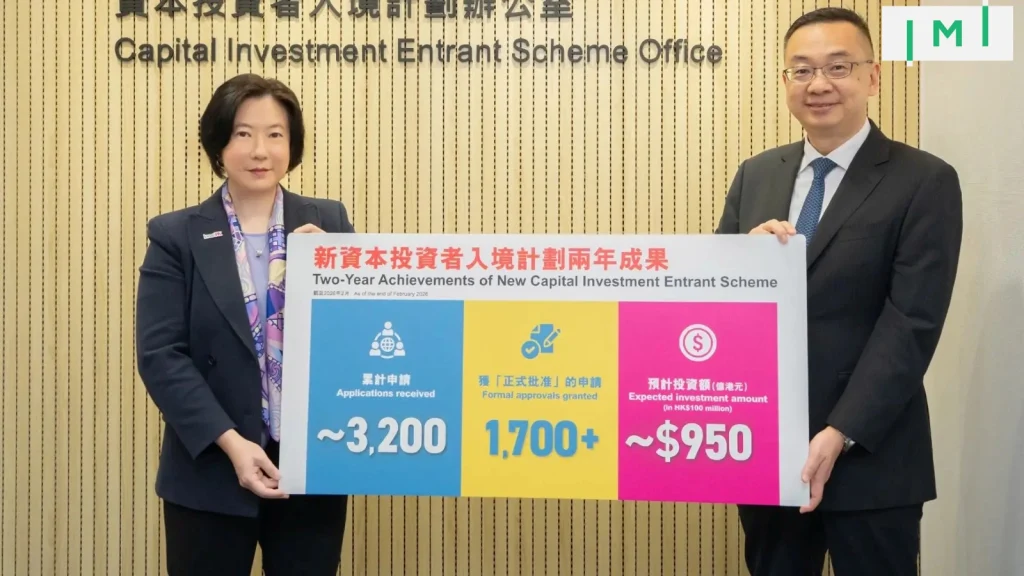
The program opened in March 2024. By end-February 2025, it had received 918 applications, and the Immigration Department had formally approved 341.
Applications in the second year rose by 145% to 2,248, taking the total to 3,166 in the program’s first two years. Invest Hong Kong (InvestHK) counted 3,967 by June 18, 2026, when 2,377 had formal approval.
Applicants first receive approval in principle from the Immigration Department. It lets them enter Hong Kong as visitors for up to 180 days to make the investment.
The gap between applications and formal approvals “isn’t a backlog,” says Chris Land, managing director of Marlow Bray. “Most of those applicants have approval in principle and are simply finishing their investment before formal approval lands,” he says.
Expected investment climbed with each update. It passed HK$27 billion by end-February 2025 and reached about HK$95 billion a year later.
InvestHK put it at about HK$108 billion as of end-April 2026, after Hui had cited HK$99 billion in mid-April.
Against the Original Target
When the program launched in March 2024, Hui based his projection on the 4,000 applications the previous program received on average each year. The Standard, a Hong Kong newspaper, framed the goal at the time as 4,000 wealthy investors and HK$120 billion in a single year.
Neither completed year reached it. Year one brought 918 applications and year two 2,248.
Stephen D. Barnes, co-founder of Hong Kong Visa Centre, says there is “no single silver bullet” behind the rise in applications since April. “The biggest driver we are seeing on the ground is April’s tightening of Hong Kong’s entrepreneur visa rules,” he says.
Clients once set on the entrepreneur route “now find those operational requirements far more onerous, so they are opting for New CIES instead,” he says.
Land, who has worked in Hong Kong for 19 years, says the conversation has changed. “In 2022 clients asked me whether they should leave HK. Now families from the mainland, Southeast Asia and the Middle East are asking how they get in.”
Of the HK$30 million minimum, HK$3 million goes into the CIES Investment Portfolio, managed by the government-led Hong Kong Investment Corporation. Its money backs technology and innovation firms. Applicants place the other HK$27 million in permissible financial assets and/or property.
Barnes calls the rest of the program “essentially a liquidity-park and portfolio-relocation play rather than direct job-creating capital.” He adds that “private wealth managers are actively selling the product.”
A Designated-Account Rule
A stricter rule applies to Net Asset Assessment applications submitted on or after November 1, 2026. Financial assets acquired through non-designated accounts no longer count toward the investment requirement.
The official New CIES website says transfers of financial assets from non-designated to designated accounts are no longer accepted. Assets counted toward the committed investment must be transacted through designated accounts.
Barnes says the rule hits applicants who already own qualifying assets in Hong Kong. It “turns what used to be a simple custodial transfer into a forced sale-and-repurchase exercise,” he says. Such applicants “must now liquidate positions in their existing accounts, move the cash into a new designated account, and buy back in,” he says.
Applicants must show net assets of at least HK$30 million throughout the six months before they apply. The government cut that period from two years in March 2025.
Investors who have ordinarily resided in Hong Kong for a continuous period of at least seven years may apply for the right of abode.
Siren Chen, chief marketing officer of Globevisa, sees “noticeably stronger intent among mainland Chinese applicants this year to genuinely relocate to Hong Kong.” Fewer treat residency as a passive “Plan B,” she says.
“A growing share of our clients are moving beyond securing a contingency option,” Chen says. They “are actively relocating their families, businesses, and daily lives to the city.”
Gold and Fund Tax Changes
On November 11, legislator Robert Lee asked whether physical gold could count as a permissible asset. Hui wrote in reply that the government “will continue to keep in view” the program, “including the arrangements for permissible investment assets.”
The FSTB also plans amendments to a bill on tax concessions for funds and single family offices. One change would relax the 20% cap on precious metals as tax-exempt qualifying investments.
A second would widen the definition of “fund” to include perpetual funds with no fundraising deadline. Officials aim to pass the bill this year.
Land says he would “be surprised if the government raised the bar now.” The program “is doing what it was built to do,” he says. He adds that “making it easier to use brings in more than making it easier to qualify for.”
IMI program guide: Hong Kong New CIES
IMI program guide: Hong Kong Capital Investment Entrant Scheme (CIES)