Henry Fan
Hong Kong
On May 14, 2024, the Australian government officially announced it would permanently close the Business Innovation and Investment Program ( (BIIP) as of July 2024, turning the series into a chapter of history.
This move is not entirely unexpected; it has been the topic of discussion for some time. I suspect many of us, while feeling a twinge of regret, are not exactly taken aback.
Beyond this, the government revealed two more pieces of news:
- The government will launch a new National Innovation Visa by the end of this year, replacing the Global Talent visa (subclass 858), commonly known as GTI.
- From September this year, applicants wishing to withdraw their BIIP applications can request a refund of their visa application fees from the immigration department.

Remember, before September 2024, the only way for Australian investment immigration applicants to get a refund from the immigration department was if the applicant passed away.

This has caused quite a stir, as many feel as if the government has written them off. It seems the government would rather give back the money than approve the applications because – apparently – they don’t want investor immigrants anymore.
The immigration department has declared it will continue processing submitted applications, as they will remain unaffected by the policy shutdown. However, the government will tighten the BIIP policy guidance to ensure that all applicants it approves benefit Australia’s economy. How they will deal with the substantial backlog of submitted applications is becoming apparent.

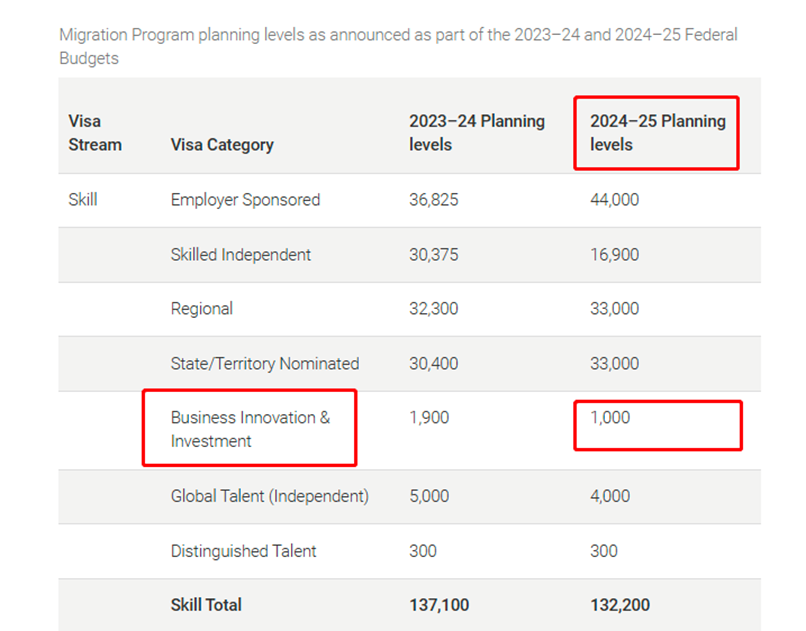
The official release of the latest immigration quota for the 2024-2025 fiscal year reveals that the government has allocated 1,000 spots to the BIIP category.
As the BIIP is now closed, no new applications will be accepted. This means that all 1,000 quotas for the 2024-2025 fiscal year will be dedicated to applicants who have already submitted their applications.
Combining the official news and quota release, here’s my analysis:
Processing of applications
The government will continue to review the applications on hand, and there will be no forced refunds. The government announced the refund policy alongside the introduction of the National Innovation Visa at the end of the year.
The government emphasizes that applicants have new options through the new program. If they feel the review process is too slow, they can withdraw from the old application, and the government will support the refund. This policy is the immigration department offering applicants more humanized choices in the context of the policy shutdown, not a forced refund.
Rising standards
Continuing to review applications doesn’t mean that applicants can pass as easily as before the policy change. According to the immigration reform logic, the government will raise the review threshold; otherwise, the purpose of the reform would be lost.
This is especially true for the 188C stream, which was popular among many high-net-worth individuals of advanced age due to its lack of age restrictions and personal resume requirements; these groups that no longer bring economic benefits to Australia may be affected and unable to get approval, even if the review continues.
Selective admissions
Applicants boasting excellent criteria, such as advantages in age, business experience, and personal resume, will be more likely to get approval in the upcoming reviews. Moreover, they will have more opportunities in the future to get approval through other programs that the government will subsequently introduce.
Shifting of Australia’s economic structure
Although the Australian government claims to open up new options for potential immigrants, it has clearly abandoned the traditional investment immigration route.
Australia has gone even further than its counterpart Canada by suspending entrepreneurial routes, namely subclass 188A and 132. The reason behind this is the local business environment has developed to a critical point where the export trade of wine, seafood, and fruit is no longer as desirable as it was.
The introduction of the National Innovation Visa marks Australia’s determination to catch up with the intelligence industry. It is practically the route for every developed country to shift from a mere service and trading sector to a more advanced sector in the face of a global talent acquisition war.
Investment immigration is typically a marathon, not a sprint, demanding extensive preparation and patience. Many applicants find themselves in a protracted period of uncertainty, still awaiting a response after years of waiting.
This lingering limbo can indeed cast a shadow of despair. The story of Waiting for Godot plays out frequently in the world of immigration, and I believe I grasp the sense of helplessness as fate seems to dangle just out of reach. But on the path of choosing our future and shaping our lives, we cling to hope, undeterred.