Today, the IMI Research Unit releases for publication the second edition of our guide, 13 Special Regimes for Low-Tax Living in High-Tax Europe, which provides detailed information on how you or your client can pay a single-digit tax rate while living in eight otherwise high-tax European countries.
Download the guide in the IMI Pro Members’ Lounge now.
About the Guide
Europe, despite its flaws, remains one of the world’s leading regions for quality of life. With its high levels of material comfort, security, political stability, and old-world charm, the continent continues to attract a global audience.
Yet, the region’s consistently heavy tax burdens on both individuals and businesses remain a notable drawback.
This report is for those drawn to Europe’s lifestyle but deterred by its steep taxation. It reveals how you (or your client) can take advantage of special tax regimes crafted by European governments to ease the fiscal impact on foreigners, allowing you to enjoy the best of both worlds.
For each country, we also provide guidance on obtaining residence permits for third-country nationals who need legal authorization to stay in Europe. These permits are typically granted by proving a certain level of income or assets, or by making an investment in the country.
The second edition of IMI’s Low-Tax Living in High-Tax Europe report explores 13 preferential tax regimes across eight European countries: Greece, Ireland, Italy, Malta, Portugal, Poland, Spain, and Switzerland.
11 of these regimes offer a path to achieving a single-digit effective tax rate in nations where top marginal income taxes exceed 30%.
This report does not cover European countries with inherently low tax rates, such as micro-states like Monaco, Gibraltar, and Andorra, or larger nations with comparatively low rates, such as Hungary, Estonia, and Czechia.
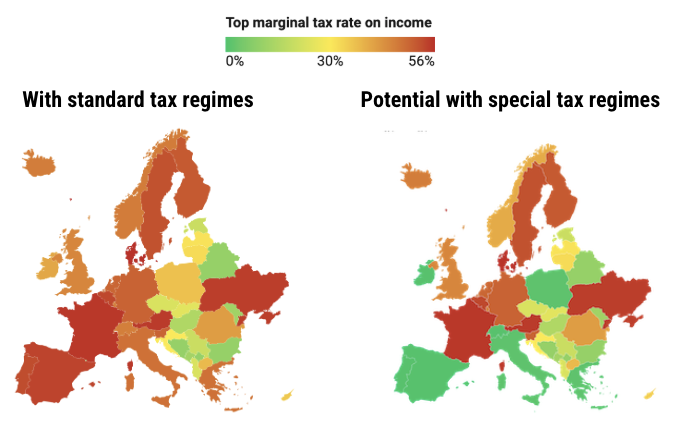
Europe’s preferential tax regimes come in various forms, each designed to accommodate specific categories of tax residents.
Some regimes are particularly advantageous for individuals with high passive incomes, such as dividends, capital gains, interest, rental income, royalties, and similar sources.
Others are tailored to those with substantial professional incomes, including senior executives, athletes, remote workers, and social media influencers.
Likewise, certain regimes are only financially viable for those earning millions, while others offer exceptionally low tax rates even to employees with modest salaries.
Although Europe is traditionally a high-tax region, leveraging these special regimes can transform it into a veritable tax haven.
Expert contributors
The guide contains contributions from specialists from each jurisdiction:
- Alexander Varnavas, Managing Partner at Varnavas Law Firm
- Liz Cahill, Partner at EisnerAmper Ireland
- Marco Mesina, Founder and CEO at Move to Dolce Vita
- Jean-Philippe Chetcuti, Managing Partner at Chetcuti Cauchi Advocates
- Magdalena Patryas, Partner at Andersen in Poland
- Daniela Lopes Costa, Tax Partner at OTS-LCCV Law Firm
- Sergio Gorina, Tax Attorney at Giménez-Salinas Abogados
- David Lesperance, Managing Partner at Lesperance & Associates