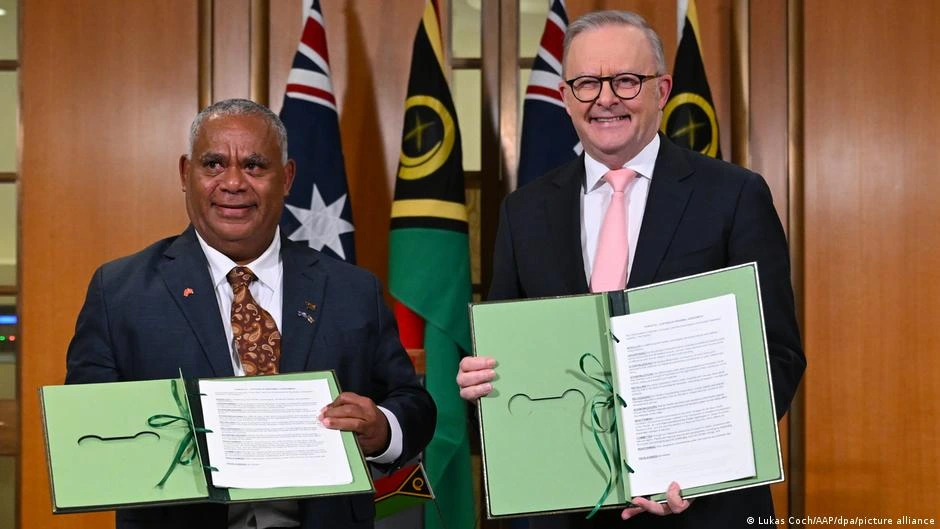
Vanuatu has committed to building mechanisms that distinguish citizenship by investment (CBI) from other forms of citizenship. The pledge sits in Article 6 of the Nakamal Agreement, a ten-year pact that Prime Ministers Jotham Napat of Vanuatu and Anthony Albanese of Australia signed in Canberra on Monday.
Australia agrees to provide “enhanced mobility arrangements for Vanuatu visitors to Australia,” while Vanuatu agrees to “develop effective mechanisms to differentiate citizenship by investment from other forms of citizenship.” A third clause commits both governments to review the mobility arrangements every year.
Nothing in the agreement defines what “enhanced mobility” delivers. It attaches no visa waiver or specific visa category to the phrase, committing only to the annual review. Vanuatu’s Daily Post reported that the pact “did not deliver the much sought-after visa-free travel status” that Napat had pressed for.
Napat had pressed the point in July last year, refusing to sign unless Australia granted visa-free travel and casting the pact as one that had to work for both countries. Canberra has long resisted relaxing travel rules for Pacific nationals, wary of overstays, and Vanuatu’s investor citizenship program sharpened that reluctance.
Outside the agreement text, Australia has assured Vanuatu that it will return to the 2026-27 Pacific Engagement Visa ballot with an allocation of 150 places, according to the Daily Post, after dropping the country from the eligible list earlier this month. That permanent-residence ballot opens for applications on July 1.

A Distinction Vanuatu Previously Worked to Remove
For most of the previous decade, Vanuatu moved in the opposite direction. It dropped the word “honorary” from citizenship granted under its Development Support Program in April 2019, a change its promoters cast as removing any sense that investor citizenship formed a separate category open to future discrimination. A 2020 proposal to issue economic citizens a different-colored passport drew objections and went nowhere, and Article 6 now commits the country to build the distinction it once worked to erase.
The Mobility Backdrop
Brussels stripped Vanuatu of visa-free Schengen access in December 2024, the first time the bloc had removed a third country from its visa-exempt list, citing security and migration risks tied to the investor citizenship program. Britain had imposed a visa requirement on all Vanuatu citizens in July 2023 on similar grounds.
Even so, the programs have continued to raise revenue, and Vanuatu’s minimum contribution remains US$130,000 for a single applicant. All three of Vanuatu’s CBI programs process applications within weeks.
What the Text Does and Does Not Say
The treaty requires that Vanuatu be able to tell its citizenship categories apart. It does not say how Australia will treat each category at the border, and practitioners read that gap differently.
Rosalind Cox, a director at Stanford Knight & Partners, grounds her reading in discussions with Vanuatu officials. She sees Article 6 as “an enhancement for every Vanuatu citizen, not the creation of different classes of citizen,” aimed at making travel and visa applications easier.

Cox cautioned against misreading the word “differentiate.” The intent “is not about treating citizens differently at the border,” she said, but about Vanuatu distinguishing “within its own records” between indigenous, naturalized, and investor citizens. That, on her account, is “a record-keeping and database commitment, not an exclusion.”
Differentiation lets Vanuatu answer security queries, she added, noting that “Australia has an obligation to their citizens to keep their borders safe as well.” She reads the outcome as “a clear positive” for clients, since most investor applicants “apply in good faith and good character” and a system that lets Vanuatu respond quickly means “well-founded applications move through without friction.”
Manpreet Kataria, managing director of Alpha Immigration Associates, calls it “a dangerous, regressive precedent.” Tiering citizens by how they acquired status compromises “the foundational principle that citizenship must be absolute and indivisible,” he said, and “undermines the legal integrity of Citizenship by Investment.”
He went further, arguing against fixating on travel access at all. “Mobility is volatile,” he said, pointing to Vanuatu’s loss of both Schengen and UK access, and he advised investors to weigh “wealth preservation, security, and a true sovereign Plan B” above visa waivers.
The agreement does not take effect until both governments exchange notes confirming their domestic steps are complete. Its first annual review will be the earliest test of what “enhanced mobility” and “differentiate” mean in practice.