Christina Tabacco
San Francisco
The EB-5 immigrant investor program offers foreign nationals a way to obtain US residency and citizenship by making a qualifying investment.
Over its 30-year history, the program has maintained a strong track record, buoyed by wide-ranging political support as it fosters foreign direct investment, stimulates areas in need of economic revitalization, and creates American jobs. Yet, it has faced a smattering of challenges.
To address concerns, Congress passed the EB-5 Reform and Integrity Act of 2022 (RIA), which aims to protect investors and improve the program’s transparency, among other benefits.
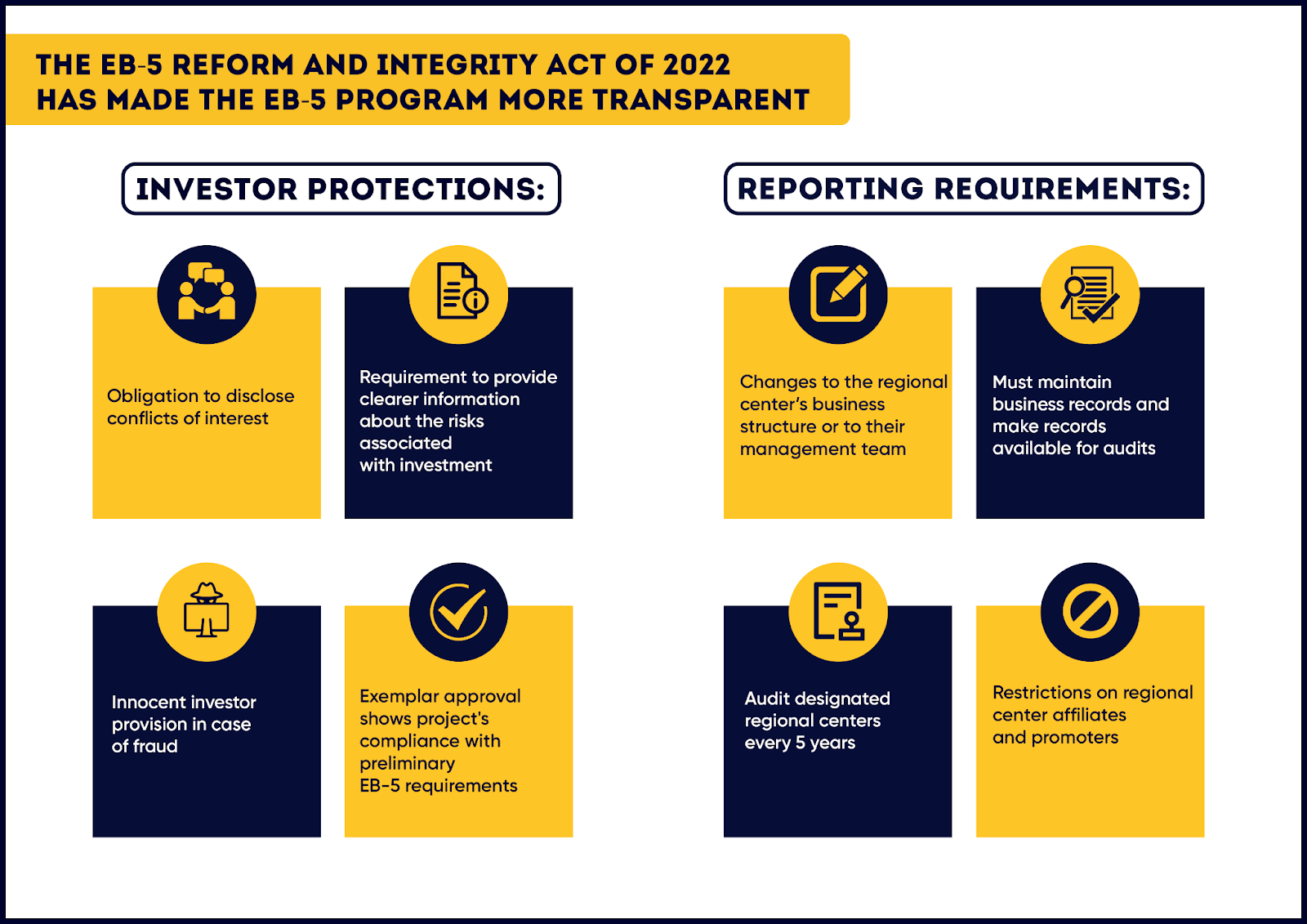
Key changes include better investor protections and tighter regional center regulations.

The RIA has helped curb macro- and micro-level EB-5 concerns, but in turn, it has led to some confusion regarding the program.
At its core, the EB-5 program requires applicant investments to be at risk, and risk has become a major talking point in recent years, be it on a governmental, regional center, or applicant level.
In this piece, I aim to shed some light on the financial, procedural, and time risks associated with the program, and how the RIA has helped mitigate them.
Regulatory Framework
Every EB-5 investment is a financial unit classified as a security, bringing it under the regulatory oversight of federal agencies such as the US Securities and Exchange Commission (SEC).
This classification subjects investments to stringent regulations designed to ensure transparency, investor protection, and market integrity.
Whistleblower complaints and programs provide a crucial mechanism for identifying potential fraud or misconduct within EB-5 projects. The “bad actor” provision prevents individuals or entities with histories of fraudulent, dishonest, or illegal conduct from participating in the program.
Disqualifying events include criminal convictions, regulatory sanctions, or court orders related to financial fraud or misconduct.
Investment Requirements
The RIA made the program permanent and extendable every five years. It introduced “grandfathering” provisions to protect investors from future rule changes, ensuring that an investor’s application remains subject to the laws in effect at filing time.
A successful EB-5 investment meets two criteria: a minimum financial investment and the creation of ten new American jobs. To qualify for a reduced investment of $800,000, investors must choose projects in targeted employment areas (TEAs), which are high-unemployment or rural geographic areas.
Infrastructure projects, which require public sector involvement, also qualify for the $800,000 threshold. Otherwise, projects require an investment of $1,050,000.
Regional Center Oversight and Requirements
Operational Standards
Regional centers that manage EB-5 projects now face increased oversight and responsibilities.
These firms handle underwriting, capital management, legal compliance, and investor communications. The Integrity Act mandates strict reporting standards, including business structure changes, record maintenance for audits, and annual reports to United States Citizenship and Immigration Services (USCIS).
Regional centers must now pay close to $50,000 per application for USCIS designation and contribute $20,000 annually to the EB-5 Integrity Fund. This fund supports Department of Homeland Security oversight for fraud detection and immigration law enforcement within the EB-5 program.
Compliance and Protection Measures
USCIS must audit each regional center every five years to verify application information and investor petitions. The law requires that EB-5 promoters register with USCIS, disclose conflicts of interest, and restrict participation from certain individuals, including recent fraud convicts, foreign nationals without US residency, and foreign government officials.
The “Innocent Investor” provision protects those affected by fraud or mismanagement.
If authorities debar a project or terminate a regional center, investors have six months to continue with the same regional center, transfer to another project, or make a new investment while maintaining their place in line for residency approval.
Processing Timelines and Investment Periods
Timeline Variables
For investors seeking US residency, key milestones like receiving a conditional green card, an unconditional green card, and the return on capital significantly impact investment decisions. This all comes down to a critical factor – time.
Processing times vary based on several factors: the type of project, the applicant’s country of origin, and USCIS workload, which can be affected by policy changes, staffing, and resources.
A key improvement in the Integrity Act is the new, more predictable timeline for investor funds known as the “sustainment period.”
Since October 2023, this period begins when investors file conditional green card applications and transfer investments to projects. This change enables faster capital recovery, particularly benefiting investors from countries with visa backlogs like China and India.

Visa Categories and Processing Approach
The Integrity Act established set-aside visa categories with specific allocations: rural areas (20% of visas), high-unemployment areas (10%), and infrastructure projects (2%).
Rural projects qualify for priority processing, resulting in faster approval for conditional green cards – approximately 12 months, compared to about 24 months for high-unemployment projects.

According to a 2023 update, the Immigrant Investor Program Office (IPO) utilizes a “visa availability approach,” replacing the previous First in First Out (FIFO) system. USCIS processes petitions through three distinct tracks:
- Applications from countries with visa caps remain unprocessed until the category becomes current
- Current visa category applications for projects awaiting IPO review
- Current visa category applications with vetted projects ready for adjudication
Projects require review only once. After approval, all linked investors move to the final processing queue, though USCIS has not clarified whether it uses FIFO or another method within this queue.
Path to Permanent Residency
The transition from conditional to unconditional green card occurs through Form I-829, filed within the last three months of the two-year conditional residency period.
Current processing times for I-829 petitions are about 36 months, with USCIS aiming to complete 80% of applications within approximately 2.5 years.
For U.S.-based investors on non-immigrant visas such as F-1, H-1B, or E-2, the Act permits concurrent filing.
This allows simultaneous applications for green cards, status adjustment, work authorization, and travel permits, typically providing benefits within about six months.
The government has taken several encouraging steps toward faster application processing, including increased USCIS focus and stated intent to hire more adjudicators.
These changes, combined with strengthened investor protections and clearer timelines, have created a more predictable program while mitigating many of the risks associated with EB-5.