

A volcano-inspired amphitheater rising from the Caribbean landscape. Artisan workshops where craftspeople will shape leather and wood before visitors’ eyes. Recording studios, theaters, and performance spaces are designed to transform a nation’s creative economy from a passion project into a profession.
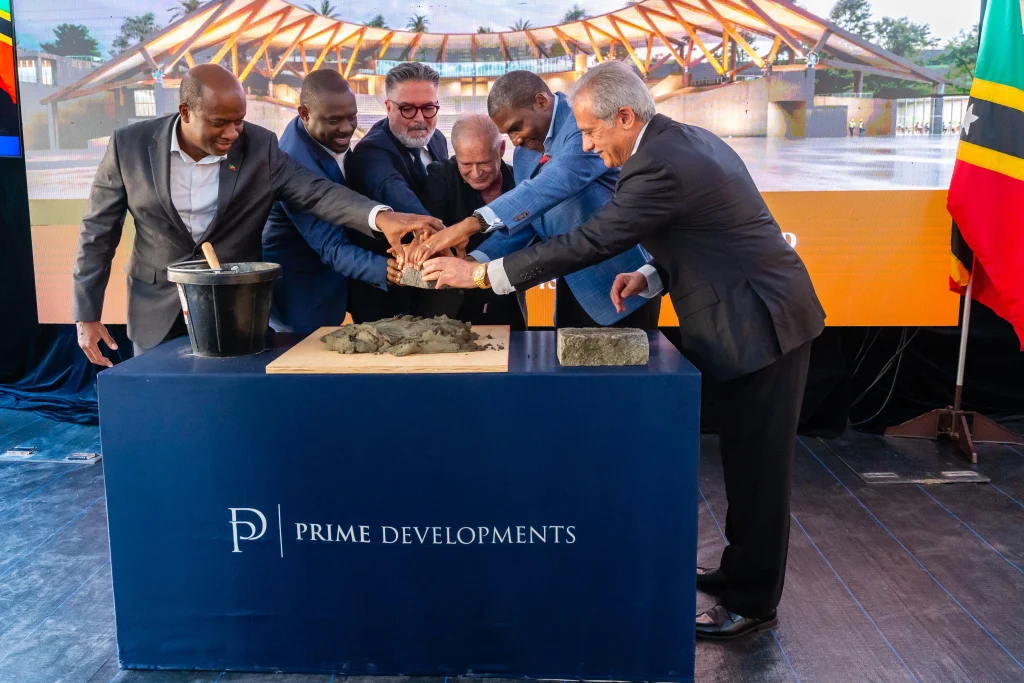
St. Kitts and Nevis turned soil this month on the Prime Creative Arts Center, a three-building cultural complex that developers and government officials describe as the region’s most comprehensive investment in creative infrastructure.
The project, funded through the country’s Citizenship by Investment (CBI) program, represents a $50 million bet that culture can drive economic diversification in a nation historically dependent on sugar and tourism.

Dr. Sirous Motevassel, founder and CEO of Prime Developments, has held the 12-acre site overlooking the airport and harbor for over a decade. “We were determined to use the land for our overall intended purpose, that is to continue to be involved in the development of St. Kitts and Nevis in a tangible and meaningful way,” he told attendees at the groundbreaking ceremony.
Prime Developments, based in Dubai, completed the Imperial Bay condominium project in 2015. Motevassel and his partner, Abbas Fahim, are both citizens of St. Kitts and Nevis.
Architecture Meets Island Identity
Italian project director Alessio D’Ascenzo designed the center around three distinct structures, each serving different facets of the creative sector. The centerpiece amphitheater draws its form from St. Kitts’ volcanic topography, using the same proportions as classical Roman theaters built millennia ago.
“Looking around, we immediately understood that this is a volcanic island,” D’Ascenzo explained. “We got inspired by this unique shape, and as you see in this picture, this will be the central amphitheater, which is a classic Roman amphitheater with the same dimensions and measurements that have been built exactly during the last thousands of years.”

The outdoor arena will accommodate 3,200 seated guests plus 800 standing near the stage. An adjacent indoor theater provides a classical venue for 1,200 attendees. Volcanic stone sourced from the island will be incorporated throughout the construction.
D’Ascenzo, whose background spans oil and gas infrastructure across multiple continents, called the creative arts center his most challenging brief in 35 years. “This is a cultural center, art center. It’s something that is not relevant to all the long experience I have got in oil and gas, infrastructure, civil, industrial, whatever,” he acknowledged.
Beyond Performance Spaces
The three-story Lab Block houses recording studios, dance rehearsal spaces, music production facilities, and educational classrooms. Co-working areas, a bowling alley, a skate park, restaurants, and a music library round out the amenities designed to serve as daily gathering points for young artists.
“The young generation will have teachers, will have the young first elevated to, let’s say, put in reality what they have in their heart,” D’Ascenzo said. “They will also have some leisure, some co-working space, a big internal bowling alley, an external skate park, and restaurants, bars, music, a library, whatever.”
The Market Block takes a different approach to cultural commerce. Two floors of workshops surround a central square where leather workers, woodworkers, and jewelers will craft goods while customers watch. D’Ascenzo envisions cruise ship passengers making it a regular stop.
“These people will, every day, hundreds of these people will come here because this will be a central hub for seeing what’s happening on the island, with the generation, with artists, with products, will interact.”
Economic Engine, Not Monument
Minister of Creative Economy Samal Mojah Duggins framed the project as validation for artists who have long operated without institutional support.
“We are not just here today to break ground on a building,” Duggins told the crowd. “More importantly, ladies and gentlemen, we are here today to affirm a belief. A belief that creativity will no longer be considered just a hobby.”
Duggins brought personal history to the role. Before entering politics, he performed with freestyle rap crews, hosted television shows on the St. Kitts and Nevis Visitor Channel, and produced Island Expressions, a monthly showcase for local talent that ran for over a decade.
“It goes back to 4th Street, freestyle battling with Rudy Morton Jr., Ronnie, Quinn, and Yannick, and so many others,” he recalled.
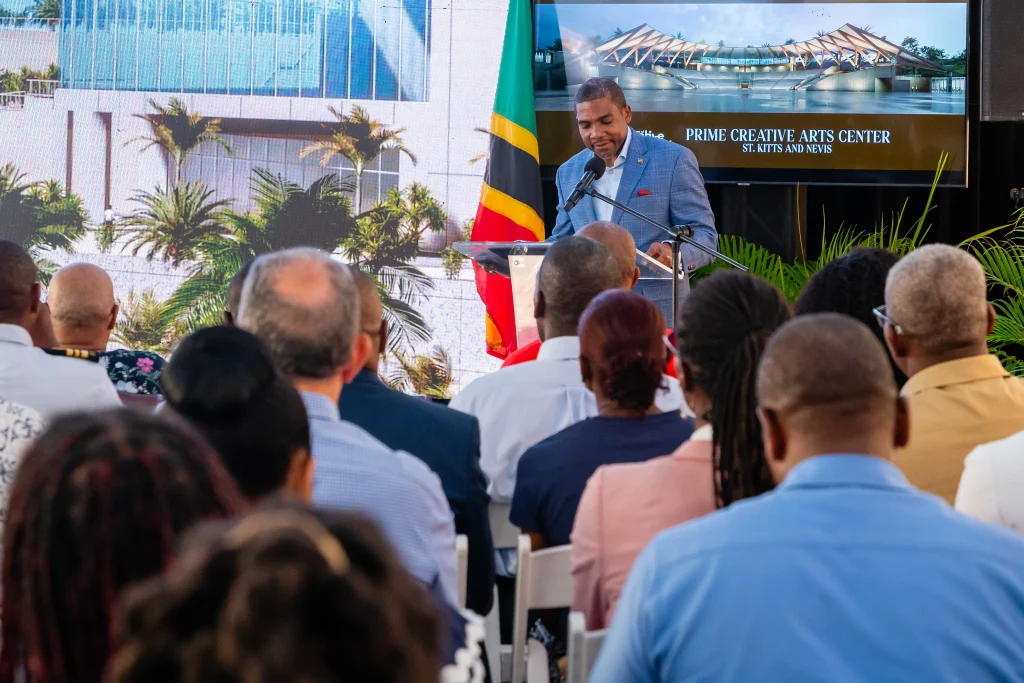
The minister emphasized economic outcomes over cultural symbolism. “For the first time in our nation’s history, we are creating a single, integrated space that welcomes and supports the cultural heritage, performing arts, culinary arts, gaming and innovation, visual arts and craft, arts administration, cosmetic arts, literary arts, and film and media. One space that embodies all of it.”
Prime Minister Terrance Drew connected the creative center to broader diversification efforts, including a new hospital, desalination plant, and high school construction. “We see that the creative sector is a significant pillar for that diversification,” Drew said.
“We seek to diversify our health care services, we seek to diversify our construction sector, we seek to diversify and expand our tourism sector with more flights, a larger cruise industry, and now we have a bona fide yacht industry as well.”
Drew defended the extended planning timeline, which stretched two years from initial concept to groundbreaking. “Sometimes when you think you have it right, you have to go back to the drawing board over and over again to get it right,” he explained. “And it’s always better to get it right the first time than to hurry it and get it wrong multiple times.”
Public Benefit Option in Practice
Calvin St. Juste, who leads St. Kitts and Nevis’ Citizenship by Investment Unit (CIU), positioned the creative center as a model for the program’s Public Benefit Option (PBO). Unlike traditional real estate developments that generate citizenship applications, PBO projects must demonstrate measurable public value.
“Our public benefit option is not speculative development. It is a regulated pathway that channels international funding directly into projects with measurable national value, projects that create jobs, which will create more jobs,” St. Juste said. “At the St. Kitts and Nevis Citizenship Unit, our mandate is not simply to administer applications, but to ensure that investments are meaningful and contribute to national development.”
The PBO framework requires continuous monitoring and milestone tracking throughout construction. St. Juste emphasized that accountability extends beyond project approval. “Developers and not just investors. They are partners in this national development,” he noted.
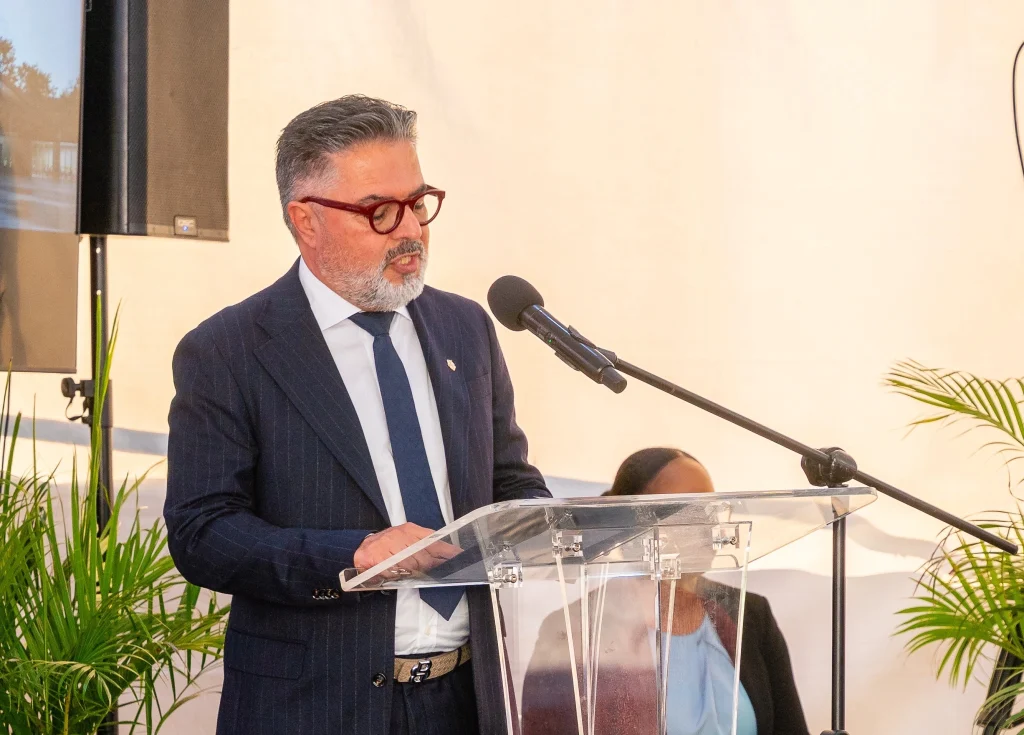
Abbas Fahim, Motevassel’s partner at Prime Developments, is committed to prioritizing local employment. “Even though our contract with the international construction firm is for engineering construction procurement, which we call EPC, we have insisted that construction and ancillary jobs must first be afforded locally, then regionally, then beyond,” Fahim said in his closing remarks.
The construction contract mandates maximum local content. International firms will handle overall engineering and procurement, while St. Kitts and Nevis contractors take on subcontracting roles. D’Ascenzo promised training components to build lasting skills. “We want to even continue to train these people, to live a legacy of what will be done in the next three years,” he said.
Three-Year Timeline Begins
Mobilization starts in February 2026, though visible construction activity may not appear for six to seven weeks. D’Ascenzo acknowledged the timeline represents “a big miracle” for a project of this complexity. International standards typically require four years from concept to groundbreaking for cultural facilities of this scale.
Motevassel set expectations for continuous progress. “We do not intend to have a groundbreaking today, then for months, there is no activity on site. We are here today because we are ready to start the work,” he declared. “Our construction firms’ representatives are here with us, and the mobilization process has begun.”

The completed center will mark St. Kitts and Nevis’ third major push into economic diversification. Sugar cultivation defined the colonial economy.
Tourism opened international revenue streams in the late 20th century. Drew described the creative economy as the next pillar. “For generations, St. Kitts and Nevis has shown an incredible ability to adapt and evolve,” the Prime Minister said. “We moved from King Sugar, which shaped our history and resilience, into tourism, opening our doors to the world.”
D’Ascenzo will remain on-site throughout construction. “I will be here. My team will be here. The contractor will be here. The investors will be here all the time necessary,” he promised. “And I will share with you the wonderful life here and the mushrooming of this entity.”
To learn more, contact Prime Developments via our website or directly via the form below:
