Somewhere along the way, citizenship by investment earned an unfair reputation as a product for buyers who wanted to pay and forget. Drop a sum in a government fund, receive a passport, and chalk up the amount as the cost of mobility.
That framing suited certain programs built around non-refundable donations to small-island economies, where the question of “what did you actually buy?” has no satisfying answer.
Turkey never fit that model. It’s a different category entirely.
Since the country opened its citizenship by investment (CBI) program in 2017, it has issued passports to more than 50,000 foreign nationals. No CBI program on earth has matched that volume. The program’s dominance isn’t a fluke of marketing; it’s the result of something structural.
The investment route driving the vast majority of applications is real estate, and Turkey’s property market is one of the world’s most liquid, data-rich, and actively traded, sitting inside a G20 economy with a GDP exceeding $1.1 trillion.
When you buy property in Istanbul to qualify for Turkish citizenship, you’re not making a contribution. You’re making an acquisition.

Why This Program Became Dominant
The program launched in 2017 at a $1 million entry price and generated little interest. The government cut the threshold to $250,000 in 2018, and applications exploded. A subsequent increase to $400,000 in 2022 did little to suppress demand. Today, Turkey consistently processes more CBI applications than any comparable direct-citizenship program in the world.
The mechanics are straightforward. An investor purchases qualifying real estate worth a minimum of $400,000, holds it for three years, and receives full Turkish citizenship for the principal applicant, their spouse, and dependent children under 18.
Government fees are minimal, an application fee running to roughly 5,000 Turkish lira, a negligible figure relative to the investment. Processing takes six to eight months. First-time foreign buyers paying in foreign currency are exempt from VAT on the purchase.
There’s also no residency requirement. The investor doesn’t need to live in Turkey before, during, or after citizenship is granted. One or two trips to Istanbul for biometric appointments are required, but the passport arrives without any obligation to spend a night in the country.
That said, the investors who take time to understand Istanbul tend to discover something: they may actually want to.
Istanbul’s Real Estate Case, by the Numbers
Real estate in Turkey currently yields an average gross rental return of 7.32% nationally, as of Q1 2026. In Istanbul’s prime investment districts, the case improves further once capital appreciation enters the calculation.
Housing prices in Istanbul grew approximately 30% annually in nominal terms through mid-2025, with some districts posting 35 to 45% growth in the same period. Rents in central neighborhoods have risen as much as 200% over the past two years.
Part of that was structural: the Turkish government’s 25% annual rent increase cap, which had previously constrained landlords from adjusting lease terms to market rates, was removed in July 2024. Landlords in Istanbul now price against current demand, and current demand in the city’s premier districts is formidable.
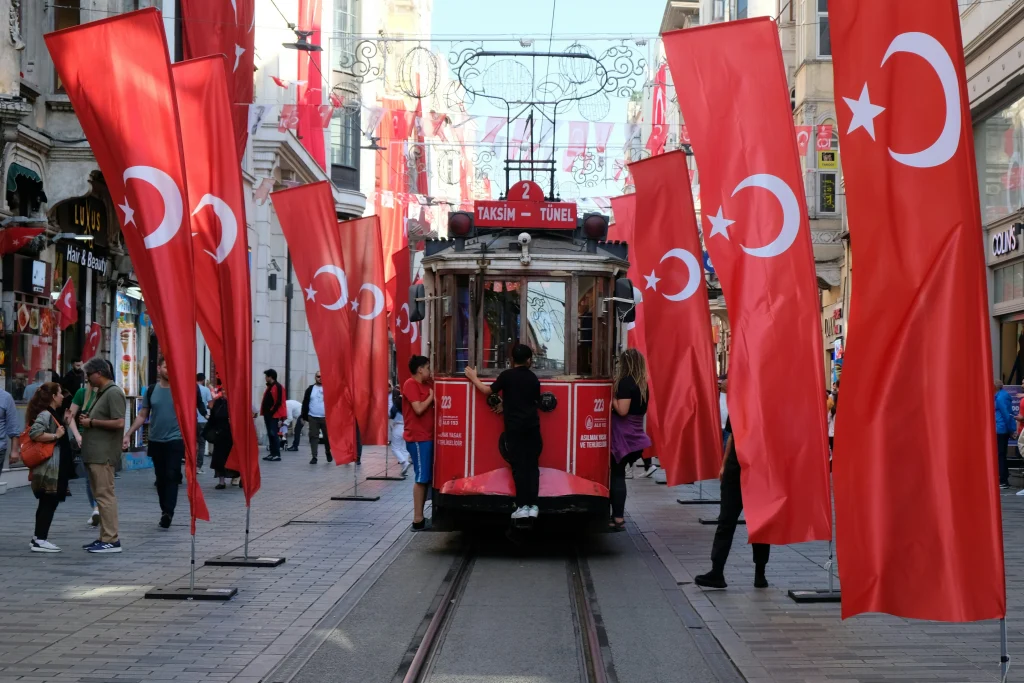
Istanbul is a city of 17 million residents that drew more than 17 million tourists in 2024. Population keeps growing. New residential supply hasn’t kept pace, particularly in established central districts where land for new development is genuinely scarce.
The Neighborhoods That Drive Returns
Not all Istanbul property performs equally, and the difference between a mediocre CBI investment and a strong one usually comes down to where you buy.
Levent and Maslak form Istanbul’s primary central business district on the European side, home to Turkey’s largest financial institutions, multinationals, and professional services firms. Office rents in Levent reached $42 per square meter per month in 2024, the highest in the city, while Maslak commanded $30.
Grade-A office vacancy across the corridor fell to 10.9% in Q1 2024, the lowest level since 2021. Residential properties here attract the same corporate tenant pool, and well-priced apartments in this zone typically rent within one to three weeks, year-round.
Şişli connects Levent’s business corridor to Taksim and the city’s cultural core. The Nişantaşı quarter within Şişli is priced at roughly €4,500 per square meter as of 2025, up 10% from the prior year, with rents that frequently denominate in USD and a tenant profile that treats the address as a lifestyle decision.
Airbnb performance here is among the strongest in the city, sustained by proximity to Istanbul’s luxury retail strip and a permanent base of high-income local residents who rarely leave the neighborhood.
Kadıköy, on Istanbul’s Asian side, has spent a decade becoming one of the most desirable addresses in the metropolitan area. Average monthly rents here run approximately 53,000 Turkish lira, the second-highest figure across all Istanbul districts.
The Moda and Fenerbahçe sub-neighborhoods rank among the city’s highest rental demand zones, with lifestyle appeal, Bosphorus proximity, and Marmaray rail access serving as structural demand drivers. Vacancy here stays low throughout the year, even during slower rental seasons.
Each of these markets carries a different risk-return profile. An investor choosing between them isn’t really making a citizenship decision. They’re making a portfolio decision that happens to come with a passport.
The Citizenship That Costs Nothing
This is the part of Turkey’s program that rarely gets explained clearly, because it requires math instead of marketing.
Take a $400,000 property purchase in a high-demand Istanbul district. At a conservative gross rental yield of 5%, that property generates $20,000 per year, or $60,000 over the three-year holding period. Capital appreciation at 10% annually in USD-adjusted terms, conservative given Istanbul’s recent trajectory, adds roughly $130,000 in asset value over the same stretch.
At year three, the investor resells. If the property has appreciated and rental income has been collected, the combined return may cover or exceed what a donor-model CBI program would have charged for a comparable passport. Government fees are a rounding error. Legal costs are a rounding error. In the best cases, with the right property and competent management, the net outlay on Turkish citizenship approaches zero.
That’s not a sales claim. It’s the arithmetic of Istanbul’s property market applied to a three-year hold.
The caveat matters, though: “the right property” requires local knowledge that most investors arriving from abroad simply don’t have. The difference between a Levent asset that performs and a peripheral development that sits half-occupied isn’t visible in a brochure.
It’s visible to someone who has watched Istanbul’s real estate cycles play out across multiple market conditions, who knows which developments have strong management, which districts have structural demand drivers, and which off-plan projects carry completion risk.
That’s where legal and advisory expertise earns its fee.
What Turkey Gives You at the End
A Turkish passport offers visa-free or visa-on-arrival access to more than 110 countries. Turkey is a NATO member, an E-2 treaty country with the United States (a pathway available to CBI investors after three years of domicile in Turkey), and the 17th largest economy in the world. Its airports connect directly to virtually every major global hub.
The country itself is livable by any measure that matters to internationally mobile families: private schooling, modern hospitals, Mediterranean and Aegean coastlines, and a cost structure that stretches foreign income further than almost any G20 peer.
Istanbul, for the investor who spends time there, ranks among the world’s genuinely great cities. Historically layered, culinarily serious, aesthetically varied in ways that few cities of its size sustain.
Citizenship also passes to children born after naturalization. The decision made today can shape a family’s document position across generations.

The Advisory Role
Turkey’s CBI process has grown more procedurally demanding in recent years. Mandatory physical presence for biometric submissions is now required for the principal applicant and spouse. State oversight of property valuations was introduced in 2024. The rules governing which properties qualify, how purchases must be structured, and what documentation satisfies due diligence have been updated multiple times since the program launched.
Ketenci & Ketenci is an Istanbul-based international law firm specializing in the Turkish Citizenship by Investment program and cross-border investment migration.
Since the program’s launch in 2017, the firm has advised and represented more than 1,000 investors and their families from the CIS region, the Middle East, Asia, Europe, and North America through the full arc of the process: asset due diligence, transaction structuring, and legal representation through to passport issuance.
The firm’s approach reflects a conviction that citizenship and asset selection are not separate decisions. Every engagement is structured around regulatory compliance, property performance, and the investor’s long-term positioning, not just the mechanics of getting an application approved. For investors navigating a market where the wrong property choice carries real financial consequences, that distinction matters.
Work With a Firm That Knows the Market
The investors who get the most out of Turkey’s CBI program are those who treat the property decision as seriously as the citizenship decision, because the two are the same decision. Identifying the right asset, in the right district, structured correctly from the title deed forward, is what separates a citizenship investment that performs from one that merely qualifies.
To learn more, contact Ketenci & Ketenci via our website.