Every passport index has a thesis. Most measure two things: how many countries you can enter visa-free and the associated freedoms with the passport. Things like mobility and lifestyle. Both factors are real. Neither are sufficient metrics for a client whose wealth is denominated in Bitcoin.
Today, 21 CBI is publishing the Bitcoin Passport Index (bpi.21cbi.io). It is the first global passport ranking that scores jurisdictions through a Bitcoiner lens, and it produces a map that looks nothing like the one the investment migration industry has worked from for a decade. This is by design.
The Bitcoin Passport Index
No published passport index has ever assigned meaningful weight to Bitcoin legal status, Bitcoin taxation, exchange licensing, self-custody rights, mining regulation, or merchant adoption. A passport’s value to a Bitcoiner depends on all six. The BPI is built around them.
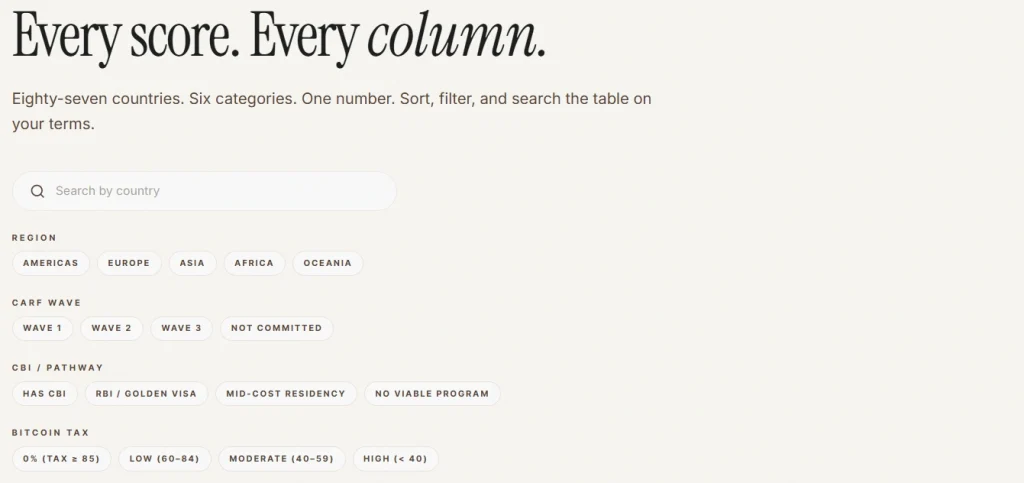
It ranks 87 jurisdictions across six weighted categories: Bitcoin and crypto tax policy (25 percent), Bitcoin legal and regulatory status (20 percent), visa-free travel (20 percent), residence and citizenship pathways (15 percent), dual citizenship (10 percent), and personal and economic freedom (10 percent).
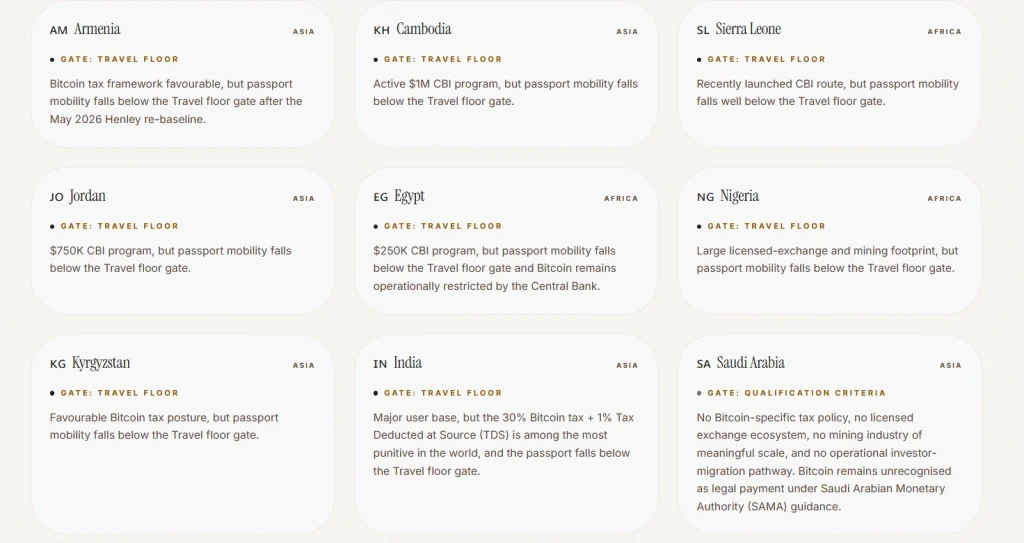
Forty-five percent of the total weight sits on Bitcoin-specific factors; the remaining 55 percent covers traditional passport quality. Thirteen additional countries are surfaced separately as unranked, each excluded for a documented methodological reason rather than left off the page. Methodology is ideology. The 45 percent weight is the proposition that Bitcoin sovereignty is nearly as important as physical mobility.
The model is reproducible. Every category has a published rubric scored from 0 to 100, weighted, run through floor gates, a balance multiplier, and a top-10 pathway requirement, then ranked. Two researchers applying the rubric to the same country should land within five points of each other. The full source list sits on the index page. You do not have to trust the ranking. You can rebuild it.
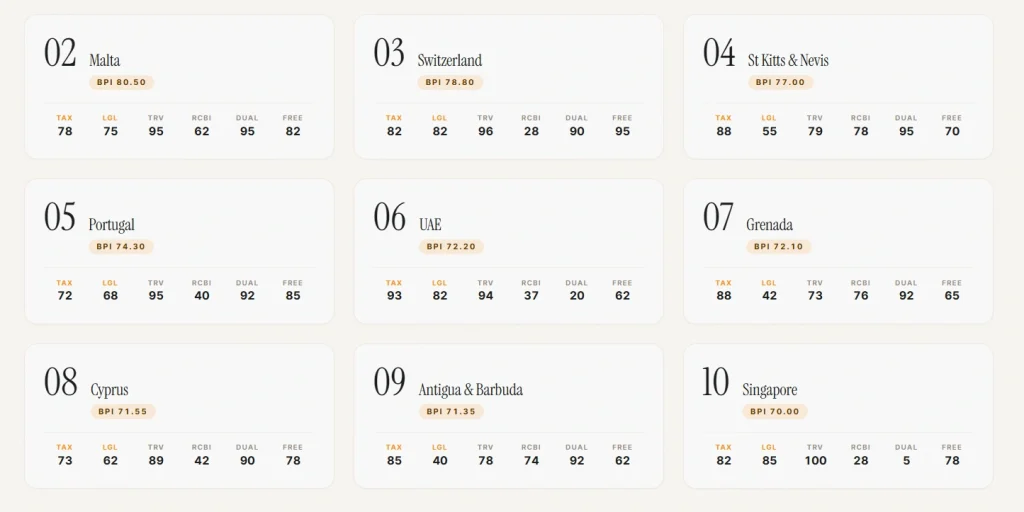
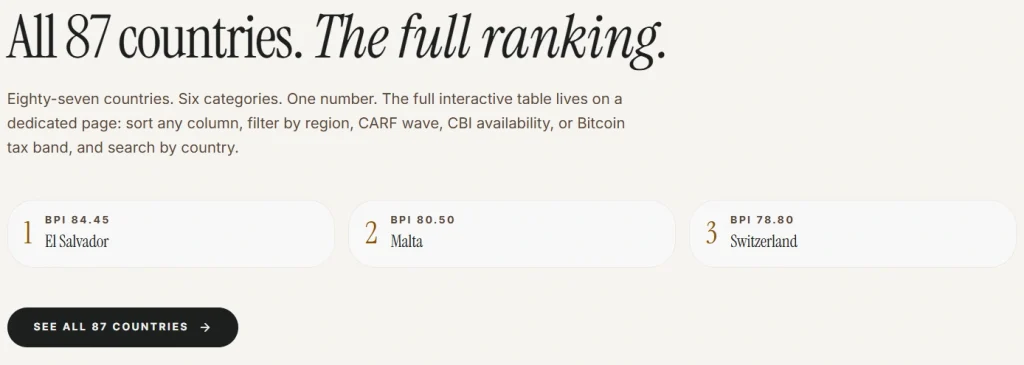
The inaugural Top 3 are the proof. El Salvador ranks #1 at 84.45, Malta is second at 80.50, and Switzerland is third at 78.80. El Salvador clears Malta by 3.95 points on a Tax score of 98 out of 100.
It is the only jurisdiction on Earth that combines a national Bitcoin framework, a state Bitcoin treasury, a statutory 0 percent capital-gains exemption that extends to foreign investors with no residency requirement, 0 percent corporate tax for CNAD-licensed Bitcoin service providers, a territorial tax base, no commitment to the OECD’s Crypto-Asset Reporting Framework (CARF), and the only CBI program that accepts BTC and USDT natively. Every other top-20 country trades at least one of those properties off.
Malta brings EU mobility and a comprehensive crypto regime transitioning to MiCA. Switzerland brings institutional depth: Crypto Valley in Zug, FINMA-licensed infrastructure, and a canton that accepts Bitcoin for tax payments.
Two results show how far the map moves at the other end of the spectrum. The United States, home to the largest Bitcoin infrastructure on Earth, ranks #55: Worldwide citizenship-based taxation reaching 40.8 percent on short-term Bitcoin gains drags its tax score to 15 out of 100.
Italy sits at #29 after raising its Bitcoin capital-gains rate from 26 to 33 percent in January 2026, lifting its lump-sum non-dom regime from EUR 200,000 to EUR 300,000, and operating under a compressed MiCA transitional regime that closes June 30, 2026, with no Italy-authorized CASPs on the ESMA register during the OAM-to-Consob handover. Under any index that does not score Bitcoin policy, neither result is visible.
The reverse trap is just as instructive. The Bahamas, Bermuda, the Cayman Islands, and BVI all score 90 to 95 on Bitcoin tax policy, yet operate no direct citizenship pathway, so the cluster lands in the mid-to-low 60s, and BVI at 52.90. A favorable tax is worthless without legal presence behind it.
The BPI is a planning tool, not a curiosity. Its central finding is a barbell: pair a top-tier passport for mobility and institutions with a Bitcoin-native citizenship for tax and legal alignment, and hold tax residency wherever you actually live. Three jurisdictions, three purposes, maximum sovereignty. For Bitcoiners who cannot acquire a top-tier European passport, the substitutes are real, and that is where 21 CBI’s program slate begins.
The index also prices in time. The OECD’s Crypto-Asset Reporting Framework begins automatic exchange in 2027 for Wave 1 jurisdictions, 2028 for Wave 2, and 2029 for the United States. Countries that have not committed, including Argentina, El Salvador, and Georgia, retain a structural information-privacy advantage, and self-custodied Bitcoin held outside reporting platforms sits outside the CARF perimeter entirely. Information privacy has an expiration date, and the BPI dates it.
The full Top 10, all 87 rankings, and the 13 unranked country notes, with the complete rubrics and country spotlights, are live at bpi.21cbi.io.
The Flagship: Vanuatu
When a Bitcoiner needs a second passport quickly, 21 CBI recommends Vanuatu more than any other program. It is the fastest citizenship-by-investment program in the world: 30 to 60 days from submission to passport. The government contribution is $130,000 for a single applicant. The 21 CBI advisory fee is 5 percent, or $6,500, published in full and quoted in USD and BTC.
The tax profile is the draw: zero income tax, zero capital gains tax, and zero inheritance tax. The passport carries 87 visa-free destinations and functions as an Asia-Pacific gateway rather than a European one. Due diligence is not a rubber stamp. Every application moves through three independent screening bodies: VFIU financial intelligence, Interpol NCB, and the Vanuatu Citizenship Commission.
There is a $5,000 FIU due diligence fee and mandatory biometric capture at one of four enrollment centers (Dubai, Hong Kong, New Caledonia, or Port Vila). That rigor is a feature; it is what keeps the program standing while looser programs draw scrutiny.
Two pathways run in parallel. The Development Support Program (established in 2017 under the Citizenship Act) is the direct-contribution route at $130,000 for a single applicant. The Capital Investment Immigration Plan, introduced in 2023 under Order No. 8, pairs a $110,000 government contribution with a $50,000 redeemable Cocoa Sustainable Fund component that brings the net cost lower for cost-conscious families.
21 CBI publishes the full fee breakdown by family size for both, so the all-in number is visible before a call rather than after one. It suits the Bitcoiner who wants speed and a clean tax base without a seven-figure contribution.
Vanuatu is the program 21 CBI built a dedicated home for, at www.cbi.vu. Fund it from your stack. Settle the entire process in USD, BTC, or USDT. Hold a second passport in under two months.
The Only CBI Advisory Built for Bitcoiners
21 CBI is the only citizenship-by-investment advisory built for Bitcoiners. Other CBI advisory firms have added a crypto payment button. 21 CBI is built the other way around: BTC, Lightning, and USDT settle on self-hosted infrastructure with no fiat conversion imposed on the client. The firm is a division of Bitcitizen LLC and a licensed agent of The Bitcoin Office of El Salvador, authorized to process Freedom Passport applications under official government certification. There is no junior associate or bloated sales team. One advisor: direct line and encrypted.
That advisor is Adam Juchniewicz, CEO: a US Air Force veteran, spent twelve years at the US Department of Homeland Security on immigration policy, holds an LL.M. in European and Comparative Law from the University of Malta, and has been stacking sats since 2020.
“Most of our clients have spent ten years learning to hold their own keys,” says Adam Juchniewicz, CEO of 21 CBI. “The next ten are about holding their own jurisdiction.”
A Site Built Like the Product
Most citizenship-by-investment websites are brochures: gated pricing, stock photography, and a contact form that routes to a sales desk. 21 CBI built the opposite, and nothing else in the category looks like it.
Every fee is published. A live Cost Calculator prices any program in USD and BTC. A Passport Program Quiz matches a reader to a jurisdiction in sixty seconds. A Compare Programs tool runs any two jurisdictions side by side. A US Exit Tool models the cost of US citizenship renunciation. The program pages are reference-grade, with source citations and verification dates on every numeric claim.
It is fast, built on a modern stack, and editorial in a category that defaults to corporate. The site is the argument: radical transparency is not a tagline. The math is on the page and every Bitcoiner can trust, but verify it for themself.
Bitcoin gave a generation a way to opt out of corrupt monetary policy. Citizenship by investment, used well, lets the same generation opt out of jurisdictional ones.
The Bitcoin Passport Index is the map. 21 CBI builds the architecture.
The index is live at bpi.21cbi.io.
The flagship program lives at cbi.vu.
The firm is at 21cbi.io.