

Switzerland will ask its citizens on June 14 to vote on whether to impose a hard cap on its population, limiting permanent residents to no more than 10 million by 2050.
The initiative, championed by the right-wing Swiss People’s Party (SVP), cleared the 100,000-signature threshold required under the country’s direct democracy system to trigger a national referendum.
Both chambers of parliament and the federal council have recommended voters reject the measure, but polls suggest the outcome remains uncertain.
The mechanics of the proposal work in stages. Once the population exceeds 9.5 million, authorities would be obliged to act by restricting asylum admissions and curbing family reunification for foreign residents.
If it reaches 10 million and other measures fail, the government would be compelled to renegotiate, or even withdraw from, international agreements that facilitate population growth, including the bilateral free movement agreement with the European Union.

Switzerland’s population currently stands at 9.1 million and has grown roughly 25% since 2000, a pace roughly five times faster than the average across neighbouring EU member states. Some 27% of residents hold foreign nationality, one of the highest proportions in Europe.
The SVP argues that this growth amounts to a “population explosion” that is overwhelming infrastructure, inflating rents, and degrading the quality of life.
A December poll found that 48% of respondents favoured the cap, with 41% opposed and 11% undecided.
How Lump-Sum Residents Fit Into The Picture
For high-net-worth individuals on Switzerland’s lump-sum tax regime, the referendum may raise questions about what a population cap would mean for their residency and path to citizenship.
Should the initiative pass, the naturalisation process, which typically takes around ten years, means residents who have not yet applied could find themselves caught out if restrictions take effect before they reach that milestone.

Philippe May, founder and CEO of EC Holdings, confirms that the proposed cap “would apply to all residents,” not only permanent-permit holders.
“Lump-sum taxpayers are not carved out as an exempt category,” he adds, which means they could, in theory, be swept into any future restrictions.
Yet May explains that the initiative aims to amend the constitution, not the law itself. If voters approve the measure, parliament would still need to draft implementing legislation, and “the majority of lawmakers are hostile to the proposal,” meaning they could substantially “water it down” during the legislative process.
The politicians driving the initiative, May adds, “are not targeting high-net-worth individuals.”
Since the centre and right hold a majority in both chambers of parliament, May sees that it is highly likely that lump-sum residents would be among the last affected, not the first.
Yamin Fouzi, a senior investment migration advisor at Fouzi Consulting, agrees that lump-sum residents are outside the categories immediately at risk, explaining that the cantons that offer lump-sum arrangements value the tax revenue these residents generate, and that “the SVP has no interest in upsetting them.”
The practical hierarchy of restrictions, Fouzi explains, would start at the bottom: asylum seekers, then family members of residents living abroad, then short-term residents whose presence is deemed non-essential.
Swiss-EU Free Movement at Risk?
The vote also carries broader implications for Switzerland's relationship with the European Union. The initiative's ultimate enforcement mechanism, withdrawing from the bilateral free movement agreement, would fundamentally change a relationship that has defined Swiss economic and political life for decades.
The EU is Switzerland's largest trading partner, absorbing more than 40% of its exports. Multinational employers, including Nestlé, Novartis, and Roche, depend on access to a deep pool of European talent.
The business lobby Economiesuisse has labelled the proposal a "chaos initiative," warning that companies unable to recruit EU workers would relocate, eroding tax revenue and innovation capacity.
According to their reseach, EU and EFTA workers also contribute disproportionately to Switzerland's pension system, meaning fewer of them would strain social insurance finances.
Switzerland reached a carefully negotiated deal with Brussels last year to preserve and improve single-market access. A vote to cap the population could unravel that agreement.
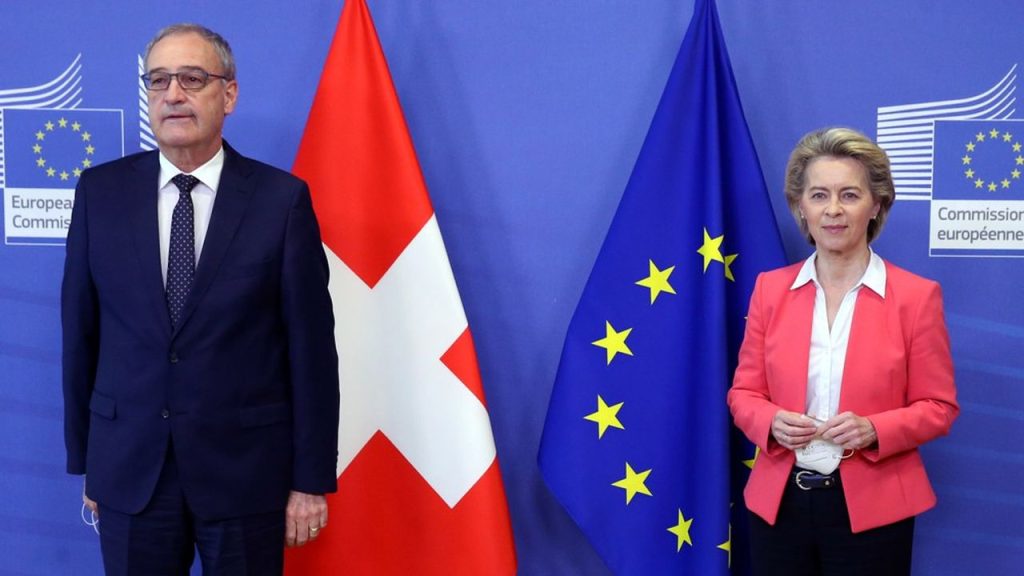
Fouzi acknowledges that opponents of the initiative will likely "use the threat of the end of free movement as their primary campaign weapon, as they have successfully done in past referendums on immigration."
But Fouzi sees a silver lining in a population cap. “Approving the cap could ultimately increase the value of Swiss residency and citizenship, pushing the country toward a model of selective sovereignty more akin to Singapore than to its current posture as a closely integrated European partner,” he argues.
According to Swiss Info, Only 26 popular initiatives have passed since 1891, and the measure needs a cantonal majority on top of the popular vote to succeed.
But more than half of those 26 successes have come in the 21st century, and with polling this tight, the outcome remains far from certain.
