

Citizenship debates rarely acknowledge what states already know: Belonging is gradual, not instantaneous. Modern immigration systems don’t split the world into citizens and foreigners.
They manage mobility through layered legal statuses, each conferring different degrees of security, rights, and permanence.
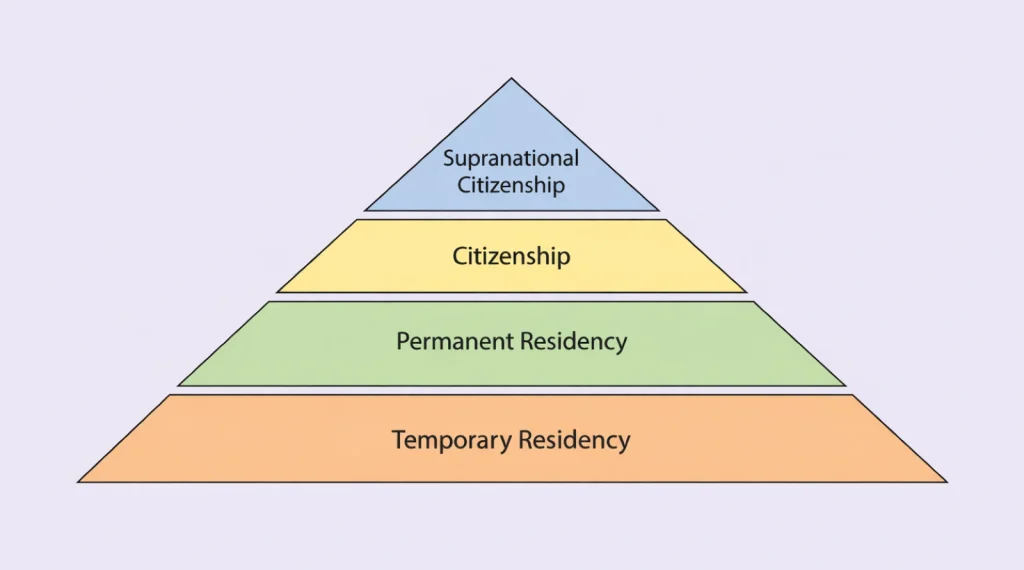
A framework developed by IMI’s Founder, Christian Nesheim, called the Settlement Rights Pyramid captures this reality. Four distinct layers mark the progression from initial settlement to supranational membership: temporary residency, permanent residency, citizenship, and supranational citizenship.
- Temporary residence
- Permanent residence
- Citizenship
- Supranational citizenship
Understanding these tiers reveals how settlement actually functions. Capital-based pathways like residency by investment (RBI) and citizenship by investment (CBI) programs don’t eliminate this structure.
They provide ladders to higher points on the pyramid, accelerating movement through it.

The pyramid begins where genuine settlement potential starts. Tourist visas fall outside this framework because they offer no path forward.
Each pyramid layer, by contrast, creates at least the possibility of progression to the next level, though no guarantee exists at any stage.
Layer One: Temporary Residency
Temporary residency marks true entry into settlement. States grant this status for work, study, family reunification, marriage, digital nomad arrangements, or investment.
Work visas, student visas, digital nomad visas, and family reunification permits all sit at this foundational layer.
Renewable yet conditional, this layer demands heavy compliance. Holders gain banking access, healthcare (in some cases), education, and often local employment rights.

Permanence becomes possible here, though states reserve judgment. Most temporary residency pathways eventually lead to permanent residency, though not all. Settlement enters a probationary phase.
Layer Two: Permanent Residency
Permanent residency crosses the settlement threshold. It confers indefinite or highly secure rights to remain, strong deportation protections, near-equal public service access, and robust family reunification provisions.
Removal becomes exceptional rather than routine. Individuals achieve settled status even though political rights remain withheld.
Layer Three: Citizenship
Full political rights, unconditional residence, diplomatic protection, and intergenerational status transmission all arrive at this level. Conditionality ends. Probation ends. Deportability effectively ends.
Irreversible belonging anchors identity in law. For most of history, citizenship represented the apex of possible settlement rights.
Layer Four: Supranational Citizenship
Supranational citizenship sits at the pyramid’s peak. Currently, only the European Union and European Economic Area offer this status in true legal form, though other blocs provide practically equivalent arrangements.
EU citizenship, which the Maastricht Treaty established, grants freedom of movement, right of establishment, and equal treatment across 27 member states.
The Organisation of Eastern Caribbean States (OECS), Mercosur, and the Gulf Cooperation Council create similar mobility and settlement rights across their member states, though without the formal legal designation of supranational citizenship.
This layer transforms national citizenship from an endpoint into a platform. A citizen of any EU member state enjoys not just national rights, but freedom of movement, establishment, and equal treatment throughout the union. Citizenship value extends far beyond the issuing state’s borders.
OECS citizenship provides movement rights across its member states. Mercosur citizenship enables residence and work throughout South America’s major economies. These arrangements function as supranational citizenship in practice, even where formal legal frameworks differ from the EU model.
Two Pathways Up the Pyramid
Investment migration programs offer two distinct approaches to climbing the Settlement Rights Pyramid. Understanding the difference between upgrade paths and direct access reveals how capital reshapes traditional settlement timelines.
Upgrade path programs insert investors at layers one or two, then provide a route to citizenship through subsequent naturalization.
Portugal’s Golden Visa exemplifies this model. Investors gain temporary residency, which can lead to permanent residency and eventually citizenship, though recent legislative changes extended the naturalization timeline from five to ten years for this pathway.
Direct CBI programs place investors immediately at Layer 3, and, in some cases, Layer 4, bypassing all intermediate stages. Investors receive citizenship directly, with minimal to no residency requirement preceding it, although some countries, like Saint Kitts & Nevis, are planning to introduce residency requirements.
When direct access programs operate in countries holding supranational citizenship, investors effectively reach Layer 4 immediately. Malta’s former Individual Investor Programme and current Citizenship by Merit program exemplify this pattern. Investors acquire not just Maltese citizenship, but EU citizenship simultaneously.
Argentina’s upcoming citizenship by investment program will also offer I direct route to Layer 4, providing a MERCOSUR citizenship.
Each model serves different investor priorities. Upgrade paths appeal to those seeking flexibility at intermediate stages, particularly investors who value permanent residency’s security without the commitment citizenship entails.
Direct access attracts those prioritizing political rights, passport strength, or immediate access to supranational platforms.
Some investors pursue both strategies simultaneously across different jurisdictions, building layered settlement portfolios at multiple pyramid levels.
The choice between models often reflects not just personal circumstances, but strategic calculations about which combination of rights, obligations, and access points serves specific mobility and security goals.
Physical Presence as Optional Variable
Traditional settlement progression demands sustained physical presence. Years of residence generate the social integration, language acquisition, and cultural familiarity that states historically required before granting permanent status or citizenship.
Investment migration programs decouple settlement rights from settlement itself. Most RBI programs require minimal physical presence, often as little as seven days annually. Many CBI programs require none at all.
This creates an alternative conception of membership. Rather than measuring belonging through time spent within borders, these programs measure it through financial contribution and enhanced compliance verification.
Investors can acquire the legal status traditional settlement processes produce without undergoing that process.
For some investors, this represents precisely the value proposition. Business executives maintaining operations across multiple continents, digital entrepreneurs with distributed teams, or families seeking backup residence options often cannot commit to extended physical presence in any single jurisdiction.
Investment migration provides the security and access of higher pyramid levels without the constraint of extended residence requirements.
The tool serves different purposes for different users. Some employ it to establish genuine secondary homes where they’ll eventually spend significant time.
Others use it purely for mobility enhancement, treating citizenship or permanent residency as access credentials rather than indicators of where they actually live. Both uses reflect legitimate responses to increasingly mobile professional and personal lives.
Why Structure Matters for Policy
This analytical framework explains recurring patterns in international responses to investment migration programs.
RBI typically attracts limited international attention because acceleration occurs within national boundaries, affecting primarily domestic settlement systems.
CBI generates significantly more scrutiny, particularly when countries with supranational citizenship issue it. The concern stems not primarily from moral objections, but from structural effects. National shortcuts can produce supranational consequences.
When Jordan launched its citizenship-by-investment program, regional implications remained limited because Jordan holds no membership in major settlement blocs. When EU member states operate such programs, effects scale across the entire union. Investors acquire not just national citizenship at Layer 3, but supranational citizenship at Layer 4.
Malta’s program granted access to Layer 4, the pyramid’s apex. Turkey’s program, for example, grant access only to Layer 3, where supranational effects remain absent.
Implications for Practitioners
Understanding settlement systems through this layered framework clarifies why different programs attract different levels of scrutiny.
The higher the pyramid level accessed, and the broader the supranational platform unlocked, the greater the policy attention generated.
Individuals often prioritize not just the rights a particular status confers, but the breadth of territories across which they can exercise those rights.
Citizenship in smaller EU member states often costs significantly more than citizenship in larger non-EU countries, reflecting the platform value of supranational membership rather than just national rights.
The Settlement Rights Pyramid reveals what drives these pricing differences. An investor acquiring Maltese citizenship doesn’t just gain Layer 3 status. They gain Layer 4 status, accessing settlement and establishment rights across 27 jurisdictions. The premium reflects this multiplication effect.
The Contemporary Settlement Reality
Modern settlement operates through a four-layer structure where each level expands rights, security, and territorial scope:
- Temporary residency establishes initial settlement with potential for advancement
- Permanent residency provides durability and near-complete rights
- Citizenship confers full political membership and intergenerational transmission
- Supranational citizenship multiplies these rights across entire blocs
Investment migration doesn’t abolish this structure. It provides accelerated pathways through it, substituting capital for time and traditional integration requirements. The framework explains why different programs generate different policy responses: the higher the insertion point, the broader the consequences.
This system represents neither the traditional nation-state model of exclusive citizenship nor the cosmopolitan vision of post-national membership. Instead, it creates layered, networked belonging where legal status functions simultaneously at national and supranational levels.
Settlement rights today are not just about belonging to a place. They’re about accessing platforms that multiply the value of that belonging across space.
The Settlement Rights Pyramid captures how this layered system actually operates, revealing the architecture beneath contemporary debates about mobility, membership, and belonging.
