

Jeffrey Henseler, the 30-year-old Chairman of Passport Legacy and 2025 IMI Person of the Year, has disclosed the unlikely origins of São Tomé and Príncipe’s citizenship by investment (CBI) program, which launched in September as the most affordable second passport option globally.
The West African island nation’s program requires a US$90,000 donation, undercutting every mainstream competitor.
Henseler credits “a little bit of luck” for the program’s genesis.
A neighbor who had been “doing investments in São Tomé for quite a long time” eventually “realized what we do as Passport Legacy, which is mainly citizenship and residence by investment” and thought “this would be the perfect island to establish something like that because they’re in need of financial help and they can profit from developments on the ground.”
The connection led to an 18-month period where Henseler’s team “worked with the government very closely” to establish the program.

He emphasizes that his team prioritized having “a proper citizenship act implemented” as the foundation, then went “through their entire regulations” because they “realized that a lot of countries, or especially the clients they want quick [processing], they want citizenship by descent, and they want a price point that they can afford.”
He confirms that “since the 1st of September,” the program “was live” and began “officially accepting applications through the citizenship by investment unit in Dubai.”
He notes the program “has currently about 20 approved agents, there are still a few more in due diligence.”
Agent requirements, according to Henseler, mandate that applicants “need to be in the industry for already two years” and “need to have another license already because we do not want to come in and just focus on all the new agencies and rather go really with the people that have a lot of experience in the industry that can then officially go and promote the program.”
Henseler predicts “the program in the first year will receive around 500 applications.” He notes, “I think we’re on a very good path to achieve that,” and hopes “next year hopefully we’ll double that number.”

He hopes this will position São Tomé as a serious competitor in the investment migration market despite limited visa-free access compared to established Caribbean programs.
The program operates through a public-private partnership model, with STP Service Advisory managing the Dubai-based CIU in collaboration with the São Tomé government.
Donations flow into a National Transformation Fund earmarked for renewable energy infrastructure, housing, education, and socioeconomic development projects.
“Blockchain created just for São Tomé“
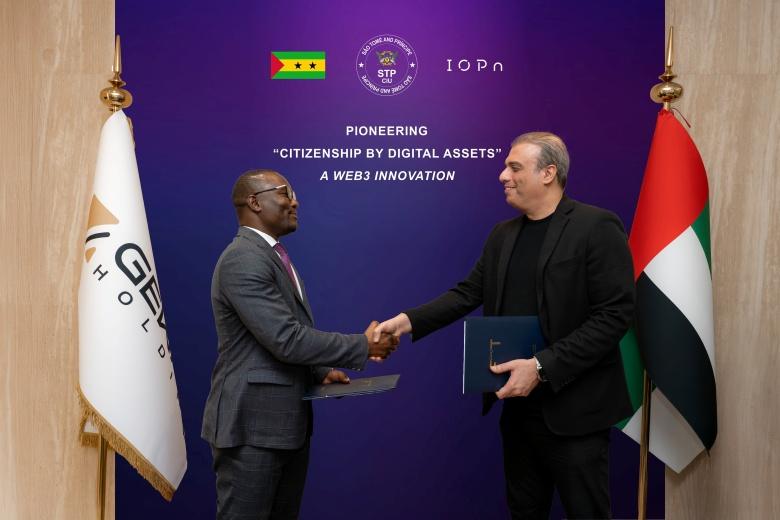
São Tomé and Príncipe announced in October a partnership with UAE-based technology firm IOPn to power the CBI program’s operations through blockchain infrastructure.
The five-year agreement establishes OPN Chain as the technological backbone for citizenship applications, which STP Service Advisory executes in collaboration with the government.
Henseler outlines six core functions the blockchain system will deliver at the CIU. The entire system “runs on OPN Chain, a blockchain created just for São Tomé,” where “every application, approval, and payment is safely recorded and can’t be changed,” providing transparency for both government and partners.
According to Henseler, investors will access online dashboards allowing them to “follow their citizenship process in real time.” He explains, “each case will be linked to a secure blockchain record showing all steps, from document checks to approvals and payments.”
He says the digital identity component introduces NeoID, which he describes as “a digital identity connected to their face or fingerprint.”
He explains that each applicant uses this ID to “log in, sign documents, and store digital citizenship certificates in a Citizen Wallet, all safely on the blockchain.”
The compliance infrastructure “uses AI to automatically check each applicant’s background and verify their identity,” according to Henseler. These verification processes are “recorded on the blockchain so everything is transparent but still private.”
He explains the payment system operates through STP-USD, which he identifies as “São Tomé’s own digital dollar.” This structure “allows the government to see where every dollar goes, in real time, through a Treasury Transparency Portal.”
Future enhancements will introduce advanced AI capabilities. He says the CIU “will add more AI tools that can instantly detect fake documents or suspicious activity,” creating a process that is “faster, more secure, and reduces human error.”
Disney Ramos, Director of the Citizenship Investment Unit, emphasizes that the partnership “ensures transparency, efficiency, and international credibility” while opening cooperation opportunities with the Emirati innovation ecosystem.
The blockchain implementation positions São Tomé as what IOPn CEO Mojtaba calls “the world’s first citizenship by investment program on blockchain.”
